Sign In to Your Account
Subscribers have complete access to the archive.
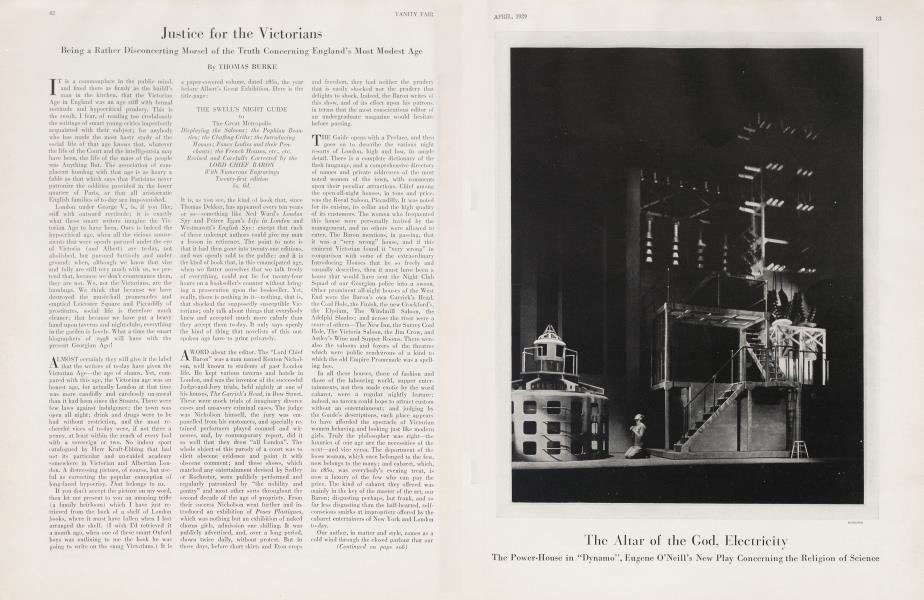
Sign In Not a Subscriber?Join NowJustice for the Victorians
Being a Rather Disconcerting Morsel of the Truth Concerning England's Most Modest Age
THOMAS BURKE
IT is a commonplace in the public mind, and fixed there as firmly as the bailiff's man in the kitchen, that the Victorian Age in England was an age stiff with formal rectitude and hypocritical prudery. This is the result, I fear, of reading too credulously the writings of smart young critics imperfectly acquainted with their subject; for anybody who has made the most hasty study of the social life of that age knows that, whatever the life of the Court and the intelligentsia may have been, the life of the mass of the people was Anything But. The association of complacent humbug with that age is as hoary a fable as that which says that Parisians never patronize the oddities provided in the lower quarter of Paris, or that all aristocratic English families of to-day arc impoverished.
London under George V., is, if you like, stiff with outward rectitude; it is exactly what these smart writers imagine the Victorian Age to have been. Ours is indeed the hypocritical age, when all the vicious amusements that were openly pursued under the eye of Victoria (and Albert) are to-day, not abolished, but pursued furtively and under ground; when, although we know that vice and folly are still very much with us, we pretend that, because we don't countenance them, they are not. We, not the Victorians, are the humbugs. We think that because we have destroyed the music-hall promenades and emptied Leicester Square and Piccadilly of prostitutes, social life is therefore much cleaner; that because we have put a heavy hand upon taverns and night-clubs, everything in the garden is lovely. What a time the smart biographers of 1998 will have with the present Georgian Age!
ALMOST certainly they will give it the label that the writers of to-day have given the Victorian Age—the age of shams. Yet, compared with this age, the Victorian age was an honest age, for actually London at that time was more candidly and carelessly un-moral than it had been since the Stuarts. There were few laws against indulgence; the town was open all night; drink and drugs were to be had without restriction, and the most recherché vices of to-day were, if not three a penny, at least within the reach of every fool with a sovereign or two. No indoor sport catalogued by Herr Kraft-Ebbing that had not its particular and un-raided academy somewhere in Victorian and Albertian London. A distressing picture, of course, but useful as correcting the popular conception of long-faced hypocrisy. That belongs to us.
If you don't accept the picture on my word, then let me present to you an amusing trifle (a family heirloom) which I have just retrieved from the back of a shelf of London books, where it must have fallen when I last arranged the shelf. (I wish I'd retrieved it a month ago, when one of these smart Oxford boys was outlining to me the book he was going to write on the smug Victorians.) It is a paper-covered volume, dated 1800, the year before Albert's Great Exhibition. Here is the title-page:
THE SWELL'S NIGHT GUIDE
to
The Great Metropolis
Displaying the Saloons; the Paphian Beauties ; the Chaffing Cribs; the Introducing Houses; Fancy Ladies and their Penchants; the French Houses, etc., etc.
Revised and Carefully Corrected by the LORD CHIEF BARON With Numerous Engravings Twenty-first edition 5s. 6d.
It is, as you see, the kind of book that, since Thomas Dekker, has appeared every ten years or so—something like Ned Ward's London Spy and Peirce Egan's Life in London and Westmacott's English Spy; except that each of these unkempt authors could give my man a lesson in reticence. The point to note is that it had then gone into twenty-one editions, and was openly sold to the public; and it is the kind of book that, in this emancipated age, when we flatter ourselves that we talk freely of everything, could not lie for twenty-four hours on a bookseller's counter without bringing a prosecution upon the bookseller. Yet, really, there is nothing in it—nothing, that is, that shocked the supposedly susceptible Victorians; only talk about things that everybody knew and accepted much more calmly than they accept them to-day. It only says openly the kind of thing that novelists of this outspoken age have to print privately.
A WORD about the editor. The "Lord Chief Baron" was a man named Renton Nicholson, well known to students of past London life. He kept various taverns and hotels in London, and was the inventor of the successful Judge-and-Jury trials, held nightly at one of his houses, The Garrick's Head, in Bow Street. These were mock trials of imaginary divorce cases and unsavory criminal cases. The judge was Nicholson himself, the jury was empanelled from his customers, and specially retained performers played counsel and witnesses, and, by contemporary report, did it so well that they drew "all London". The whole object of this parody of a court was to elicit obscene evidence and point it with obscene comment; and these shows, which matched any entertainment devised by Sedley or Rochester, were publicly performed and regularly patronized by "the nobility and gentry" and most other sorts throughout the second decade of the age of propriety. From their success Nicholson went further and introduced an exhibition of Poses Plastiques, which was nothing but an exhibition of naked chorus girls, admission one shilling. It was publicly advertised, and, over a long period, shown tAvice daily, without protest. But in those days, before short skirts and Eton crops and freedom, they had neither the prudery that is easily shocked nor the prudery that delights to shock. Indeed, the Baron writes of this show, and of its effect upon his patrons, in terms that the most conscientious editor of an undergraduate magazine would hesitate before passing.
THE Guide opens with a Preface, and then goes on to describe the various night resorts of London, high and low, in ample detail. There is a complete dictionary of the flash language, and a comprehensive directory of names and private addresses of the most noted women of the tOwn, with comments upon their peculiar attractions. Chief among the open-all-night houses, in tone and price. was the Royal Saloon, Piccadilly. It was noted for its cuisine, its cellar and the high quality of its customers. The women who frequented this house were personally invited by the management, and no others were allowed to enter. The Baron mentions, in passing, that it was a "very wrong" house, and if this eminent Victorian found it "very wrong" in comparison with some of the extraordinary Introducing Houses that he so freely and casually describes, then it must have been a house that would have sent the Night Club Squad of our Georgian police into a swoon. Other prominent all-night houses of the West End were the Baron's own Garrick's Head, the Coal Hole, the Finish, the new Crockford's, the Elysium, The Windmill Saloon, the Adelphi Shades; and across the river were a score of others—The New Inn, the Surrey Coal Hole, The Victoria Saloon, the Jim Crow, and Astley's Wine and Supper Rooms. There were also the saloons and foyers of the theatres which were public rendezvous of a kind to which the old Empire Promenade was a spelling bee.
In all these houses, those of fashion and those of the labouring world, supper entertainments, not then made exotic by the word cabaret, were a regular nightly feature; indeed, no tavern could hope to attract custom without an entertainment; and judging by the Guide's descriptions, each place appears to have afforded the spectacle of Victorian women behwing and looking just like modern girls. Truly the philosopher was right—the luxuries of one age are the necessities of the next—and vice versa. The deportment of the loose woman, which once belonged to the few, now belongs to the many; and cabaret, which, in 1800, was everybody's evening treat, is now a luxury of the few who can pay the price. The kind of cabaret they offered was mainly in the key of the master of the art, our Baron; disgusting perhaps, but frank, and so far less disgusting than the half-hearted, self-conscious smirks at impropriety offered by the cabaret entertainers of New York and London to-day.
Our author, in matter and style, comes as a cold wind through the closed parlour that our historians have furnished for us. "Enjoy women," he says, "hut let them be of the right sort. Make your hearts glad with wine, hut let that, too, be of the right sort, and then neither in health nor heart will you be a jot the worse. As to company, if you are told to beware of had company, then we advise you to beware of going into any company at all." A pretty comment on the Victorian age. On the subject of vice our dashing old Baron is what we should call "fearless" and "straight-from-the-shoulder", only he didn't know he was being fearless. But as not even a Sunday paper of today would allow him to he as fearless as he is I must suppress him from your inexperienced and modern ears. Perhaps he is most typical of his age (as it really was) in the section where he catalogues the then most notable demi-mondaines by name and address, and appends comments on the social manners of each in what he humorously describes as her private life. It reads rather like an auctioneer's address at a bloodstock sale. The person of each girl is described in such detail in this openly-circulated Guide that even a quotation of half a paragraph would cause this magazine to be seized by the authorities; so again I must suppress him. I can only refer you to the book and to others like it if you wish to see how stiff and staid the age of Victoria was.
(Continued on page 106)
(Continued from page 82)
In fairness to the young historians, though, I make them a present of one point for their case. In one spot of this hook of two hundred pages the author is on their side. In a paragraph which makes a blunter statement concerning sexual matters than any modern writer has yet achieved, containing words that even James Joyce would frown at, the author wishes to use the word damned. And he prints it "d—d".
Subscribers have complete access to the archive.
Sign In Not a Subscriber?Join Now
