Sign In to Your Account
Subscribers have complete access to the archive.
Sign In Not a Subscriber?Join NowWhat radio has done to music
ERNEST NEWMAN
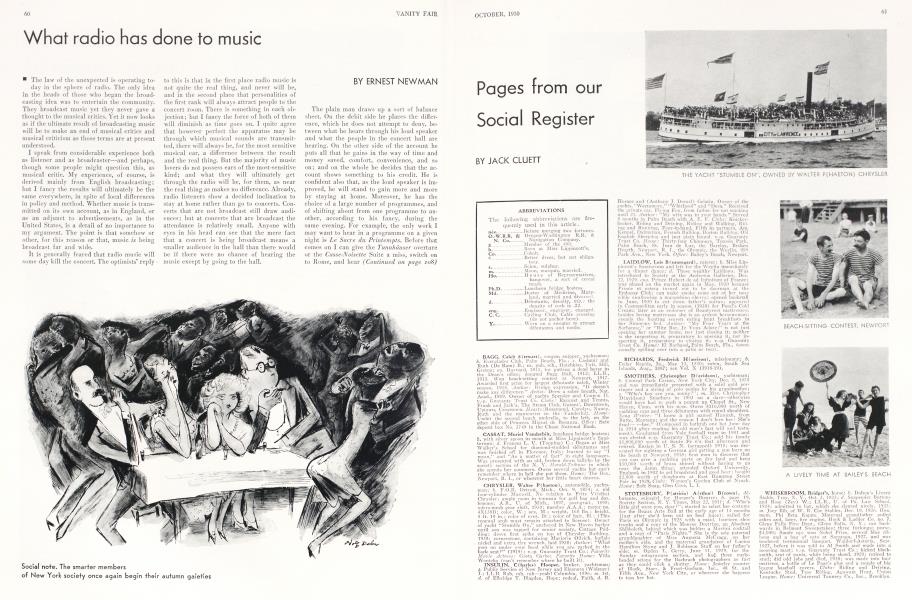
The law of the unexpected is operating today in the sphere of radio. The only idea in the heads of those who began the broadcasting idea was to entertain the community. They broadcast music yet they never gave a thought to the musical critics. Yet it now looks as if the ultimate result of broadcasting music will be to make an end of musical critics and musical criticism as those terms are at present understood.
I speak from considerable experience both as listener and as broadcaster—and perhaps, though some people might question this, as musical critic. My experience, of course, is derived mainly from English broadcasting; but I fancy the results will ultimately be the same everywhere, in spite of local differences in policy and method. Whether music is transmitted on its own account, as in England, or as an adjunct to advertisements, as in the United States, is a detail of no importance to my argument. The point is that somehow or other, for this reason or that, music is being broadcast far and wide.
It is generally feared that radio music will some day kill the concert. The optimists' reply to this is that in the first place radio music is not quite the real thing, and never will be, and in the second place that personalities of the first rank will always attract people to the concert room. There is something in each objection; but I fancy the force of both of them will diminish as time goes on. I quite agree that however perfect the apparatus may be through which musical sounds are transmitted, there will always be, for the most sensitive musical ear, a difference between the result and the real thing. But the majority of music lovers do not possess ears of the most-sensitive kind; and what they will ultimately get through the radio will be, for them, as near the real thing as makes no difference. Already, radio listeners show a decided inclination to stay at home rather than go to concerts. Concerts that are not broadcast still draw audiences; but at concerts that are broadcast the attendance is relatively small. Anyone with eyes in his head can see that the mere fact that a concert is being broadcast means a smaller audience in the hall than there would be if there were no chance of hearing the music except by going to the hall.
The plain man draws up a sort of balance sheet. On the debit side he places the difference, which he does not attempt to deny, between what he hears through his loud speaker and what the people in the concert hall are hearing. On the other side of the account he puts all that he gains in the way of time and money saved, comfort, convenience, and so on; and on the whole he decides that the account shows something to his credit. He is confident also that, as the loud speaker is improved, he will stand to gain more and more by staying at home. Moreover, he has the choice of a large number of programmes, and of shifting about from one programme to another, according to his fancy, during the same evening. For example, the only work I may want to hear in a programme on a given night is Le Sucre du Printempts. Before that comes on I can give the Tanhäuser overture or the Casse-Noisette Suite a miss, switch on to Rome, and hear a good performance of Turandot; and after the Sacre I can listen to the Meistersinger in Rome or a new Hindemith work at Frankfort or Cologne.
Continued on page 108
Continued from page 60
It is true that a great personality will always be an attraction in the flesh. But since practically the whole of the personality can be got by radio, the impulse to see the man is diminished. Not one hearer in a quarter of a million sees Toscanini when he is "on the air"; hut even in remote hamlets people know that they are listening to something quite exceptional in the way of conducting. I can speak positively on this point, for in my capacity of music critic to the British Broadcasting Company (my duty is to speak once a fortnight on the music of the intervening period) I received letters from all over on the subject. Further—and this is a point of the utmost importance—many of my correspondents commented on the fact that never before, in all their experience, had the transmission been so pure; and they shrewdly asked whether the bad results they so often get may not be simply the result of bad orchestral playing. One of the most welcome results of the visit of the New York orchestra to England was to kindle a desire for a broadcasting orchestra there of the same calibre.
In former days, not one person in a million who was interested in music heard a new work till years after its production, if then. It took its opinions of the new work from somebody or I other, known as a critic, who happened to have heard it. The system I laboured under a double disadvantage: I a man like Hanslick—surely the most stupid man who has ever won a reputation as a music critic—could retard for a time the vogue of a really great work, or a Press charlatan or a merely well-meaning numbskull could give a momentary vogue to a work of no real account whatever. During the last twenty years or so there have been few masterpieces produced for the more ignorant of the critics to decry, but there has been a vast amount of quite ordinary or really bad music produced for the more feather-brained critics, anxious to win notoriety as pioneers, to over-praise. The result, in normal circumstances, would have been a longcontinued confusion of the public mind. What broadcasting has done is to abbreviate the period of that confusion by making it possible for tbe public to judge for itself.
The ultimate judge of musical values is the plain man; it has been he, in every epoch, who has decided that this or that composer was the real thing, no matter what the critics said about him. To get modern musical values right, and pretty quickly, all that is | necessary is to let as many ordinarily ! sensible people as possible hear the typical new works. There is an instructive example of this in connection with | Stravinsky's Sacre. It was given in London two or three times just before the war, when, of course, it was heard only by a comparative handful of I people. For some years after that, a vigorous effort was made in some sections of the press to persuade the public that here was a work the like of which had never been heard in our day—a work that had transvalued all previous values and changed the face of music. This was all very well so long as the Sacre remained unknown to the new generation; the public could bardly help believing what was drummed into it at every opportunity. Then a great mistake was made. The Sacre was given, and instantly the bottom fell out of the propaganda. The plain man could not understand what all the fuss had been about. He saw that the Sacre was a work like any other. He thought that about half of it bore the mark of original genius, while the other half showed ordinary talent or even mediocrity. In any case there was nothing about the work that made it necessary for him to be born again musically before he could understand it; he understood it easily.
Multiply this experience by a hundred, and you get the present situation with regard to radio music, the press, and the public. Before the coming of radio, it was possible for a handful of enthusiasts to talk any nonsense they liked about their favourite new composers, and no one could say them nay, for no one else had heard the music. But as a result of the liberal and progressive policy of the broadcasting companies, the whole world has heard, during the last two or three years, the latest music of the most "advanced" schools in every land; and the various countries, instead of being led by the nose by the newspapers, are forming their own opinion upon what they hear.
Every man, in fact, is becoming his own music critic; the day is almost over when a few individuals in the press could control or direct musical opinion. If Everyman likes a work, he will demand another hearing of it no matter how the critics may run it down; and if he does not like it, the critics may talk till they are black in the face without convincing him that the work is good. And from all this two great results will come. In the first place, the present muddle will clear itself up much more quickly than it would otherwise have done; comparative and absolute values in the new music will soon be settled, the rubbish will be cleared away, and the ground will be ready for the next big man. In the second place, the creation of a large and well-informed musical public will transform musical criticism, which, it will soon be seen, does not consist in scribbling about tenors and fiddlers and coloratura sopranos and the other small fry of the musical aquarium, but in the discussion of things that really matter in connection with music. It will be possible for the critic then to talk about these things, because he will have what he unfortunately lacks at present—an instructed audience large enough to make it economically possible for him to devote all his time to the study and the discussion of the things that matter.
Subscribers have complete access to the archive.
Sign In Not a Subscriber?Join Now
