Sign In to Your Account
Subscribers have complete access to the archive.
Sign In Not a Subscriber?Join NowMusic and international amity
ERNEST NEWMAN
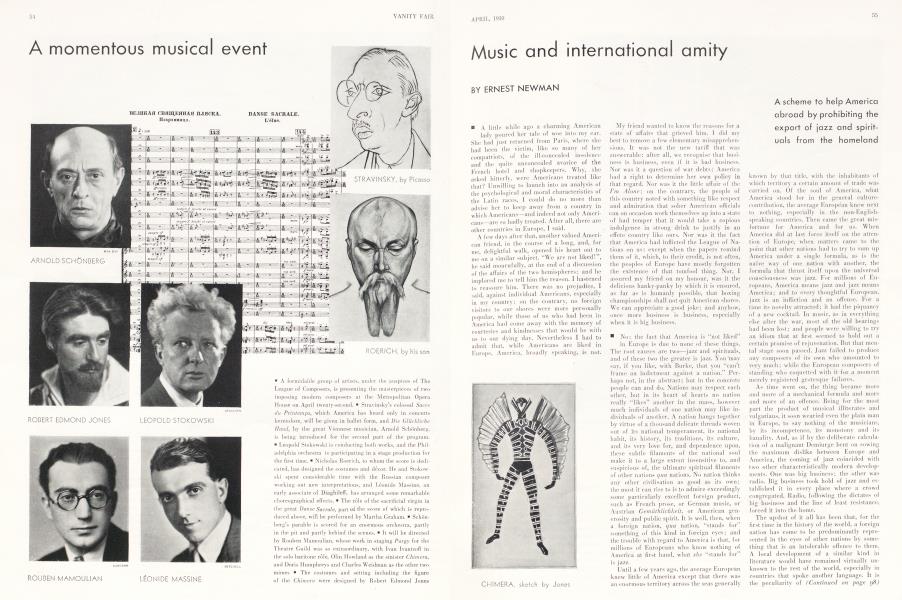
A scheme to help America abroad by prohibiting the export of jazz and spirituals from the homeland
■ A little while ago a charming American lady poured her tale of woe into my ear. She had just returned from Paris, where she had been the victim, like so many of her compatriots, of the ill-concealed insolence and the quite unconcealed avarice of the French hotel and shopkeepers. Why, she asked bitterly, were Americans treated like that? Unwilling to launch into an analysis of the psychological and moral characteristics of the Latin races, I could do no more than advise her to keep away from a country in which Americans—and indeed not only Americans—are so badly treated. After all, there are other countries in Europe, I said.
A few days after that, another valued American friend, in the course of a long, and, for me, delightful walk, opened his heart out to me on a similar subject. "We are not liked!", he said mournfully, at the end of a discussion of the affairs of the two hemispheres; and he implored me to tell him the reason. I hastened to reassure him. There was no prejudice, I said, against individual Americans, especially in my country; on the contrary, no foreign visitors to our shores were more personally popular, while those of us who had been in America had come away with the memory of courtesies and kindnesses that would be with us to our dying day. Nevertheless I had to admit that, while Americans are liked in Europe, America, broadly speaking, is not.
My friend wanted to know the reasons for a state of affairs that grieved him. I did my best to remove a few elementary misapprehensions. It was not the new tariff that was answerable: after all, we recognise that business is business, even if it is bad business. Nor was it a question of war debts; America had a right to determine her own policy in that regard. Nor was it the little affair of the Vm Alone.-, on the contrary, the people of this country noted with something like respect and admiration that sober American officials can on occasion work themselves up into a state of bad temper that it would take a copious indulgence in strong drink to justify in an effete country like ours. Nor was it the fact that America had inflicted the League of Nations on us: except when the papers remind them of it, which, to their credit, is not often, the peoples of Europe have mostly forgotten the existence of that tomfool thing. Nor, I assured my friend on my honour, was it the delicious hanky-panky by which it is ensured, as far as is humanly possible, that boxing championships shall not quit American shores. We can appreciate a good joke; and anyhow, once more business is business, especially when it is big business.
■ No; the fact that America is "not liked" in Europe is due to none of these things. The root causes are two—jazz and spirituals, and of these two the greater is jazz. You'may say, if you like, with Burke, that you "can't frame an indictment against a nation." Perhaps not, in the abstract; but in the concrete people can and do. Nations may respect each other, but in its heart of hearts no nation really "likes" another in the mass, however much individuals of one nation may like individuals of another. A nation hangs together by virtue of a thousand delicate threads woven out of its national temperament, its national habit, its history, its traditions, its culture * and its very love for, and dependence upon, these subtle filaments of the national soul make it to a large extent insensitive to, and suspicious of, the ultimate spiritual filaments of other nations qua nations. No nation thinks any other civilisation as good as its own; the most it can rise to is to admire exceedingly some particularly excellent foreign product, such as French prose, or German music, or Austrian Gcmuthlichkeit, or American generosity and public spirit. It is well, then, when a foreign nation, qua nation, "stands for" something of this kind in foreign eyes; and the trouble with regard to America is that, for millions of Europeans who know nothing of America at first hand, what she "stands for" is jazz.
Until a few years ago, the average European knew little of America except that there was an enormous territory across the seas generally known by that title, with the inhabitants of which territory a certain amount of trade was carried on. Of the soul of America, what America stood for in the general culturecontribution, the average European knew next to nothing, especially in . the non-Englishspeaking countries. Then came the great misfortune for America and for us. When America did at last force itself on the attention of Europe, when matters came to the point that other nations had to try to sum up America under a single formula, as is the naive way of one nation with another, the formula that thrust itself upon the universal consciousness was jazz. For millions of Europeans, America means jazz and jazz means America; and to every thoughtful European, jazz is an infliction and an offense. For a time its novelty attracted; it had the piquancy of a new cocktail. In music, as in everything else after the war, most of the old bearings had been lost; and people were willing to try an idiom that at first seemed to hold out a certain promise of rejuvenation. But that mental stage soon passed. Jazz failed to produce any composers of its own who amounted to very much; while the European composers of standing who coquetted with it for a moment merely registered grotesque failures.
As time went on, the thing became more and more of a mechanical formula and more and more of an offence. Being for the most part the product of musical illiterates and vulgarians, it soon wearied even the plain man in Europe, to say nothing of the musicians, by its incompetence, its monotony and its banality. And, as if by the deliberate calculation of a malignant Demiurge bent on sowing the maximum dislike between Europe and America, the coming of jazz coincided with two other characteristically modern developments. One was big business; the other was radio. Big business took hold of jazz and established it in every place where a crowd congregated. Radio, following the dictates of big business and the line of least resistance, forced it into the home.
The upshot of it all has been that, for the first time in the history of the world, a foreign nation has come to be predominantly represented in the eyes of other nations by something that is an intolerable offence to them. A local development of a similar kind in literature would have remained virtually unknown to the rest of the world, especially in countries that spoke another language. It is the peculiarity of music that it is understandable by every nation, irrespective of language; and, as I have said, it was misfortune of the first order that just when the world, for one reason and another growing out of the Great War, was beginning to take an absorbing interest in America, that country should figure before the eyes of the world in general mainly under this aspect alone—that of a purveyor of the most dreary, the most brainless, the most offensive form of music that the earth has ever known. The average European unfortunately knows next to nothing of the better sort of American music. For him, the national American music is jazz, the appalling thing that is as likely as not to assail his ears and turn his stomach each time he enters a restaurant or switches on his radio.
Continued on page 98
(Continued from page 55)
It is true that in Europe the reign of jazz is virtually over. Apart from the dancers, everyone is thoroughly weary of it, weary of its incompetence, its inanity, its banality, its incessant harping upon the same half-dozen melodic and rhythmic formulae, the stereotyped instrumental tricks, and the whining eunuchs who add to the instrumental a vocal inbecility. But the mischief has been done. America has been identified with jazz, and jazz with America; and the desire to hear no more of jazz has become identified in many European minds with the desire to hear no more of America. That in itself, I admit, is also a manifestation of stupidity; every rational man knows that jazz is no more representative of the real America than the avarice of the French shopkeeper is representative of the fine civilisation of France, or the beerswilling Münchener representative of the fine civilisation of Germany. But the fact that jazz speaks the universal language of sound has made it an almost inescapable part of the daily round.
The case as regards the spiritual is not quite so bad, though it is bad enough. Here again the new thing was welcomed at first because it was new. The spirituals were not of much musical account in themselves, but they had a certain naive charm. It was undoubtedly an effort for English audiences to remain as serious as some of the singers were in face of words that had a strong flavour of the comic about them; but the effort was made, because it was recognised that, naïve as these songs were, they were sincere. The trouble developed when the commercial exploitation of the spirituals set in—a process that might be described as the exploitation of Uncle Tom. The spiritual as Uncle Tom may have sung it was one thing. The spiritual as maudlinised by hefty gentlemen on the concert platform, and as dished up by "arrangers", was another. The spiritual as a simple melodic flowering of a simple religious sentiment had the appeal that sincerity is always sure of making; the spiritual decked out in the harmonic commonplaces and cliches of the academic "arrangers" divided us between laughter and nausea. Once more we felt that we were being made the victims of an organised commercial "push"; and once more we resented it, and once more the plain man on my side of the water saw "America" in what was really only the activity of a few energetic Americans with an eye to business.
I am not justifying this general English and European confusion of American individuals and American business interests with "America". I am merely pointing out that it exists, and that while it exists it does not make for a sympathetic understanding of the real America. If the peace of the world is to be assured, let America, for heaven's sake, send us no more jazz and no more spirituals, but especially no more jazz. Do what you. like with us, we say to you; raise your tariff walls till they touch high heaven, continue to spread the stereotyped fiction that England has a monopoly of rubber production, refrain from paying us a penny of what is owing by the defaulting Southern States while insisting on payment of our own debt to you; only send us no more jazz, and if possible take back what you have already sent, and all shall be forgiven.
Subscribers have complete access to the archive.
Sign In Not a Subscriber?Join Now
