

Sign In to Your Account
Subscribers have complete access to the archive.
Sign In Not a Subscriber?Join NowOur own popular science department
COREY FORD
A few modern inventions in the style of "Popular Mechanics" to brighten up the American Household
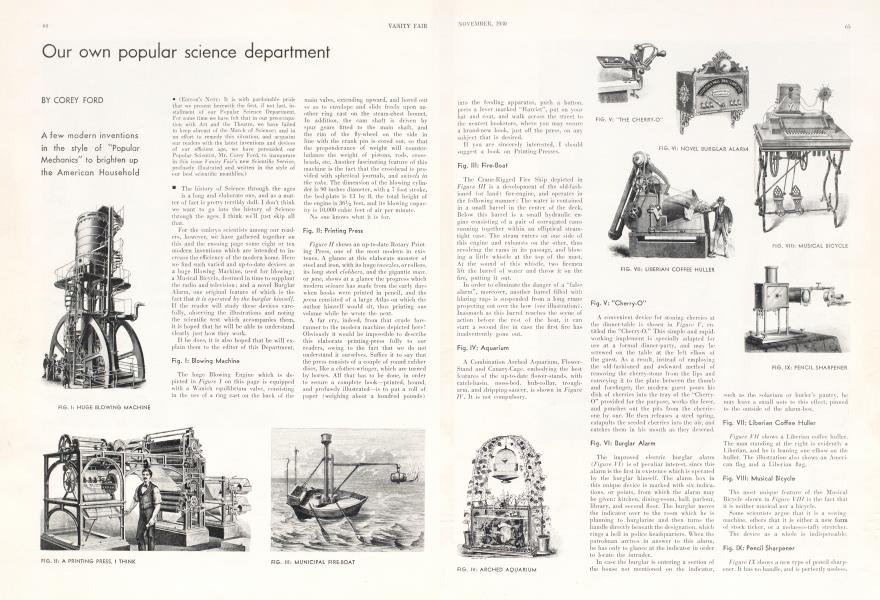
(EDITOR'S NOTE: It is with pardonable pride that we present herewith the first, if not last, installment of our Popular Science Department. For some time we have felt that in our preoccupation with Art and the Theatre, we have failed to keep abreast of the March of Science; and in an effort to remedy this situation, and acquaint our readers with the latest inventions and devices of our efficient age, we have persuaded our Popular Scientist, Mr. Corey Ford, to inaugurate in this issue Vanity Fair's new Scientific Service, profusely illustrated and written in the style of our best scientific monthlies.)
The history of Science through the ages is a long and elaborate one, and as a matter of fact is pretty terribly dull. I don't think we want to go into the history of Science through the ages. I think we'll just skip all that.
For the embryo scientists among our readers, however, we have gathered together on this and the ensuing page some eight or ten modern inventions which are intended to increase the efficiency of the modern home. Here we find such varied and up-to-date devices as a huge Blowing Machine, used for blowing; a Musical Bicycle, destined in time to supplant the radio and television; and a novel Burglar Alarm, one original feature of which is the fact that it is operated by the burglar himself. If the reader will study these devices carefully, observing the illustrations and noting the scientific text which accompanies them, it is hoped that he will be able to understand clearly just how they work.
If he does, it is also hoped that he will explain them to the editor of this Department.
Fig. I: Blowing Machine
The huge Blowing Engine which is depicted in Figure I on this page is equipped with a Wanich equilibrium valve, consisting in the use of a ring cast on the back of the main valve, extending upward, and bored out so as to envelope and slide freely upon another ring cast on the steam-chest bonnet. In addition, the cam shaft is driven by spur gears fitted to the main shaft, and the rim of the fly-wheel on the side in line with the crank pin is cored out, so that the preponderance of weight will counterbalance the weight of pistons, rods, crossheads, etc. Another fascinating feature of this machine is the fact that the crosshead is provided with spherical journals, and swivels in the yoke. The dimension of the blowing cylinder is 90 inches diameter, with a 7 foot stroke, the bed-plate is 13 by 8, the total height of the engine is 36½ feet, and its blowing capacity is 10,000 cubic feet of air per minute.
No one knows what it is for.
Fig. II: Printing Press
Figure II shows an up-to-date Rotary Printing Press, one of the most modern in existence. A glance at this elaborate monster of steel and iron, with its huge tweezles, or rollers, its long steel clobbers, and the gigantic maw, or paw, shows at a glance the progress which modern science has made from the early days when books were printed in pencil, and the press consisted of a large Atlas on which the author himself would sit, thus printing one volume while he wrote the next.
A far cry, indeed, from that crude forerunner to the modern machine depicted here! Obviously it would be impossible to describe this elaborate printing-press fully to our readers, owing to the fact that we do not understand it ourselves. Suffice it to say that the press consists of a couple of round rubber discs, like a clothes-wringer, which are turned by horses. All that has to be done, in order to secure a complete book—printed, bound, and profusely illustrated—is to put a roll of paper (weighing about a hundred pounds) into the feeding apparatus, push a button, press a lever marked "Harriet", put on your hat and coat, and walk across the street to the nearest bookstore, where you may secure a brand-new book, just off the press, on any subject that is desired.
If you are sincerely interested, I should suggest a book on Printing-Presses.
Fig. III: Fire-Boat
The Crane-Rigged Fire Ship depicted in Figure HI is a development of the old-fashioned for land) fire-engine, and operates in the following manner: The water is contained in a small barrel in the center of the deck. Below this barrel is a small hydraulic engine consisting of a pair of corrugated cams running together within an elliptical steam-tight case. The steam enters on one side of this engine and exhausts on the other, thus revolving the cams in its passage, and blowing a little whistle at the top of the mast. At the sound of this whistle, two firemen lift the barrel of water and throw it on the fire, putting it out.
In order to eliminate the danger of a "false alarm", moreover, another barrel filled with blazing rags is suspended from a long crane projecting out over the bow (see illustration). Inasmuch as this barrel reaches the scene of action before the rest of the boat, it can start a second fire in case the first fire has inadvertently gone out.
Fig. IV: Aquarium
A Combination Arched Aquarium, FlowerStand and Canary-Cage, embodying the best features of the up-to-date flower-stands, with catch-basin, moss-bed. hub-collar, trougharm. and dripping-saucer, is shown in Figure IV. It is not compulsory.
Fig. V: "Cherry-O"
A convenient device for stoning cherries at the dinner-table is shown in Figure V, entitled the "Cherry-O." This simple and rapid-working implement is specially adapted for use at a formal dinner-party, and may be screwed on the table at the left elbow of the guest. As a result, instead of employing the old-fashioned and awkward method of removing the cherry-stone from the lips and conveying it to the plate between the thumb and forefinger, the modern guest pours his dish of cherries into the tray of the "Cherry0" provided for the purpose, works the lever, and punches out the pits from the cherries one by one. lie then releases a steel spring, catapults the seeded cherries into the air. and catches them in his mouth as they descend.
Fig. VI: Burglar Alarm
The improved electric burglar alarm (Figure VI) is of peculiar interest, since this alarm is the first in existence which is operated by the burglar himself. The alarm box in this unique device is marked with six indications, or points, from which the alarm may be given: kitchen, dining-room, hall, parlour, library, and second floor. The burglar moves the indicator over to the room which he is planning to burglarize and then turns the handle directly beneath the designation, which rings a bell in police headquarters. When the patrolman arrives in answer to this alarm, he has only to glance at the indicator in order to locate the intruder.
In case the burglar is entering a section of the house not mentioned on the indicator, such as the solarium or butler's pantry, he may leave a small note to this effect., pinned to the outside of the alarm-box.
Fig. VII: Liberian Coffee Huller
Figure VII shows a Liberian coffee huller. The man standing at the right is evidently a Liberian, and be is leaning one elbow on the huller. The illustration also shows an American flag and a Liberian flag.
Fig. VIII: Musical Bicycle
The most unique feature of the Musical Bicycle shown in Figure VIII is the fact that it is neither musical nor a bicycle.
Some scientists argue that it is a sewing-machine, others that it is either a new form of stock ticker, or a molasses-taffy stretcher. The device as a whole is indispensable.
Fig. IX: Pencil Sharpener
Figure IX shows a new type of pencil sharpener. It has no handle, and is perfectly useless.
Subscribers have complete access to the archive.
Sign In Not a Subscriber?Join Now
