
Sign In to Your Account
Subscribers have complete access to the archive.
Sign In Not a Subscriber?Join NowEnter backgammon
GROSVENOR NICHOLAS
Some practical advice on opening moves in thenew form of an old game now a dread rival of Contract
To those who accept the view that there is nothing new under the sun, the recent remarkable revival of backgammon will seem to be merely a revival. It is, however, more than that. It is an elaboration or development of what is perhaps the oldest game in the world, and the result is something extremely novel.
This new backgammon is said to have made its first appearance in Paris. It came to this country only a few years ago and then from Park Avenue and Long Island spread rapidly to Newport, Palm Beach, Tuxedo and Aiken, and is now sweeping the country, threatening to rival Contract Bridge in popularity.
This ancient game, known in England as backgammon and upon the Continent as trictrac, has existed for centuries. Chaucer referred to it as "tables," and there can be little doubt that it was the ludus duodecim scriptorum, or twelve line game, of the Roman Empire. But the actual origin of backgammon must have been far more remote. From the tomb of Tutankhamen, Mr. Howard Carter recently has brought to light a game played in a similar way with primitive dice, while in Mesopotamia, in Chaldean tombs of even greater antiquity, there have been found highly decorated boards, dice and playing pieces.
But it is the new backgammon with its recent spirited development of "doubling" that is taking the country by storm. Backgammon has been always peculiarly a game in which the advantage shifts suddenly and frequently. By giving the players the right alternately to double the stake there has been added to the game the possibility of an increase of the stake in an unlimited geometrical progression. A game of poker offers no more exciting possibilities. At the same time the players retain the right to surrender, or decline any proffered double. Therefore even the most conservative player is afforded perfect protection.
Furthermore, this new backgammon is no longer limited to two persons. "Chouette," another elaboration of the game, has made it possible for three, four or any reasonable number to play at the same board. In this, the thrower of the highest dice plays la chouette or is "in the box," and in turn plays each of the others until he is dislodged and succeeded "in the box" by his conqueror.
Gammons or double games are preserved so that a fortunate player of "chouette" may, while "in the box" win double the amount of the stake, which may have been already doubled and redoubled several times. He wins this, moreover, from each of his opponents. And while the total of such winnings may amount to a large sum there is no possibility of a prolonged unfortunate experience, such as one might have at roulette with a run of bad luck. In "chouette," after each defeat "the box" changes hands.
It is difficult to realize with what rapidity the stake may mount after the initial doubles. One to two, or two to four are by no means unusual. The progression then proceeds with astonishing rapidity. In fact twenty successive doubles (which though possible, are decidedly improbable) would exceed a million!
Furthermore, this game as it is now played includes the possibility of even another double, known as the "automatic double" that occurs on the initial throw which determines who shall play first. When both players throw the same number and are accordingly obliged to throw again, the stake doubles automatically. This may occur, of course, more than once and, as there is theoretically no limit to the number of doubles which might happen in this way, many players place upon these "automatic doubles" an arbitrary limit of three.
Of course, luck is a factor of tremendous importance in backgammon. But it does not follow that skill is not equally important. Certainly if the skill of two players is equal, luck does become the deciding factor, but the slightest preponderance of skill will, in the long run give the experienced player an advantage over a luckier but less skillful opponent.
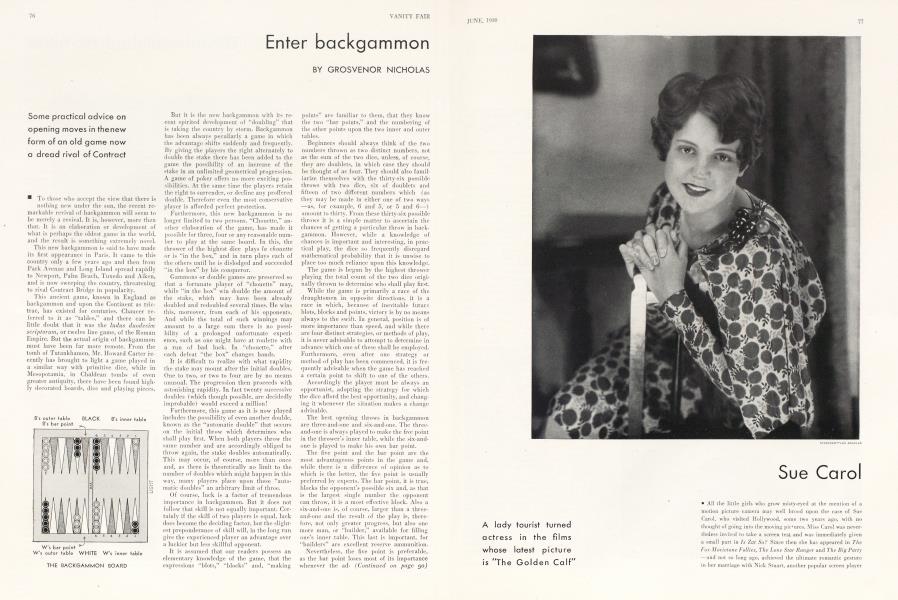
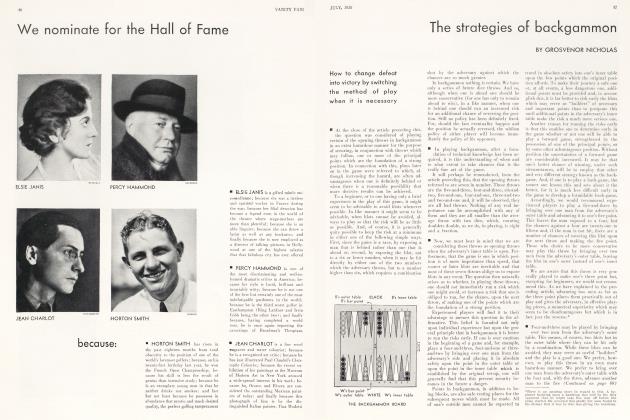
It is assumed that our readers possess an elementary knowledge of the game, that the expressions "blots," "blocks" and, "making points" are familiar to them, that they know the two "bar points," and the numbering of the other points upon the two inner and outer tables.
Beginners should always think of the two numbers thrown as two distinct numbers, not as the sum of the two dice, unless, of course, they are doublets, in which case they should be thought of as four. They should also familiarize themselves with the thirty-six possible throws with two dice, six of doublets and fifteen of two different numbers which (as they may be made in either one of two ways —as, for example, 6 and 5, or 5 and 6—) amount to thirty. From these thirty-six possible throws it is a simple matter to ascertain the chances of getting a particular throw in backgammon. However, while a knowledge of chances is important and interesting, in practical play, the dice so frequently disregard mathematical probability that it is unwise to place too much reliance upon this knowledge.
The game is begun by the highest thrower playing the total count of the two dice originally thrown to determine who shall play first.
While the game is primarily a race of the draughtsmen in opposite directions, it is a race in which, because of inevitable future blots, blocks and points, victory is by no means always to the swift. In general, position is of more importance than speed, and while there are four distinct strategies, or methods of play, it is never advisable to attempt to determine in advance which one of these shall be employed. Furthermore, even after one strategy or method of play has been commenced, it is frequently advisable when the game has reached a certain point to shift to one of the others.
Accordingly the player must be always an opportunist, adopting the strategy for which the dice afford the best opportunity, and changing it whenever the situation makes a change advisable.
The best opening throws in backgammon are three-and-one and six-and-one. The threeand-one is always played to make the five point in the thrower's inner table, while the six-andone is played to make his own bar point.
The five point and the bar point are the most advantageous points in the game and, while there is a difference of opinion as to which is the better, the five point is usually preferred by experts. The bar point, it is true, blocks the opponent's possible six and, as that is the largest single number the opponent can throw, it is a most effective block. Also a six-and-one is, of course, larger than a threeand-one and the result of the play is, therefore, not only greater progress, but also one more man, or "builder," available for filling one's inner table. This last is important, for "builders" are excellent reserve ammunition.
Nevertheless, the five point is preferable, as the bar point loses most of its importance whenever the adversary advances to make points within one's inner table, and is of no importance at all after he has moved out. The five point blocks an opponent's four, prevents a man that has been taken up from reentering with a five and also makes it impossible for the adversary to make this point. This last is of great importance for, when the adversary is established upon one's five point he commands every open point of one's outer table in which blots are frequently unavoidable.
Continued on page 90
Continued from page 76
Furthermore, when the two men in the adversary's inner table are advanced to his five point it is difficult for him to block them effectively and they can rarely become the victims of a perfect block, or "side prime."
However, without regard to the relative merits of these three points, they are all so advantageous that, at the commencement of a game, the possession of any two of them, unless the adversary's position is equally strong, is a sufficient advantage to justify an immediate double of the stake. Other possible throws, which enable the player to make one of these three points are double sixes, double fours, double threes and double twos.
An excellent illustration of the superiority of position to speed is in the throw of double aces. Although this is one of the smallest throws, it is the best in backgammon, and it is always played to make the five point in the thrower's inner table and the bar point in his outer table.
Double sixes is always played to make one's own bar point and it is usually played to make the adversary's bar point as well. The value of this last point is always dubious. When one is ahead, excepting with the aid of another doublet, it is a position from which it is impossible to move with absolute safety. On the other hand, when one is behind, it is a source of embarrassment to the adversary.
Double fours is played by bringing over two men from the adversary's outer table and advancing them both eight points to make one's five point. This throw is also played by advancing the two men in the adversary's inner table to make the adversary's five point, and then bringing two men over from the adversary's outer table to make a point in one's own outer table.
Double threes is played to make the five point in one's inner table, the two remaining threes being used to make the three point in one's inner table or else to advance the two men in the adversary's inner table where they will command most of the open points in the adversary's outer table. Double threes is also played by bringing over two men from the adversary's outer table to make one's bar point. Which of these two plays will prove the better, the future throws of the dice alone can determine.
Double twos may be played by advancing the two men in the adversary's inner table to establish the five point in the adversary's inner table. As this is one of the points which has been described as an immediate objective, the play is an excellent one. However, many good players prefer to utilize this throw to make the four point in their inner table and then to bring over two men from the adversary's side, making an additional point in their outer table.
In the beginning of a game the seven throws described are the best. None of the others enables one to make any of the three principal points immediately. Some of the remaining throws, however, are by no means bad for they can be played to accomplish results which, although not of the first importance, are nevertheless helpful.
Double fives are always played by advancing two men ten points from the adversary's outer table to make one's three-point. Four-and-two is always played to make one's four point, while six-and-five is invariably employed to accomplish the escape of one of the two hindmost men which is moved across the board to safety. This last play is sometimes described as "the lover's leap."
The other possible throws, when considered independently of throws which may follow, are all either indifferent or bad. With a six-and-four, a three-and-four and also probably with a five-and-four one should advance one of the hindmost men as far as it will go. These plays leave a blot in the adversary's outer table but, as it is exposed to only one number, the chances are against its being hit. Fiveand-two is generally played by bringing two men over from the adversary's outer table and many prefer to play a five-and-four in this way also.
There remain for consideration the five-and-three, four-and-three, six-andtwo, five-and-one, four-and-one, twoand-three and two-and-one. These seven throws, while in themselves bad, may all be used in conjunction with throws which may follow to make one of the principal points and especially the five point. This can only be done by voluntarily exposing a blot in the hope that, upon the next throw, it may be covered and the point secured.
In this method of play the hazard is considerably increased for, while after most of these seven throws, blots are inevitable, they can all be played so that the blots, when unavoidable are only exposed in one's outer table, (where they can only be hit with a combination of numbers) ; or else in the adversary's inner table, (where, if hit, they may be reentered with very little effect upon one's progress).
This voluntary exposure of blots, for the purpose of strengthening one's position upon the next throw, is advisable only in the beginning of a game when the adversary's table is open. While this method of play is advantageous, it is one which should not be attempted by beginners.
Beginners, for example, should play a five-and-three to make the three point in their inner table, although that point is too far advanced to be of much value and the men are practically put out of play, giving the adversary, in effective playing pieces, a numerical advantage. Beginners should also play the remainder of the seven throws, described in this article, with as little risk as possible.
More experienced players often find it to their advantage, when definitely behind, or in order to achieve decisive results, to run greater risks. This subject and the various strategies of backgammon will be taken up in next month's article.
Subscribers have complete access to the archive.
Sign In Not a Subscriber?Join Now
