Sign In to Your Account
Subscribers have complete access to the archive.
Sign In Not a Subscriber?Join NowLOW TIDE ON THE POTOMAC
JAY FRANKLIN
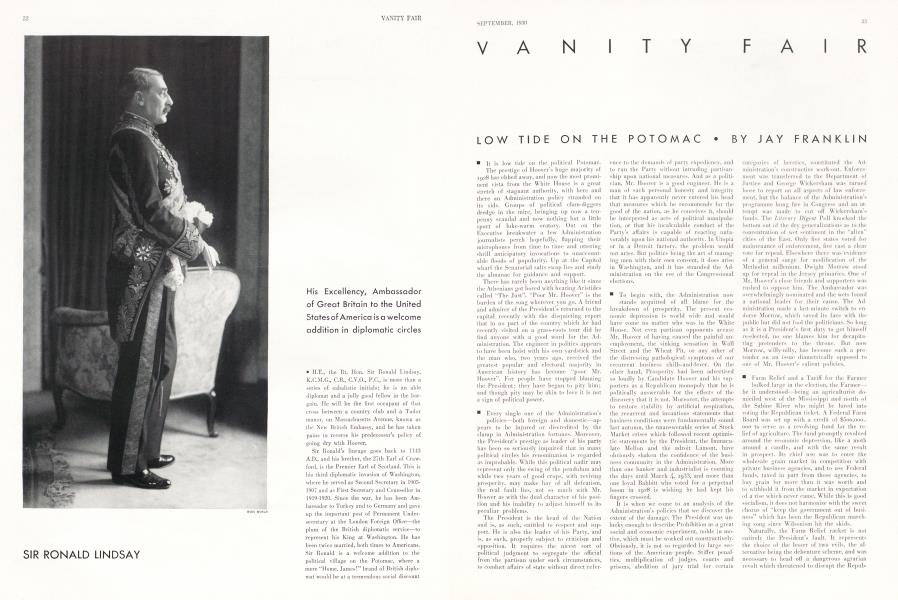
It is low tide on the political Potomac. The prestige of Hoovers huge majority of 1928 has ebbed away, and now the most prominent vista from the White House is a great stretch of stagnant authority, with here and there an Administration policy stranded on its side. Groups of political clam-diggers dredge in the mire, bringing up now a tenpenny scandal and now nothing but a little spurt of luke-warm oratory. Out on the Executive breakwater a few Administration journalists perch hopefully, flapping their microphones from time to time and uttering shrill anticipatory invocations to unaccountable floods of popularity. Up at the Capitol wharf the Senatorial salts swap lies and study the almanac for guidance and support.
There has rarely been anything like it since the Athenians got bored with hearing Aristides called "The Just". "Poor Mr. Hoover" is the burden of the song wherever you go. A friend and admirer of the President's returned to the capital recently with the discpiieting report that in no part of the country which he had recently visited on a grass-roots tour did he find anyone with a good word for the Administration. The engineer in politics appears to have been hoist with his own yardstick and the man who, two years ago, received the greatest popular and electoral majority in American history has become "poor Mr. Hoover". For people have stopped blaming the President; they have begun to pity him; and though pity may be akin to love it is not a sign of political power.
Every single one of the Administration's policies—both foreign and domestic—appears to be injured or discredited by the slump in Administration fortunes. Moreover, the President's prestige as leader of his party has been so seriously impaired that in many political circles his renomination is regarded as improbable. While this political nadir may represent only the swing of the pendulum and while two years of good crops, with reviving prosperity, may make hay of all defeatism, the real fault lies, not so much with Mr. Hoover as with the dual character of his position and his inability to adjust himself to its peculiar problems.
The President is the head of the Nation and is, as such, entitled to respect and support. He is also the leader of his Party, and is, as such, properly subject to criticism and opposition. It requires the nicest sort of political judgment to segregate the official from the partisan under such circumstances, to conduct affairs of state without direct reference to the demands of party expediency, and to run the Party without intruding partisanship upon national measures. And as a politician, Mr. Hoover is a good engineer. He is a man of such personal honesty and integrity that it has apparently never entered his head that measures which he recommends for the good of the nation, as he conceives it, should be interpreted as acts of political manipulation, or that his incalculable conduct of the Party's affairs is capable of reacting unfavorably upon his national authority. In Utopia or in a Detroit factory, the problem would not arise. But politics being the art of managing men with their own consent, it does arise in Washington, and it has stranded the Administration on the eve of the Congressional elections.
To begin with, the Administration now stands acquitted of all blame for the breakdown of prosperity. The present economic depression is world wide and would have come no matter who was in the White House. Not even partisan opponents accuse Mr. Hoover of having caused the painful unemployment, the sinking sensation in Wall Street and the Wheat Pit, or any other of the distressing pathological symptoms of our recurrent business chills-and-fever. On the other hand, Prosperity had been advertised so loudly by Candidate Hoover and his supporters as a Republican monopoly that he is politically answerable for the effects of the discovery that it is not. Moreover, the attempts to restore stability by artificial respiration, the recurrent and incautious statements that business conditions were fundamentally sound last autumn, the unanswerable series of Stock Market crises which followed recent optimistic statements by the President, the Immaculate Mellon and the adroit Lamont, have obviously shaken the confidence of the business community in the Administration. More than one banker and industrialist is counting the days until March 4, 1933, and more than one loyal Babbitt who voted for a perpetual boom in 1928 is wishing he had kept his fingers crossed.
It is when we come to an analysis of the Administration's policies that we discover the extent of the damage. The President was unlucky enough to describe Prohibition as a great social and economic experiment, noble in motive, which must be worked out constructively. Obviously, it is not so regarded by large sections of the Americanpeople. Stiffer penalties, multiplication of judges, courts and prisons, abolition of jury trial for certain categories of heretics, constituted the Administration's constructive work-out. Enforcement was transferred to the Department of Justice and George Wickersham was turned loose to report on all aspects of law enforcement, but the balance of the Administration's programme hung fire in Congress and an attempt was made to cut off Wickersham's funds. The Literary Digest Poll knocked the bottom out of the dry generalizations as to the concentration of wet sentiment in the "alien" cities of the East. Only five states voted for maintenance of enforcement, five cast a clear vote for repeal. Elsewhere there was evidence of a general surge for modification of the Methodist millenium. Dwight Morrow stood up for repeal in the Jersey primaries. One of Mr. Hoover's close friends and supporters was rushed to oppose him. The Ambassador was overwhelmingly nominated and the wets found a national leader for their cause. The Administration made a last-minute switch to endorse Morrow, which saved its face with the public but did not fool the politicians. So long as it is a President's first duty to get himself re-elected, no one blames him for decapitating pretenders to the throne. But now Morrow, willy-nilly, has become such a pretender on an issue diametrically opposed to one of Mr. Hoover's salient policies.
* Farm Relief and a Tariff for the Farmer bulked large in the election, the Farmer— be it understood—being an agriculturist domiciled west of the Mississippi and north of the Sabine River who might be lured into voting the Republican ticket. A Federal Farm Board was set up with a credit of $500,000,000 to serve as a revolving fund for the relief of agriculture. The fund promptly revolved around the economic depression, like a moth around a candle, and with the same result in prospect. Its chief use was to enter the wholesale grain market in competition with private business agencies, and to use Federal funds, taxed in part from those agencies, to buy grain for more than it was worth and to withhold it from the market in expectation of a rise which never came. While this is good socialism, it does not harmonize with the sweet chorus of "keep the government out of business" which has been the Republican marching song since Wilsonism hit the skids.
Naturally, the Farm Relief racket is not entirely the President's fault. It represents the choice of the lesser of two evils, the alternative being the debenture scheme, and was necessary to head off a dangerous agrarian revolt which threatened to disrupt the Republican Party. Both as President and Party leader, Mr. Hoover was wise to head off the Borahs-from-within in the ranks of the G.O.P. Even now, Chairman Legge of the Farm Board is being forced to repel boarders in bleeding Kansas.
The tariff is too recent, too painful and too unpopular to require elucidation. Whether it is a bad or merely an obsolete economic measure is beside the point. Unquestionably it was one of the worst-managed pieces of party legislation ever put through Congress. It was allowed to stew for nearly a year and a half of agitation, vituperation and propaganda, which has left it with few apologists and no friends. The best the Administration can say for it is that the flexible clause will permit the President to redress its inequalities, and that, as young Bob La Follette has reckoned, will consume forty-eight years under the complicated procedure enjoined upon the Tariff Commission. Unquestionably, the President would have acquired popularity and prestige if he had vetoed it, but the water looked too cold, and he decided to sign on the dotted line.
On the purely Administrative side, Mr. Hoover has admittedly made some valuable changes. He has cleaned up and reorganized the Augean Stables of the Harding Administration—the Department of Justice. He has put asunder those whom the Anti-Saloon League had joined together—the Treasury and Prohibition enforcement. He has secured more and badly needed funds for the orphan in the storm of patronage—the State Department. He prevented the Department of Commerce from attempting to take over the entire government. His diplomatic appointments have been open to criticism but are perfectly consistent: shrewd and thoroughly experienced men in the Far East, career diplomats in Latin America, deserving Republican Senators and industrialists in European posts. While the Supreme Court nominations have been too conservative, the rank-and-file appointments have been sound and reasonable. No party hacks have been allowed to mess up our foreign relations, which is a great improvement over preceding Administrations.
The President's two major foreign policies have not been fortunate. He advocated adherence to the World Court, by the Root formula, under the impression that ingrained American suspicion of the League of Nations had been circumvented by that adroit Elder Statesman. Then along came Ruth McCormick and trimmed Senator Deneen to a fare-you-well in the Illinois primary on a platform of uncompromising opposition to the Court and the League. The World Court issue is, accordingly, politically dead for the next few years.
The London Naval Treaty was a much better bet. We are a peace-loving and a tax-hating nation. We want naval equality with Great Britain, providing it doesn't cost too much, and we want a naval agreement with the British and the Japanese, provided it gives our peculiar naval requirements an even break. The Treaty of London tended to accomplish these things and there was every prospect of a nice international ideal to wave at the voters this fall. Having spent months and weeks in preparing the diplomatic end of the treaty, the Administration grudged a few weeks preparing the Senatorial end. Nearly every conceivable blunder that could be made tvas made in the domestic handling of the treaty. The Navy was not squared. When the Admirals were called on to testify as to a technical treaty they gave "sea-going" opinions and turned thumbs down. Preliminary political criticism was converted into active opposition by a point-blank refusal to permit the Foreign Relations Committee to study the circumstances of the negotiation. The Laodicean rank-and-file of the Senate was annoyed by a peremptory threat to call an extra session to compel the passage of a treaty which suddenly began to be regarded with suspicion, as not bearing investigation. Technical and other jokers were discovered in the document and what had originally been a sure thing became a fifty-fifty struggle between Administration stubbornness and Senatorial dignity, with hot weather and a quorum as the real adversaries. The Administration found it impossible to secure pledges from the majority of the Senate to stick Washington in July until the Treaty is disposed of. When it passes, after all the blunders which have been committed in its name, it will be because it is a relatively harmless measure rather than because of its actual and substantial merits.
The reason for this record of frustration and defeat is that "poor Mr. Hoover" has lost control of his Party. He was nominated and elected by a private extra-party political machine and no sooner had he climbed into the White House than he sawed the limb off after him. The list of his discarded supporters is impressive. Dr. Work, his campaign manager, was turned out to grass after yielding the Chairmanship of the Republican National Committee to Claudius Huston, who is himself about to cross the Great Divide. Colonel Mann, who helped split the Solid South, was let out. "Wild Bill" Donovan, who deserved a Cabinet post for his Administrative experience and electioneering ability, was turned down largely because of his Catholic affiliations. Even Mabel Walker Willebrandt, who had been the Joan of Arc of Hoover's Prohibition army in the Holy War of 1928, was euchred out of command of Prohibition enforcement and walked the plank into private life.
Continued on page 96
Continued from page 34
This slaughter of the innocents left the President exposed to the hostility of the Party leaders who had tried to head him ofT at the Kansas City Convention and to the advice of his wellmeaning friends. It is difficult to say which has proved more dangerous: the good advice of Secretary Wilbur or the hearty hostility of Hiram Johnson, devourer of Presidents, who could, if propitiated, have delivered the California delegation in 1932. Certainly, Mr. Hoover has selected his enemies most unwisely. They now—politically speaking—include George Moses, Senator Watson, Robinson of Indiana, Borah, Nick Longworth — old party warhorses who delight in the part of planting Senatorial bandilleras in the flanks of the Presidential bull.
Accordingly, Hoover's parly leadership has become progressively weaker as his charges have become wilder. His nomination of Judge Parker for the Supreme Court led to a humiliating rejection by the Senate—humiliating because the President threw every ounce of leadership he possessed into the fight for Parker's confirmation. His veto of the Spanish War Veterans Bill was contemptuously overridden by Congress, in a vote which aligned his Party squarely against the somewhat Pecksniffian though entirely sound criteria he advanced against the measure. His veto of the World War Veterans Bill—an unsound and unwholesome political measure—led to further Party opposition, when a pocket veto was entirely within his power, to prevent a legalized raid from endangering the Treasury surplus and to save the Party's face at the polls.
In short, the President, as a politician, is in the position of a general who has. squandered his ammunition in a lot of small skirmishes and finds himself with empty cassions on the eve of a general engagement. The Congressional elections are at hand and the real problem of the Party and of its titular leader is to keep from losing control of Congress.
It is for this reason that the observers on the breakwater are crying that the tide has turned. Matters could not possibly be worse for Mr. Hoover, they argue, therefore they are bound to improve. The President's vetoes of the pension grabs have won for him public support. His determination to force through the London Treaty appeals to the popular love of a good dogfight. For the American people will support and follow a fighter where they will laugh at a philosopher who relies upon chemically pure intentions and the critique of pure reason to win acceptance for his policies. There are already signs that the economic depression is passing. If the stock market goes "long" before November and if employment and business improve, there is a chance that the "Party of Prosperity" will pull itself together, swallow its intestine animosities and disappoint the defeatists by a little practical pre-election politics. If this proves to be the case, Herbert Hoover will be the luckiest President who ever entered the White House. For by'the rules of the game he is licked. If he has nerve enough to throw the rules away and to stage a good fight for the benefit of the electorate, his Administration will look less like a noble experiment and more like what you can get on prescription from the doctor.
Hitherto, "poor Mr. Hoover" has not been much of a fighter. Now, like the proverbial Turk, he has begun his defence at the point where a less tenacious leader would surrender. To the consternation of the Senate and the pleasure of the public, he has begun to hit back. A thin streak of popularity is creeping up the political estuary in the direction of the White House. He has just discovered that politics is the art of making and holding friendships. In the second week of July, he suddenly came to life and began one of the most intelligent, adroit and amusing campaigns for the ratification of a treaty the country has seen since the Webster-Ashburton Treaty was floated through the Senate on a sea of champagne. And since the Senate passed the Treaty, Mr. Hoover has been left holding the center of the stage.
Subscribers have complete access to the archive.
Sign In Not a Subscriber?Join Now

