Sign In to Your Account
Subscribers have complete access to the archive.
Sign In Not a Subscriber?Join NowTHE GREAT WICKERSHAM MYSTERY
WALTER LIPPMANN
The true story of the Wickersham Commission still lies buried in the breasts of a small number of men. It is unlikely that the secret can be kept forever, and it is possible that before these lines reach the reader, the mystery -will have been solved. Yet a quick solution is improbable, for all those who share the secret have the strongest motives for keeping it. Even those who did no more than passively consent must feel that they cannot disclose the truth without some kind of personal disloyalty.
The evidence shows that for reasons unknown, which constitute the mystery, two things happened to the report of the Wickersham Commission. One is that its most important conclusion was reversed after the majority had reached it; the other is that the Commission issued a summary of its findings which conveyed a radically false impression.
When I say that the evidence shows these two things I mean it in an exact sense. The evidence is conclusive. It is not derived from rumor or the testimony of outsiders. The evidence is in the report itself. The main conclusion was changed at some time very near the publication of the report, and the Commission forgot to remove all the clues. There is no more doubt about this than there is about the meaning of the canary's feathers on the cat's whiskers.
The evidence has been put together by many newspapers and published repeatedly. It has never been met by any of the commissioners. Let us look at one of the clues again: among the eleven commissioners was Judge William I. Grubb of Birmingham, Alabama. Judge Grubb, along with Mr. Wickersham, Judge Kenyon, and Judge McCormick, constituted the minority of four who favored a further trial of prohibition. Judge Grubb had no doubts that he belonged to the minority. He had no doubts that his colleagues stood nearly two to one for the immediate abandonment of constitutional bone-dry prohibition. When he wrote his personal statement the Commission had adopted a report recommending that the Eighteenth Amendment should be revised immediately without awaiting a further trial. Judge Grubb was unwilling to agree to this and so wrote:
I join in the findings of facts and all the ultimate conclusions of the general report of the Commission (except that recommending that the Amendment be revised immediately, without awaiting a further trial) . . .
After Judge Grubb wrote this sentence, the conclusions of the report must have been changed. For they do not contain the recommendation that the Amendment be revised immediately without awaiting a further trial.
Now it is impossible to suppose that a federal judge would expressly dissent from the most important of all possible conclusions if that conclusion had never been in the report. It must have been there at one time. It must have been taken out because it is no longer there. It must have been taken out very late in the day or under such extraordinary circumstances that none of the commissioners had time to notice that Judge Grubb's remarks reveal that the change was made.
As a matter of fact, the clue left by Judge Grubb is confirmed by the remarks of Judge McCormick and by other clues all of which compel the conclusion that the Commission reversed itself at the very end when it was too late or the members were too distraught to hide the evidence of what had been done.
Even if we did not possess this evidence, which is compelling because it is so inadvertent, there would still be no doubt that a majority of the commissioners—seven out of eleven—believe that constitutional prohibition has failed hopelessly and that it should be abandoned immediately. Nobody would know that from reading the official summary which was given out twenty-four hours before the report itself. But nobody can deny it who reads the report. Seven commissioners explicitly favor changes in the Constitution which would permit legal sale of liquor.
Now it is the exact truth to say that everything possible was done officially to conceal this truth from the public generally, and from the rural voters in particular. It was cut out of the conclusions. It was suppressed in the official summary. It was ignored by the President. The official summary was so trickily devised that for nearly twenty-four hours it fooled every newspaper in America.
To speak plainly, what happened was that untruth was given a headstart of twenty-four hours. For practical purposes, such as the avoidance of a sharp political issue, that is enough in a democracy. Therefore, I say that whoever wrote that summary, and conceived the idea of publishing it in advance, had the guile and the morals of Machiavelli's Prince. He knew "how to circumvent the intellect of men by craft" and "how to overcome those who have relied on (his) word."
It must not be supposed that the manipulation of the Wickersham report is a novelty in our public life. It is characteristic of prohibition since the beginning. What was done was done to evade a direct and explicit official confession that federal prohibition is a hopeless failure. Individually the commissioners were permitted to confess this truth. With the exception of Mr. Lemann of New Orleans they were persuaded not to confess it collectivelv as the National Commission on Law Observance and Enforcement.
The distinction is not so metaphysical as at first it appears. For when seven individuals named Anderson, Baker, Comstock, Lemann, Loesch, Mackintosh, and Pound say prohibition is a failure that is just seven individuals speaking. But if those same seven, being a three-fifths majority of the Commission, had spoken as a Commission and declared Prohibition a failure their conclusion would be an official act, like the verdict of a court, which Presidents and legislators could not thereafter ignore.
To understand the reasons why it seemed so important to avert an official decision is to understand, I think, the true inwardness of the politics of prohibition. By a dramatic coincidence there was published in the same week as the Wickersham report a book which goes to the heart of the matter. This book is The Dry Decade, by Charles Merz. I do not know where in the field of contemporary American history one can find the equal of this book for mastery of material, intellectual candor and restrained brilliance of statement. It would be hard, moreover, to imagine a more severe test than that to which this book was put. Mr. Merz wrote it while the Wickersham Commission was conducting its inquiries and he knew it would be published at about the same time as the report. It was a comparison which few American journalists could or would have dared to challenge.
The Commission consisted of eleven distinguished persons, drawing upon a fund of several hundred thousand dollars and having access to all the official and other sources of information. Mr. Merz had at his disposal only the nights and weekends of a busy newspaper editor, his own indefatigable gift for exploiting facts which are available to any private person, and an uncanny capacity for getting at the truth. He got at the truth. A careful check of his statements with those in the report has shown that working singlehanded his account agrees in general and in detail with the findings of the Commission.
But it goes beyond the Commission's report, into the dynamic history of the prohibition experiment. That is why The Dry Decade is so important. The Wickersham Report discloses the failure to enforce prohibition and the insuperable obstacles to enforcement. Mr. Merz's book shows among other things how this failure has evolved since prohibition went into effect, and how there has developed the situation in which we find ourselves where the President and Congress will neither seriously attempt to make prohibition effective nor candidly admit that it has failed.
Mr. Merz has written the history of this dilemma. With a wealth of detail he has brought to light the three controlling elements of the problem: the willingness of Congress to make the prohibition laws more and more strict on paper, the unwillingness of Congress and the three prohibition Presidents, Harding, Coolidge and Hoover, to touch any program which was adequate for more than nominal enforcement, and the steady adherence of officials to the dogmatic prophecy that the law was going to succeed.
When seven of the eleven commissioners selected by President Hoover reached the conclusion that the law could not succeed, the ten-year-old structure of pretences and evasions was in danger of collapse. For if the law could not succeed, then there was no use making even stricter laws that were still harder to enforce. If the present efforts of the President and Congress were admitted to be a practical failure, then the convenient game of giving the drys the law and the wets their liquor was up. Something would have to be done and nobody now in power wishes to take the risk of doing anything. Hence the ingenious perversions of the Wickersham report.
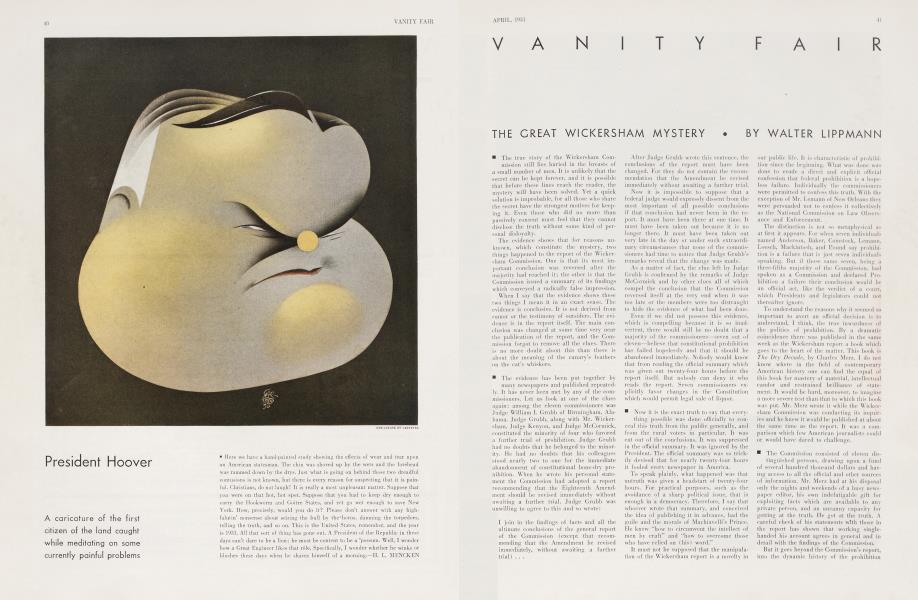
The effect of the President's repudiation of the real views of his own fact-finding commission is to land him in the camp of the nullificationists. I know how eloquently Mr. Hoover has denounced nullification. But a statesman who insists on preserving a law while making only nominal efforts to enforce it is, in fact, whatever he may say, acquiescing in nullification. The law is now nullified on a gigantic scale. Beyond what he is now doing Mr. Hoover has no program for enforcing it apart from trifling administrative changes. Now a law can either be enforced, revised, or nullified by disobedience. There is no other choice. Mr. Hoover cannot enforce. He refuses to revise. It follows that he looks upon the existing nullification as the least bad of the three choices before him.
There are many opponents of prohibition who take substantially this view and argue that prohibition will be dissolved by nullification because it cannot be cured by repeal. I used to hold this view. The practical difficulties of repealing a constitutional amendment are enormous, and the American political practice in regard to laws which embody a moral principle has almost always been to nullify them till they become dead letters.
I still believe that nullification will proceed at an accelerated pace in the immediate future and that before the law can be repealed the process of nullification will be very far advanced in all the thickly populated sections of the country. But I do not believe any longer that the problem will disappear, as it has disappeared in other instances, when the law is nullified and liquor is again fully available without subterfuge or risk of punishment.
For while nullification can and is restoring liquor, it cannot solve the real problem of prohibition. What the Eighteenth Amendment did was to deprive all American communities of the power to regulate the liquor traffic. Now the liquor traffic has to be regulated. It cannot be left to Al Capone. Under nullification no regulation of the liquor traffic would be legal. No state or city would have the power to drive the bootleggers out of business by substituting an orderly system of liquor distribution. It now seems to me, therefore, that it is impossible to stop at nullification, and that sheer necessity will compel the inhabitants of the populated states to keep on fighting for repeal.
Before very long it will be generally manifest, that the goal of the wets is not to make liquor available but to bring the liquor traffic under the control of the law. This statement may surprise most drys and many wets. Yet it seems to me to be the inevitable logic of the facts. Let it be granted that almost all wets today are actuated by a longing for good liquor obtainable at reasonable prices without trouble or furtiveness. The fact is that nullification is rapidly working to satisfy this demand. If all that the wets want is liquor the Eighteenth Amendment need not concern them much.
For in these last ten years the technical problem of supplying liquor under the Eighteenth Amendment has with characteristic American enterprise and inventiveness advanced rapidly to a solution. Anyone who will study the Wickersham report can see there that what has defeated prohibition finally is the invention of methods of manufacture which defy detection. Ten years ago it was assumed that the bulk of the liquor drunk in America was brewed or distilled in large plants or imported from abroad. It was theoretically possible, therefore, to close down these plants and barricade the frontier. But in ten years chemists and engineers have developed methods of making liquor which do not call for expensive machinery or conspicuous buildings. The methods are rapidly being improved, and we have already entered an era where there is an inexhaustible supply of reasonably safe and fairly palatable liquor.
When this fact has been made evident to the general public it will become clear that the only effect of the Eighteenth Amendment is to prevent communities from exercising any legal social control over the liquor traffic. Therefore, when the current process of nullification has run its course, the only point in agitating for revision will be to make it possible to enact laws to regulate the manufacture and sale of liquor.
We shall soon find, therefore, that those who are interested only in their own drinks will lose their passionate interest in repeal of the Amendment and that the wet cause will gradually be transformed into a temperance movement. That, in all truth, is what it is. When nullification has done its work, the standpatter drys will find that they are in fact defending no principle except the right of bootleggers to be free of any social control. The most fanatical among them may still stand pat. But they will be unmistakably a minority.
I have come to believe therefore that in spite of the theoretical difficulty of amending the Constitution, the movement for the recovery of legal power by the states is certain to succeed. For as nullification proceeds at its present momentum, the political pressure which the larger states can exert upon the smaller dry states will become very difficult to resist.
Obstruction is a game which two can play. If the drys obstruct, the wets can obstruct, and anyone who examines the legislative projects before Congress and in party platforms will discover that the dry states are on the whole the principal seekers for government favors. It does not seem to me likely that the drys can hold the dry states permanently to a policy of obstruction when the wets have really got themselves organized, and are ready to pass from argument to political action. The drys may hold the Republican Party through 1932. They may hold Congress until 1936. I do not see how, when all the tides are running against them, they can hold on much longer than that.
Subscribers have complete access to the archive.
Sign In Not a Subscriber?Join Now
