Sign In to Your Account
Subscribers have complete access to the archive.
Sign In Not a Subscriber?Join NowSardonic sawdust
JULIAN JEROME
The elephant walks around
The band begins to play,
The boys surround the monkey cage,
They'd better keep away.
—PARADE SONG
When Spring, the season of youth, brings the circus to town (denuded, in Madison Square Garden, of one of its greatest fascinations—"the big top") the press agents strew the town with gaudy posters, on which are emblazoned such words as stupendous, astounding, amazing, mammoth, incomparable, mastodonic and "most unique." And the press agents, notorious addicts of the major American crime, overstatement, are in this instance only to be pitied for the paltriness, timidity and inadequacy of their vocabulary! "The Greatest Show on Earth" Phineas T. Barnum, inspired, called it; and, for once, he did not exaggerate. For the circus of today is a threering miracle of colour, form and action—indeed, something which is magnificently all things to all men.
Although thousands of adults consistently claim every year that they take their thousands of youngsters to the circus because it makes them (the youngsters) so happy, it is significant, that once under the big tent, it is the grown-ups whose attention must be clamoured for, and not the children's; it is they who eat too much pop corn, drink too much ginger pop, who stare wide-eyed at the swordswallower, and who crowd the gypsy tents to have their fortunes told, who roll from their benches with mirth at the antics of the clowns, who shriek when a "balancing Wallenda" threatens to lose his equilibrium, and shudder when Hugo Zacchini, the "human projectile", is shot out of a cannon's maw.
The circus is truly the "Greatest Show on Earth" because it runs the gamut of human emotions, expressing in the simplest terms of the theatre, childish hopes and adult fears, and all there is of human frailty and aspiration.
The circus is a savage and bitter, a gay and artless commentary on civilization and, if you will, evolution. . . . The blood beats a swift atavistic tattoo at the strange sights and pungent jungle smells of the menagerie, or what the ballyhoo men call "the lordly lions, the royal tigers, and their pachydermic majesties, the elephants." Upon the tanbark there are simulated combats between men and beasts, and there is the thrill of a higher destiny fulfilled, in seeing man conquer and render ridiculous his ancient enemies, making them stand idiotically on tubs, do somersaults and jump through paper hoops. In the graceful, aerial flight of the trapeze artists there is the memory of a time when (in a hairier form) man swung himself from tree to tree, from vine to vine.
The circus is the supreme paradox: it is the brute reality of caged animals and the human horror of freaks; the lyrical romance of men and women overcoming the laws of gravity, weaving glittering patterns through the moted air, like swallows in the sunshine; it is vulgarity so natural, so healthy, that it is exquisite: bandwagons in solid crimson and gold, spangles, silver, tinsel, the blare of the big brass band, the gay stridence of the calliope. It is also stern logic and satire: the white-faced clown riding in a rickety Ford or a toy aeroplane (burlesquing all the scientific progress of man, making jests of those things which have meant too much perhaps to him— "joeys", giving all things their proper spiritual value). The circus is the poetry of snowy horses, of billowy ballet skirts, and beautiful maidens balancing delicately, like great butterflies, on silver wires.
The sawdust is redolent of romance and adventure of far places, of the "darkest depths" of the African jungles, India and Siam. Upon it swarm Tasmanian, Bornean wild men, hideous saucer-lipped Ubangi, tattooed men and women, covered with strange cabalistic signs ("every prick of the needle drew blood and brought a tear to the eye"). There on the hippodrome track the Wild West still lives: cowboys yell, throw steers, hurl lassoes, while on the war-path, fierce Indians brandish rifles; rodeos, roundups, presided over by the deathless spirit of the great Buffalo Bill Cody. A temple of curiosity, the circus deeply satisfies man's craving for the furious and the unnatural, the monstrous and the profane. In the freak show, or "kid" top ("never out, never over, going on all the time"), he weeps and grins at the absurd elastic-skinned man and the fearful fire-eater, at the sickening armless wonder, the "human pincushion," the half-man-half-woman, the towering giant and the pathetic dwarf, the painful-looking living skeleton and the beautiful 500-pound Bertha, suffering from elephantiasis. He gapes and laughs and inwardly says, "There, but for the grace of evolution's God, go I."
In short, the circus is life; for life, too, is a three-ring circus, above which our trapezed thoughts fly free, like troupes of acrobats, pleasantly safeguarded by the nets of convention below. Like life, the circus is a splendid coordination of seemingly unrelated parts, a spectacle without plot, without rhyme, without reason, combining all of life's frenzied sounds, tragic buffoonery, divine garishness and brilliant phantasmagoria, and possessing abundantly the qualities of nightmare and vision alike.
It is literature's loss that the circus has never inspired an epic. A few writers in our own day have touched on it—Charles Dickens, whose Sleary's Circus everyone remembers; John Masefield, and, to step down a circuspeg or two, George Ade; e. e. curamings; Jim Tully, author of Circus Parade—a vivid, unforgettable caricature of the seamier and least truthful side of the big tents—a book which is a sort of Mother India of the profession. Courtney Ryley Cooper (Under the Big Top, Lions and Tigers 'n Everything) has written more than anyone on it; he served two seasons as a press agent for a big circus to get the feel of it and circus folk say he does, admirably. A few actual circus showmen have written creditable, but uninspired, accounts of the mountebanks —James Loyd, George Conklin, W. C. Coup, "Lord" George Sanger (who wrote in Seventy Years a Showman, "Good roads, good times and merry tenting, that is the showman's benison") ; the famous clown, Robert Sherwood (not to be confused with the author of The Road to Rome) and Phineas Taylor Barnum, the greatest showman of them all, who wrote voluminously but dully about the circus in his own memoirs.
As there has been no great fiction about the circus, likewise no adequate history has been written of it. Perhaps this is because the circus, in the form in which we know it, is a comparatively recent institution. (George Washington attended the first circus produced in America, in Philadelphia, in 1780 and it was not until 1880, under the aegis of Barnum that the circus developed into "three rings".) More likely it is the essentially nomadic character of the enterprise which makes the circus difficult to follow and study, and the kaleidoscopic artlessness of its art, the aura of cheapness and buncombe with which it has always been surrounded, that have discouraged its would-be chroniclers.
(Continuedon page 107)
(Continued from page 79)
But what a splendid, varied field for a novelist: rich in personalities, the circus has had its famous clowns, Grimaldi, George Fox, Pete Conklin the Shakespearian clown, Irish Dan Rice (Daddy of American Clowns, who ran his own show-boats on the Mississippi): it has had its fascinating freaks, like the Siamese Twins, who, after having been "one flesh" for twenty years, morning, noon and night, quarreled over a few dollars one day, and quite literally broke up their act, each going unimpeded, without aid of surgery, her own way. There was General Tom Thumb, who they say, conceived the idea of life insurance. And Jo-Jo, the dog-faced boy, whose face was as smooth as a baby's but who could really bark.
There was that incomparable plainsman and Civil War veteran, Colonel William Frederick Cody—"Buffalo Bill"—the idol of Europe and America both. (He offered his aged, but indomitable arm and his Congress of Rough Riders to aid King George at the outbreak of the World War.) There was Annie Oakley, the eagle-eyed; and Jenny Lind, the sweet warbler who received a thousand dollars a night in the days when Hollywood was undreamed of; there was the famous "Poodles" Hannaford Equestrian family.
These are only a few of the alluring personalities about whose lives and loves a great circus saga might be written. It would be an epic of "the open road," too, of touring in all sorts of weather, over all sorts of road and pitching tents, rain or shine. It would tell of the loyalties and treacheries, the courage and cowardice of the performers; of the feuds and superstitions and friendships, of death that is their daily companion. (Lillian Leitzel, the tiny dainty blonde whose muscles bulged like a stevedore's, for ten years the greatest woman aerial star of Barnum and Bailey-Ringling Brothers, has just been killed in Copenhagen when an iron ring gave way.) There would be a thrilling chapter or two about the terrors and delicacies of transporting from one town to another, a menagerie of great cats, apes, elephants, zebras, horses, dogs, sea-lions, and even hippopotami! And of what happens when some of the ferocious or terrifying creatures escape, and go for a stroll. Or the horror that reigns "on the lot" when an elephant turns "killer," or a bear or lion turns upon a trainer, and rips his hand, his arm, off.
There would be other chapters (in addition to those on the history and development of the circus), on the codes, ethics, morals of the circus people (they are supposed to be healthy, clean-living provincial folk. Indeed, who can imagine Con Colleano, the double-somersaulting "wizard of the wire" or Alfredo Codona, only exponent of the triple somersault between high trapezes, as anything else but a teetotaling, God-fearing gentleman?). There would be sections devoted to the exploits of the founders of the circus, the art of pantomime, animal training, acrobatics, equestrianship, wirewalking, tumbling, freaks, pressagentry (the genius who induced twenty-seven of America's most famous physicians to attend the birth of the first elephant born in American captivity, and then immortalized its name "Jumbo"—in peanuts, in candies, in garters, in Lord knows what other commodities, does not deserve to die unsung). Another chapter would include many famous hoaxes, like "The Royal White Elephant," and the Japanese Mermaid (made of a fish and a monkey), the White Negress, and the Wooly Horse. And through the book, like a golden, joyous thread, the cry of children everywhere, "When, oh when is the circus coming to town?"
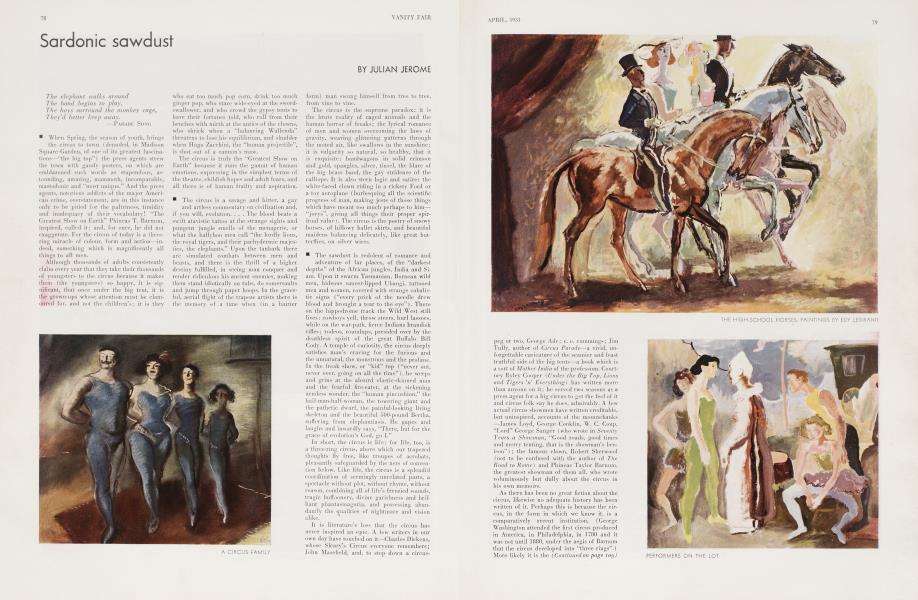
But if writers have neglected it, artists have always found in the circus a strong and colorful inspiration, the moderns particularly paying very serious attention to it. They have been quick to catch its spiritual and human qualities, and not to dispose of its vulgarities and crudities as child's play. They have found in its brilliant colours and strange forms, in the gay lights and dark shadows of the tent tops, a rare and compelling beauty. Beginning with Seurat and Forain, in our own day such successful "moderns" as Laurencin, Foujita, Laprade, George Bellows, Dame Laura Knight, Rouault, Dufy, Edy Legrand, and Vertes, have used circus models and scenes as subjects of some of their most famous pictures.
In France today the "Cirque"—(the Cirque d'Hiver, Cirque Medrano and Cirque de Paris)—has become quite a cult among the intellectuals. The three Fratellinis, France's most famous clowns, were made officers of the Academy. Perhaps the intelligentsia read into these antics on the sawdust, too much bitterness and tragedy (as they have been inclined to do with Charlie Chaplin, who also chose the Circus as the bright and sad theme for one of his finest moving pictures). For while the circus holds up a sardonic mirror to nature, it also whimsically and gaily mocks that very reflection. Perhaps, after all, it is safest to leave the circus to the judgment of the children. In their gentle, if unphilosophic hearts, it will be safe and cannot die. For as long as children laugh at laughable things, and adults are secretly pleased at the misfortunes of their fellows, clowns will play and prosper; as long as there still remains in the world one small boy who teaches his dog tricks, who shoots imaginary lions and Indians from behind the sofa, or practices flying from the bed-post; and as long as disappointed young men dream of lovely women pirouetting on the broad, rosined backs of milky horses, and women dream of being rescued from jungle beasts; and lastly, and most important of all, as long as human beings of all ages are glamourhungry, and curious as apes, the circus will come every year to your town and mine—Rain or Shine.
Subscribers have complete access to the archive.
Sign In Not a Subscriber?Join Now

