Sign In to Your Account
Subscribers have complete access to the archive.
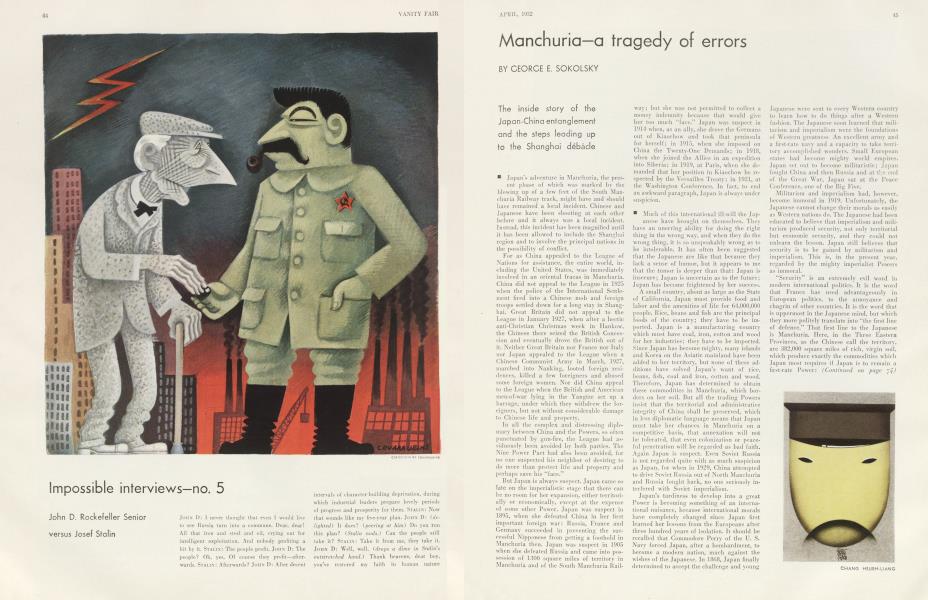
Sign In Not a Subscriber?Join NowManchuria—a tragedy of errors
GEORGE E. SOKOLSKY
The inside story of the Japan-China entanglement and the steps leading up to the Shanghai débâcle
Japan's adventure in Manchuria, the present phase of which was marked by the blowing up of a few feet of the South Manchuria Railway track, might have and should have remained a local incident. Chinese and Japanese have been shooting at each other before and it always was a local incident. Instead, this incident has been magnified until it has been allowed to include the Shanghai region and to involve the principal nations in the possibility of conflict.
For as China appealed to the League of Nations for assistance, the entire world, including the United States, was immediately involved in an oriental fracas in Manchuria. China did not appeal to the League in 1925 when the police of the International Settlement fired into a Chinese mob and foreign troops settled down for a long stay in Shanghai. Great Britain did not appeal to the League in January 1927, when after a hectic anti-Christian Christmas week in Hankow, the Chinese there seized the British Concession and eventually drove the British out of it. Neither Great Britain nor France nor Italy nor Japan appealed to the League when a Chinese Communist Army in March, 1927, marched into Nanking, looted foreign residences, killed a few foreigners and abused some foreign women. Nor did China appeal to the League when the British and American men-of-war lying in the Yangtze set up a barrage, under which they withdrew the foreigners, but not without considerable damage to Chinese life and property.
In all the complex and distressing diplomacy between China and the Powers, so often punctuated by gun-fire, the League had assiduously been avoided by both parties. The Nine Power Pact had also been avoided, for no one suspected his neighbor of desiring to do more than protect life and property and perhaps save his "face."
But Japan is always suspect. Japan came so late on the imperialistic stage that there can be no room for her expansion, either territorially or economically, except at the expense of some other Power. Japan was suspect in 1895, when she defeated China in her first important foreign war: Russia, France and Germany succeeded in preventing the successful Nipponese from getting a foothold in Manchuria then. Japan was suspect in 1905 when she defeated Russia and came into possession of 1300 square miles of territory in Manchuria and of the South Manchuria Railway; but she was not permitted to collect a money indemnity because that would give her too much "face." Japan was suspect in 1914 when, as an ally, she drove the Germans out of Kiaochow and took that peninsula for herself; in 1915, when she imposed on China the Twenty-One Demands; in 1918, when she joined the Allies in an expedition into Siberia; in 1919, at Paris, when she demanded that her position in Kiaochow be respected by the Versailles Treaty; in 1921, at the Washington Conference. In fact, to end an awkward paragraph, Japan is always under suspicion.
Much of this international ill-will the Japanese have brought on themselves. They have an unerring ability for doing the right thing in the wrong way, and when they do the wrong thing, it is so unspeakably wrong as to be intolerable. It has often been suggested that the Japanese are like that because they lack a sense of humor, but it appears to me that the tumor is deeper than that: Japan is insecure; Japan is uncertain as to the future; Japan has become frightened by her success.
A small country, about as large as the State of California, Japan must provide food and labor and the amenities of life for 64,000,000 people. Rice, beans and fish are the principal foods of the country; they have to be imported. Japan is a manufacturing country which must have coal, iron, cotton and wood for her industries; they have to be imported. Since Japan has become mighty, many islands and Korea on the Asiatic mainland have been added to her territory, but none of these additions have solved Japan's want of rice, beans, fish, coal and iron, cotton and wood. Therefore, Japan has determined to obtain these commodities in Manchuria, which borders on her soil. But all the trading Powers insist that the territorial and administrative integrity of China shall be preserved, which in less diplomatic language means that Japan must take her chances in Manchuria on a competitive basis, that annexation will not be tolerated, that even colonization or peaceful penetration will be regarded as bad faith. Again Japan is suspect. Even Soviet Russia is not regarded quite with as much suspicion as Japan, for when in 1929, China attempted to drive Soviet Russia out of North Manchuria and Russia fought back, no one seriously interfered with Soviet imperialism.
Japan's tardiness to develop into a great Power is becoming something of an international nuisance, because international morals have completely changed since Japan first learned her lessons from the Europeans after three hundred years of isolation. It should be recalled that Commodore Perry of the U. S. Navy forced Japan, after a bombardment, to become a modern nation, much against the wishes of the Japanese. In 1868, Japan finally determined to accept the challenge and young Japanese were sent to every Western country to learn how to do things after a Western fashion. The Japanese soon learned that militarism and imperialism were the foundations of Western greatness An excellent army and a first-rate navy and a capacity to take territory accomplished wonders. Small European states had become mighty world empires. Japan set out to become militaristic; Japan fought China and then Russia and at the end of the Great War, Japan sat at the Peace Conference, one of the Big Five.
Militarism and imperialism had, however, become immoral in 1919. Unfortunately, the Japanese cannot change their morals as easily as Western nations do. The Japanese had been educated to believe that imperialism and militarism produced security, not only territorial but economic security, and they could not unlearn the lesson. Japan still believes that security is to be gained by militarism and imperialism. This is, in the present year, regarded by the mighty imperialist Powers as immoral.
"Security" is an extremely evil word in modern international politics. It is the word that France has used advantageously in European politics, to the annoyance and chagrin of other countries. It is the word that is uppermost in the Japanese mind, but which they more politely translate into "the first line of defence." That first line to the Japanese is Manchuria. Here, in the Three Eastern Provinces, as the Chinese call the territory, are 382,000 square miles of rich, virgin soil, which produce exactly the commodities which Japan most requires if Japan is to remain a first-rate Power: coal, iron, wood, wheat, beans, in such an abundance as to provide amply for Japan's requirements even in time of war. In addition, this region is a corridor between Japan and Russia and Japan and China. If Japan can hold or even dominate this area, Japan need never fear starvation (although there might be a rice shortage) ; her industries could thrive (although the textile mills might be short of cotton) and she could protect her boundaries without an invading army touching the four islands of Japan Proper.
(Continued on page 74)
(Continued from page 45)
Unfortunately for Japan, Manchuria is an integral part of China. In 1895, when Japan might have taken Manchuria from a degenerate and defeated Manchu court, Manchuria was not as much Chinese as it is today. For, since the founding of the Republic of China in 1912, the claims of the Manchu house to the territory, originally their home, have been relinquished to China, and the Chinese population has grown tremendously.
The Japanese have had ample opportunities to penetrate Manchuria. Since 1905, they have owned the principal railway, the South Manchuria, which runs through the heart of the country from Changchun to Dairen; they also own a strip of 1300 square miles, the Kwantung Leased Territory with its port of Dairen, the principal mart of Manchuria.
The fact is that the Japanese are poor colonizers and unwilling emigrants. On the other hand, the Koreans in Manchuria are Japanese only when they need protection from the Chinese authorities.
Manchuria, thus colonized by Chinese from inside the Wall, became Chinese politically, although its economic life was dominated in the South by the South Manchuria Railway of the Japanese and in the North by the Chinese Eastern Railway of the Russians.
On the whole, China benefited by Japan's economic activity, while the Chinese lost little by Japan's military aims. The Chinese are better traders than the Japanese, and the more money Japan put into Manchuria, the more money the Chinese there made.
Therefore, from 1915 to 1928, China and Japan always quarrelled over Manchuria, but somehow the officials of both countries managed to find a modus operandi which really worked advantageously for both countries.
The League's interest in China was not a sudden flush of emotion on the morning of September 19. For years, the League had been seeking a modus operandi for what their secretariat calls collaboration in China. League officials came to China from time to time but they were unable to interest the Chinese in their various projects.
When, therefore, the incident of September 18 occurred, Japan regarded the League not altogether as an impartial body. League agents in China were suspected of favoring China's cause. The Japanese even contend that the curious first resolution of the Council of the League, ordering Japan out of Manchuria in a fortnight, which was as astonishing a political blunder as it was a display of ignorance of the psychology of Eastern peoples, was instigated by the League agents in China. Then the League erred frightfully by doing nothing about it, by actually backing down. From that moment, the influence of the Western Powers with both China and Japan suffered. Japan regarded each note as just another bluff and China looked upon Western diplomacy as beneficial to Japan.
Secretary Stimson at the beginning followed League diplomacy step by step. His formula was apparently that unless the League prevented China from declaring war on Japan, it would be impossible to maintain world peace; for then Japan, in retaliation, would annex parts of China as a war measure. It was of course impossible for Mr. Stimson to know that China would avoid such a declaration, for the dominant politicians of that country feared then that Japan would finance a Chinese political opposition to them, which, as a matter of fact, Japan has actually done in Manchuria.
Since January 8, Mr. Stimson has been pursuing a more realistic policy: the United States will protect American lives and property whenever endangered, and the Open Door for American trade must be maintained at any cost whatsoever.
The European countries have been motivated by mixed interests. Great Britain would prefer that Japan should succeed, because such a success would strengthen Great Britain in the Far East and in India, and because the general imperialistic tendency in world politics would reappear; on the other hand, the precedent set by Japan imperils the peace of Europe, which is not so good for Great Britain; furthermore, whereas a Japanese victory in Manchuria lessens Soviet influence in China, a Japanese victory in Shanghai may seriously interfere with British trade in a distinctively British sphere of influence. France seems to have been supporting Japan, although M. Briand was most antagonistic to the Japanese at Geneva, and the French group in the League engineered the plan for League collaboration in China. France may one day be faced by problems in Indo-China and South China not unlike those which Japan is now attempting to settle by war measures. Soviet Russia is frightened and uncertain: her Five Year Plan is not completed, and a war with Japan is unthinkable in the present circumstances.
As long as the war between China and Japan results in the loss only of Chinese and Japanese lives, it will remain an academic factor in world politics. When foreigners are killed, it may develop into a frightful situation. It may melt away as similar rows have or it may lead to an international war of serious proportions. There can be only one way out in the Shanghai phase of the war and that way has apparently been taken: the United States and Great Britain, as the two most interested parties, because of their investments and trade in the Far East, should call a halt—should enforce their demands on both countries. Then China and Japan should sit down and negotiate a settlement of the Manchurian problem.
Subscribers have complete access to the archive.
Sign In Not a Subscriber?Join Now
