Sign In to Your Account
Subscribers have complete access to the archive.
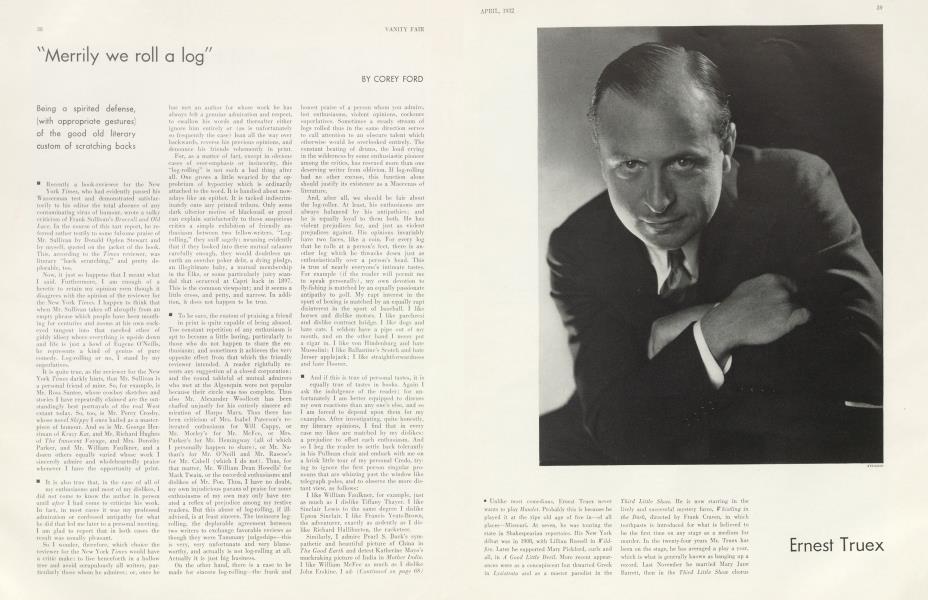
Sign In Not a Subscriber?Join Now"Merrily we roll a log"
COREY FORD
Being a spirited defense, (with appropriate gestures) of the good old literary custom of scratching backs
Recently a book-reviewer for the New York Times, who had evidently passed his Wasserman test and demonstrated satisfactorily to his editor the total absence of any contaminating virus of humour, wrote a sulky criticism of Frank Sullivan's Broccoli and Old Lace. In the course of this tart report, he referred rather testily to some fulsome praise of Mr. Sullivan by Donald Ogden Stewart and by myself, quoted on the jacket of the book. This, according to the Times reviewer, was literary "back scratching," and pretty deplorable, too.
Now, it just so happens that I meant what I said. Furthermore, I am enough of a heretic to retain my opinion even though it disagrees with the opinion of the reviewer for the New York Times. I happen to think that when Mr. Sullivan takes off abruptly from an empty phrase which people have been mouthing for centuries and zooms at his own cockeyed tangent into that rarefied ether of giddy idiocy where everything is upside down and life is just a bowl of Eugene O'Neills, he represents a kind of genius of pure comedy. Log-rolling or no, I stand by my superlatives.
It is quite true, as the reviewer for the New York Times darkly hints, that Mr. Sullivan is a personal friend of mine. So, for example, is Mr. Ross Santee, whose cowboy sketches and stories I have repeatedly claimed are the outstandingly best portrayals of the real West extant today. So, too, is Mr. Percy Crosby, whose novel Skippy I once hailed as a masterpiece of humour. And so is Mr. George Herriman of Krazy Kat, and Mr. Richard Hughes of The Innocent Voyage, and Mrs. Dorothy Parker, and Mr. William Faulkner, and a dozen others equally varied whose work I sincerely admire and wholeheartedly praise whenever I have the opportunity of print.
It is also true that, in the case of all of my enthusiasms and most of my dislikes, I
did not come to know the author in person until after I had come to criticize his work. In fact, in most cases it was my professed admiration or confessed antipathy for what he did that led me later to a personal meeting. I am glad to report that in both cases the result was usually pleasant.
So I wonder, therefore, which choice the reviewer for the New York Times would have a critic make: to live henceforth in a hollow tree and avoid scrupulously all writers, particularly those whom he admires; or, once he has met an author for whose work he has always felt a genuine admiration and respect, to swallow his words and thereafter either ignore him entirely or (as is unfortunately so frequently the case) lean all the way over backwards, reverse his previous opinions, and denounce his friends vehemently in print.
For, as a matter of fact, except in obvious cases of over-emphasis or insincerity, this "log-rolling" is not such a bad thing after all. One grows a little wearied by the opprobrium of hypocrisy which is ordinarily attached to the word. It is bandied about nowadays like an epithet. It is tacked indiscriminately onto any printed tribute. Only some dark ulterior motive of blackmail or greed can explain satisfactorily to these suspicious critics a simple exhibition of friendly enthusiasm between two fellow-writers. "Logrolling," they sniff sagely: meaning evidently that if they looked into these mutual salaams carefully enough, they would doubtless unearth an overdue poker debt, a dying pledge, an illegitimate baby, a mutual membership in the Elks, or some particularly juicy scandal that occurred at Capri back in 1897. This is the common viewpoint; and it seems a little cross, and petty, and narrow. In addition, it does not happen to be true.
To be sure, the custom of praising a friend in print is quite capable of being abused. Too constant repetition of any enthusiasm is apt to become a little boring, particularly to those who do not happen to share the enthusiasm; and sometimes it achieves the very opposite effect from that which the friendly reviewer intended. A reader rightfully resents any suggestion of a closed corporation; and the round tableful of mutual admirers who met at the Algonquin were not popular because their circle was too complete. Thus also Mr. Alexander Woollcott has been chaffed unjustly for his entirely sincere admiration of Harpo Marx. Thus there has been criticism of Mrs. Isabel Paterson's reiterated enthusiasm for Will Cuppy, or Mr. Morley's for Mr. McFee, or Mrs. Parker's for Mr. Hemingway (all of which I personally happen to share), or Mr. Nathan's for Mr. O'Neill and Mr. Rascoe's for Mr. Cabell (which I do not). Thus, for that matter, Mr. William Dean Howells' for Mark Twain, or the recorded enthusiasms and dislikes of Mr. Poe. Thus, I have no doubt, my own injudicious paeans of praise for some enthusiasms of my own may only have created a reflex of prejudice among my restive readers. But this abuse of log-rolling, if illadvised, is at least sincere. The insincere logrolling, the deplorable agreement between two writers to exchange favorable reviews as though they were Tammany judgeships—this is very, very unfortunate and very blameworthy, and actually is not log-rolling at all. Actually it is just big business.
On the other hand, there is a case to be made for sincere log-rolling—the frank and honest praise of a person whom you admire, hot enthusiasms, violent opinions, cocksure superlatives. Sometimes a steady stream of logs rolled thus in the same direction serves to call attention to an obscure talent which otherwise would be overlooked entirely. The constant beating of drums, the loud crying in the wilderness by some enthusiastic pioneer among the critics, has rescued more than one deserving writer from oblivion. If log-rolling had no other excuse, this function alone should justify its existence as a Maecenas of literature.
And, after all, we should be fair about the log-roller. At least, his enthusiasms are always balanced by his antipathies; and he is equally loyal to them both. He has violent prejudices for, and just as violent prejudices against. His opinions invariably have two faces, like a coin. For every log that he rolls at a person's feet, there is another log which he thwacks down just as enthusiastically over a person's head. This is true of nearly everyone's intimate tastes. For example (if the reader will permit me to speak personally), my own devotion to fly-fishing is matched by an equally passionate antipathy to golf. My rapt interest in the sport of boxing is matched by an equally rapt disinterest in the sport of baseball. I like horses and dislike motors. I like parcheesi and dislike contract bridge. I like dogs and hate cats. I seldom have a pipe out of my mouth, and on the other hand I never put a cigar in. I like von Hindenburg and hate Mussolini; I like Ballantine's Scotch and hate Jersey applejack; I like straightforwardness and hate Hoover.
And if this is true of personal tastes, it is equally true of tastes in books. Again I ask the indulgence of the reader; for unfortunately I am better equipped to discuss my own reactions than any one's else, and so I am forced to depend upon them for my examples. After investigating, quite honestly, my literary opinions, I find that in every case my * likes are matched by my dislikes: a prejudice to offset each enthusiasm. And so I beg the reader to settle back tolerantly in his Pullman chair and embark with me on a brisk little tour of my personal Credo, trying to ignore the first person singular pronouns that are whizzing past the window like telegraph poles, and to observe the more distant view, as follows:
I like William Faulkner, for example, just as much as I dislike Tiffany Thayer. I like Sinclair Lewis to the same degree I dislike Upton Sinclair. I like Francis Yeats-Brown, the adventurer, exactly as ardently as I dislike Richard Halliburton, the racketeer.
Similarly, I admire Pearl S. Buck's sympathetic and beautiful picture of China in The Good Earth and detest Katherine Mayo's muckraking picture of India in Mother India. I like William McFee as much as I dislike John Erskine. I admire Walter Lippmann's wise and tolerant articles in the New York Herald Tribune as much as I deplore Mark Sullivan's sycophantic articles on Hoover in the same paper, or Mr. Garet Garrett's prejudiced jingoism in the Saturday Evening Post.
(Continued on page 68)
(Continued from page 38)
I like Hemingway, and dislike Dreiser. I like Edward McKenna who wrote Tomorrow Once Again, and dislike Sherwood Anderson who wrote Tar. I think Noel Coward and Somerset Maugham and Alexander Woollcott are brilliant. On the other hand, I always get Benjamin de Casseres and George Jean Nathan a little confused.
F. G. Wodehouse, Nunnally Johnson, W. W. Jacobs, Benchley, Stewart, Lardner, Cuppy and the authors of 1066 And All That seem to me funny. Sam Heilman and W. 0. McGeehan seem to me not funny, and Will Rogers is a finger down my throat.
Likes—Stuart Chase's Mexico, Graham Greene's The Man Within, David Garnett's The Grasshoppers Come, and Philip Stevenson's neglected story of adolescence, The Gospel According to St. Luke. Dislikes—the popular The Story of San Michele by Axel Munthe, and The Impatient Virgin by Donald Henderson Clarke, and Westward Passage by Margaret Ayer Barnes.
Likes—James Stephens, Captain John Thomason, Thomas Boyd, Ross Santee, Deems Taylor, Rebecca West, James Gould Cozzens, E. M. Delafield, William Seabrook, J. Frank Dobie, Henry Beston, Don Marquis, and the Maxes Beerbohm and Eastman. Dislikes—Emil Ludwig, Will Durant, Edgar Lee Masters, Warwick Deeping, John Cowper Powys, Morris Markey, Warner Fabian, Morley Callaghan, E. E. Cummings and Floyd Gibbons.
Log-rolling? Yes. Biased, opinionated, cocksure? Of course. That is what log-rolling really is. Above all, I should never wish to be called unbiased and calm and free from violence, either in my likes or in my dislikes. To be sure, I do not criticize the calm ones among the critics. They are dependable, they are as staple as cereal, they are always there, like the Supreme Court, unimpassioned and cold and just. I want to have violent opinions, passionate, biased, lively. I want to be enthusiastic about them, and enjoy them to the full.
Later, when I have no opinions left about anything, there will be plenty of time to be a critic.
Subscribers have complete access to the archive.
Sign In Not a Subscriber?Join Now
