Sign In to Your Account
Subscribers have complete access to the archive.
Sign In Not a Subscriber?Join NowTHE EDITOR'S UNEASY CHAIR
American painter
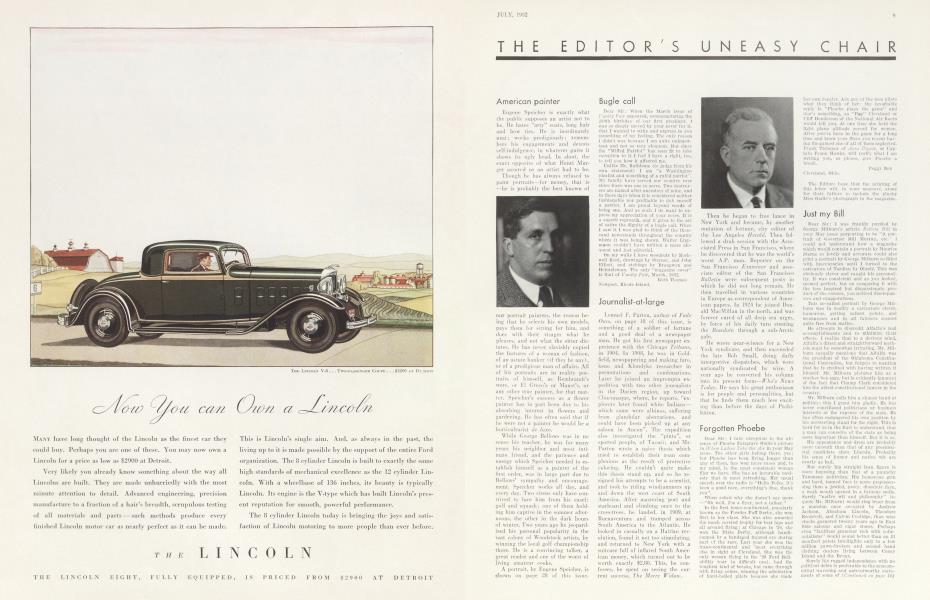
Eugene Speicher is exactly what the public supposes an artist not to be. He hates "arty" coats, long hair and bow ties. He is inordinately neat; works prodigiously; remembers his engagements and detests self-indulgence, in whatever guise it shows its ugly head. In short, the exact opposite of what Henri Murger assured us an artist had to be.
Though he has always refused to paint portraits—for money, that is —he is probably the best known of
our portrait painters, the reason being that he selects his own models, pays them for sitting for him, and does with their visages what he pleases, and not what the sitter dictates. He has never slavishly copied the features of a woman of fashion, of an astute banker (if they be any), or of a prodigious man of affairs. All of his portraits are in reality portraits of himself, as Rembrandt's were, or El Greco's or Manet's, or any other true painter, for that matter. Speicher's success as a flower painter has in part been due to his absorbing interest in flowers and gardening. He has often said that if he were not a painter he would be a horticulturist de luxe.
While George Bellows was in no sense bis teacher, he was for many years his neighbor and most intimate friend, and the patience and energy which Speicher needed to establish himself as a painter of the first order, was in large part due to Bellows' sympathy and encouragement. Speicher works all day, and every day. Two sirens only have contrived to lure him from his easel: golf and squash; one of them holding him captive in the summer afternoons, the other in the dark hours of winter. Two years ago he jeopardized his personal popularity in the vast colony of Woodstock artists, by winning the local golf championship there. He is a convincing talker, a great reader and one of the worst of living amateur cooks.
A portrait, by Eugene Speicher, is shown on page 28 of this issue.
Bugle call
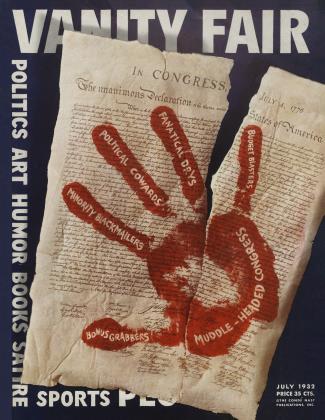
Dear Sir: When the March Issue of Vanity Fair appeared, commemorating the 200th birthday of our first president, I was so deeply moved by your cover for it, that I wanted to write and express to you something of my feeling. The only reason I didn't was because I am quite unimportant and not so very eloquent. But since the "Miffed Patriot" has seen fit to take exception to it I feel I have a right, too, to tell you how it affected me.
Unlike Mr. Rathbone (to judge from his own statement) I am "a Washington idealist and something of a rabid patriot". My family have served our country ever since there was one to serve. Two destroyers are named after ancestors of mine, and in these days when it is considered neither fashionable nor profitable to dub oneself a patriot, I am proud beyond words of being one. And as such I do want to express my appreciation of your cover. It is a superb reproach, and It gives to the art of satire the dignity of a bugle call. When I saw it I was glad to think of the thousand newsstands throughout the country where it was being shown. Walter Llppmann couldn't have written a more eloquent and just editorial.
On my walls I have woodcuts by Rockwell Kent, drawings by Sterner, and John Elliott, and etchings by Brangwyn and Heintzleman. The only "magazine cover" is that of Vanity Fair, March, 1932.
Ruth Thomas
Newport, Rhode Island.
Journalist-at-large
Lemuel F. Barton, author of Fade Outs, on page 18 of this issue, is something of a soldier of fortune and a good deal of a newspaper man. He got his first newspaper experience with the Chicago Tribune, in 1904. In 1908, he was in Goldfield, newspapering and making faro, keno and Klondyke researches in permutations and combinations. Later he joined an impromptu expedition with two other journalists in the Darien region, up toward Chucunaque, where, he reports, "explorers later found white Indians— which same w'ere albinos, suffering from glandular aberrations, and could have been picked up at any saloon in Ancon". The expedition also investigated the "pinto", or spotted people, of Tucuti; and Mr. Barton wrote a naive thesis which tried to establish their roan complexions as the result of protective coloring. He couldn't quite make this thesis stand up, and so he resigned his attempts to be a scientist, and took to riding windjammers tip and down the west coast of South America. After mastering port and starboard and climbing once to the cross-trees, he landed, in 1909, at Buenaventura and tramped across South America to the Atlantic. He looked in casually on a Haitian revolution, found it not too stimulating, and returned to New York with a suitcase full of inflated South American money, which turned out to be worth exactly $2.80. This, he confesses, he spent on seeing the current success, The Merry Widow.
Then he began to free lance in New York and became, by another mutation of fortune, city editor of the Los Angeles Herald. Then followed a drab session with the Associated Bress in San Francisco, where he discovered that he was the world's worst A.B. man. Reporter on the San Francisco Examiner and associate editor of the San Francisco Bulletin were subsequent posts in which he did not long remain. He then travelled in various countries in Europe as correspondent of American papers. In 1924 he joined Donald MacMillan in the north, and was forever cured of all deep sea urges, by force of his daily turn steering the Bowdoin through a sub-Arctic gale.
He wrote near-science for a New York syndicate, and then succeeded the late Bob Small, doing daily interpretive dispatches, which were nationally syndicated by wire. A year ago he converted his column into its present form—Who's News Today. He says his great enthusiasm is for people and personalities, but that he finds them much less exciting than before the days of Brohibition.
Forgotten Phoebe
Dear Sir: I take exception to the absence of Phoebe Fairgrave Omlie's picture in When Ladies Take the Air in your May issue. Tile other girls belong there, yes; but Phoebe has been flying longer than any of them, has won more races and, to my mind, is the most consistent woman flier we have. She has an incurable modesty that is most refreshing. Her usual speech over the radio is "Hello Folks, it's been a good race, everything's fine, thank you".
When asked why she doesn't say more —"Oh well, I'm a flyer, not a talker."
In the first trans-continental, popularly known as the Powder Puff Derby, she won first in her class. She was also awarded the much coveted trophy for best laps and all around flying; at Chicago in '30, she won the Dixie Derby, although handicapped by a bandaged injured eye during part cf the race. Last year she won the trans-continental and 'most everything else in sight at Cleveland. She was the only woman flying in the '28 Ford Reliability tour (a difficult one), had the toughest kind of breaks, but came through with flying colors, winning the admiration of hard-boiled pilots because she made
her own repairs. Ask any of the men idiots what they think of her: the Invariable reply is "Phoebe plays the game" and that's something, as "Pop" Cleveland or Cliff Henderson of the National Air Races would tell you. At one time she held the light plane altitude record for women. After you've been in the game for a long time and know your fliers you resent having the gamest one of all of them neglected. Frank Tlchenor of Aero Digest, or Captain Frank Hawks, will verify what I am writing you, so please, give Phoebe a break.
Peggy Rex
Cleveland, Ohio.
The Editors hope that the printing of this letter will, in some measure, atone for their failure to Include the plucky Miss Omlie's photograph in the magazine.
Just my Bill
Dear Sir: I was frankly puzzled by George Milburn's article Bolivia Bill in your May issue purporting to be "A portrait of Governor Bill Murray, etc." I could not understand how a magazine which would contain a portrait by Maurice Sterne so lovely and accurate could also print a portrait by George Milburn so filled with inaccuracies until I turned to the caricature of Tardieu by Obcrle. This was obviously clever and caught his personality. It was consistent and as you looked, seemed perfect, but on comparing it with the less Inspired but dispassionate product of the camera, you noticed discrepancies and exaggerations.
This so-called portrait by George Milburn was in reality a caricature clever, humorous, getting salient points, and weaknesses and in all fairness seemed quite free from malice.
He attempts to discredit Alfalfa's real accomplishments and to minimize their effects. I realize that to a devious mind, Alfalfa's direct and straightforward methods must be somewhat irritating. Mr. Milburn casually mentions that Alfalfa was the president of the Oklahoma Constitutional Convention, but forgets to mention that he is credited with having written it himself. Mr. Milburn pictures him as a cracker box sage, but is evidently ignorant of the fact that Champ Clark considered him the ablest constitutional lawyer in the country.
Mr. Milburn calls him a clumsy hand at politics; this I grant him gladly. He has never conciliated politicians or business interests at the expense of the state. He has often endangered his own position by his unswerving stand for the right. This Is hard for us in the East to understand, that a man can conceive of the state as being more important than himself. But it Is so.
His appearance and dress are probably more uncouth than that of any presidential candidate since Lincoln. Probably his sense of humor and native wit are nearly as bad.
But surely his straight lean figure is more imposing than that of a paunchy Tammany politician. His humorous grin and hard, tanned face is more prepossessing than a jowled, pasty, dissolute face, a weak mouth opened in a fatuous smile. Surely "native wit and philosophy" (to quote Mr. Milburn) would ring truer from a mansion once occupied by Andrew Jackson, Abraham Lincoln, Theodore Roosevelt, and Calvin Coolidge, than wise cracks garnered twenty years ago in East Side saloons and cigar stores. Perhaps even "faultless grammar rich with colloquialisms" would sound better than an ill mouthed patois intelligible only to a few million pawn-brokers and second hand clothing dealers living between Coney Island and the Bronx.
Surely his rugged independence with no political debts is preferable to the noncommittal wavering and untrustworthy statements of some of our eastern aspirants. He may belong to an era of oratory but he doesn't drivel any demagogic flummery, or insult one's intelligence.
Continued on page 10
Continued from page 9
He may be a remnant of that great army which pushed the frontier into the Pacific. He may not come from a family born to generations of leisure and wealth. His training may have been brief (I refer to his formal education). Perhaps his associations were among such unlettered men. But he has guarded the standards and character that he has. He never traded it for political advancement, or aligned himself with gamblers, grafters, shady politicians, crooked police, and criminals, to place himself in the Governor's chair of Oklahoma. That was an honor honestly won. And from that eyrie (the Governor's chair) I believe lie could look Samuel Seabury in tlie eye and smile!
I don't agree with Alfalfa on prohibition but I admire the courage of his convictions. He may not restore Lüchow's in all its glory of Wurzburger Hofbrau. But even that is better than half-made promises never to be fulfilled.
Measured as a man he looms much larger than another candidate whose soul would probably sift down much finer than that of Kipling's Tomlinson. If you are interested compare Alfalfa Bill with some other rural and even frontier presidents.
Edward Deyo Jacobs Highland, New York.
Is Nullification possible?
Dear Sir:
Mr. John Hemphill, writing in a recent issue of Vanity Fair under the title "The Eighteenth Amendment can be Repealed'' has arrived at mental peace by climbing what William James called tlie "faith ladder" ; the rungs of which are: what I want MIGHT conceivably be true. It MAY be true. It OUGHT to be true. It MUST be true. It IS true. Having given himself up to a wishing debauch, he has become abusive to those who agree with him that the present reign of corruption, hypocrisy and oppression under national prohibition must cease. He has found it easier and more alluring to chase "isms" than to face the concrete realities of life. In his enthusiasm for outright Repeal, he has characterized Clarence Harrow as a "defeatist, a fainthearted wet and a weak-kneed modifleationist." and thereby, to the extent of his influence is giving aid and comfort to the forces of Volsteadism.
The anti-prohibitionists are divided into three schools; (1) the modificationists, (2) the repealers (with or without a substitute amendment) and (3) the nulliflcationists. The first school of thought is represented by the Congressional Districts Modification League. The aim of this organization is to amend the Volstead Act so as to allow light wines and beer. It is the opinion of the writer that this is a futile attempt although there is argument in Mr. Hemphill's article that supports the aim of this group of "milk and water modifleationists". . . .
The second school of anti-prohibitionist thought is represented by those who favor the outright repeal of the Eighteenth Amendment or the repeal and the adoption of a substitute amendment. Mr. Harrow in the November Vanity Fair has presented cogent arguments to show that tills method of attack is outside the scope of practical political remedies. An amendment to become a part of the Constitution must be ratified by legislatures or conventions in three-fourths of the states. Thirteen states can block any effort at repeal. . . .
In the recent vote on a proposal to bring the Beck-Linthicum Prohibition Amendment out of committee which was the first wet-dry test vote in Congress in a decade, the wets idled up a surprise vote of 187, but were defeated by 227 dry-voting Congressmen. If the vote in Congress were tabulated by states, we would find that the 227 dry votes would carry 28 states into the dry column. Thirteen states can block a repeal. The wet trend does not give much encouragement to Mr. Hemphill's thesis. But it should be noted that if the wets can acquire only 22 additional votes in Congress, they can refuse to appropriate money for enforcement of the Volstead Act.
The third school of anti-prohibitionist thought is represented by the nulllflcationists. Since repeal of the Eighteenth
Amendment is impossible, the best present strategy for the wets would be for the House of Representatives to refuse to appropriate money for the enforcement of the Volstead Act. The Eighteenth Amendment is not selfexecuting. Then when the time conies when a majority of the Senate is wet, repeal the Volstead Act. Tiie wet states, in the meantime, can repeal their enforcement acts. Some nulliflcationists have gone no further than this. They have simply played with the idea as a slogan. But this would not constitute a solution of the prohibition problem. It would not even satisfy the wets. An unregulated and a non-revenue producing liquor traffic is unthinkable as a way out of the prohibition muddle.
Before nullification can be advocated as an effective process of government for solving the prohibition problem, it is incumbent on the adherents to show (1) that it is possible to raise revenue from the liquor traffic and (2) that it is possible to regulate the traffic without having either the revenue or the regulatory laws declared unconstitutional as in violation of the Eighteenth Amendment that is still in the Constitution and cannot be repealed. The law is well settled that the government in taxing a business does not recognize its lawful character and does not sanction its existence. Further, the Supreme Court has held that gains from illicit traffic in liquor are subject to the income tax.
When it conies to the regulation of the liquor traffic it is our contention that if federal and state enforcement acts were repealed it would be possible for the states, under the police power to regulate the liquor traffic without authorizing anything that the Eighteenth Amendment condemns. By a system of NEGATIVE regulations the state can penalize what it wants to penalize. It may select and choose the evils that it wants to punish. An illustration will aid in making clear the proposition we are defending. The state of Montana has repealed its state prohibition law. But in another section of the Code there is still on the statute books a law providing for a penalty for the sale of liquor to minors. Does anyone doubt that a violator of that law does not commit an offense against the state for which he can be punished ? Does anyone contend that such a law sanctions or authorizes the sale of liquor to adults? That law constitutes a typical illustration of what we designate as a NEGATIVE regulation under a system of state nullification. If that law is valid, is it not within the constitutional competency of a state under the police power to make the selling of liquor on Sunday an offense? And if that can be done, why is it not possible to provide by a series of negative regulations a control of the time, place, and manner of sale, the quality and quantity of liquor sold, and the place of consumption ?
The effect of such a policy will be that where public sentiment in a state allows it. all persons who are not within the proscribed classes will be enabled to procure palatable liquor under the circumstances and conditions permitted by the state law. It should be noted further that under a policy of nullification (1) liquor manufacturers and dealers will not be permitted to incorporate and (2) contracts for the sale of alcoholic beverages will not be enforclble in either state or federal courts as long as the Eighteenth Amendment remains in the Constitution. The absence of corporate and credit facilities for the liquor traffic will constitute a distinct social advantage. We need fear no repetition of the sinister machinations of the "Liquor Trust" in politics. Under the new regime, the liquor business will be in the hands of small producers and retailers and under circumstances wherein the forces of competition will prevail as to quality and price. Further, the business will be limited to "cash and carry" or "collect on delivery".
If nullification comes to pass, it should be as a process of government permitting public opinion in each state to regulate and tax the liquor traffic as best suits its interests. Tiie revenue possibilities will encourage doubtful states to fall into line. The plan we have outlined affords the American people the opportunity in the near future of enjoying the "pursuit of happiness" vouchsafed to us by our forebears.
Forest Revere Black.
Mr. Black is Professor of Law, University of Kentucky, author of "Ill-Starred Prohibition Gases" with a foreword by Clarence Harrow. Gorham Press 1931.—The Editors.
Subscribers have complete access to the archive.
Sign In Not a Subscriber?Join Now
