Sign In to Your Account
Subscribers have complete access to the archive.
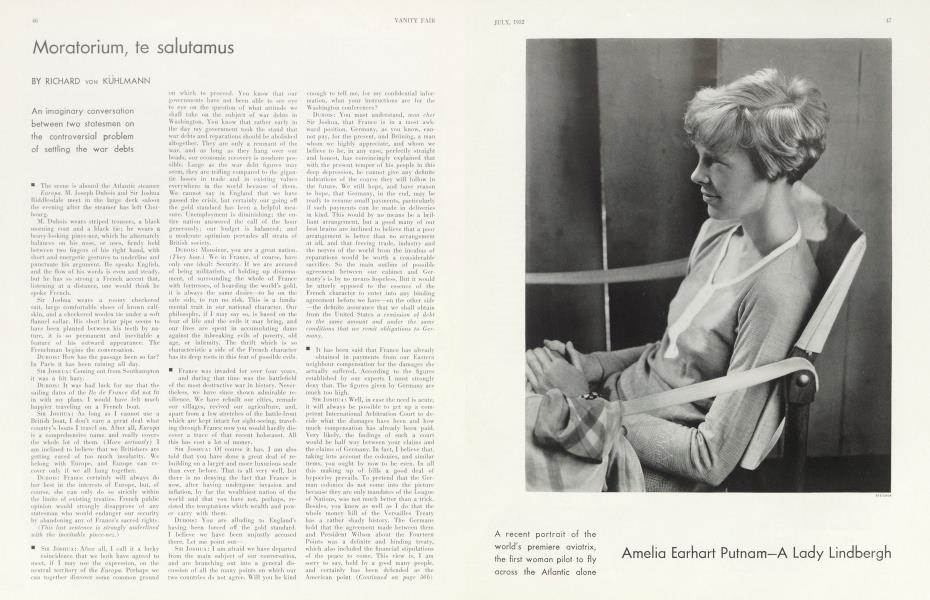
Sign In Not a Subscriber?Join NowMoratorium, te salutamus
RICHARD VON KÜHLMANN
An imaginary conversation between two statesmen on the controversial problem of settling the war debts
The scene is aboard the Atlantic steamer Europa. M. Joseph Dubois and Sir Joshua
Riddlesdale meet in the large deck saloon the evening after the steamer has left Cherbourg.
M. Dubois wears striped trousers, a black morning coat and a black tie; he wears a heavy-looking pince-nez, which he alternately balances on his nose, or uses, firmly held between two fingers of his right hand, with short and energetic gestures to underline and punctuate his argument. He speaks English, and the flow of his words is even and steady, but he has so strong a French accent that, listening at a distance, one would think he spoke French.
Sir Joshua wears a roomy checkered suit, large comfortable shoes of brown calfskin, and a checkered woolen tie under a soft flannel collar. His short briar pipe seems to have been planted between his teeth by nature, it is so permanent and inevitable a feature of his outward appearance. The Frenchman begins the conversation.
DUBOIS: HOW has the passage been so far? In Paris it has been raining all day.
SIR JOSHUA: Coming out from Southampton it was a bit hazy.
DUBOIS: It was bad luck for me that the sailing dates of the Ile de France did not fit in with my plans. I would have felt much happier traveling on a French boat.
SIR JOSHUA: AS long as I cannot use a British boat, I don't care a great deal what country's boats I travel on. After all, Europa is a comprehensive name and really covers the whole lot of them. (More seriously) I am inclined to believe that we Britishers are getting cured of too much insularity. We belong with Europe, and Europe can recover only if we all hang together.
DUBOIS: France certainly will always do her best in the interests of Europe, but, of course, she can only do so strictly within the limits of existing treaties. French public opinion would strongly disapprove of any statesman who would endanger our security by abandoning any of France's sacred rights.
(This last sentence is strongly underlined with the inevitable pince-nez.)
SIR JOSHUA: After all, I call it a lucky coincidence that we both have agreed to meet, if I may use the expression, on the neutral territory of the Europa. Perhaps we can together discover some common ground on which to proceed. You know that our governments have not been able to see eye to eye on the question of what attitude we shall take on the subject of war debts in Washington. You know that rather early in the day my government took the stand that war debts and reparations should be abolished altogether. They are only a remnant of the war, and as long as they hang over our heads, our economic recovery is nowhere possible. Large as the war debt figures may seem, they are trifling compared to the gigantic losses in trade and in existing values everywhere in the world because of them. We cannot say in England that we have passed the crisis, but certainly our going off the gold standard has been a helpful measure. Unemployment is diminishing; the entire nation answered the call of the hour generously; our budget is balanced; and a moderate optimism pervades all strata of British society.
DUBOIS: Monsieur, you are a great nation. (They bow.) We in France, of course, have only one ideal: Security. If we are accused of being militarists, of holding up disarmament, of surrounding the whole of France with fortresses, of hoarding the world's gold, it is always the same desire—to be on the safe side, to run no risk. This is a fundamental trait in our national character. Our philosophy, if I may say so, is based on the fear of life and the evils it may bring, and our lives are spent in accumulating dams against the inbreaking evils of poverty, old age, or infirmity. The thrift which is so characteristic a side of the French character has its deep roots in this fear of possible evils.
France was invaded for over four years, and during that time was the battlefield of the most destructive war in history. Nevertheless, we have since shown admirable resilience. We have rebuilt our cities, remade our villages, revived our agriculture, and, apart from a few stretches of the battle-front which are kept intact for sight-seeing, traveling through France now you would hardly discover a trace of that recent holocaust. All this has cost a lot of money.
SIR JOSHUA: Of course it has. I am also told that you have done a great deal of rebuilding on a larger and more luxurious scale than ever before. That is all very well, but there is no denying the fact that France is now, after having undergone invasion and inflation, by far the wealthiest nation of the world and that you have not, perhaps, resisted the temptations which wealth and power carry with them.
DUBOIS: YOU are alluding to England's having been forced off the gold standard. I believe we have been unjustly accused there. Let me point out—
SIR JOSHUA: I am afraid we have departed from the main subject of our conversation, and are branching out into a general discussion of all the many points on which our two countries do not agree. Will you be kind enough to tell me, for my confidential information, what your instructions are for the Washington conferences?
DUBOIS: YOU must understand, mon cher Sir Joshua, that France is in a most awkward position. Germany, as you know, cannot pay, for the present, and Brüning, a man whom we highly appreciate, and whom we believe to be, in any case, perfectly straight and honest, has convincingly explained that with the present temper of his people in this deep depression, he cannot give any definite indications of the course they will follow in the future. We still hope, and have reason to hope, that Germany, in the end, may be ready to resume small payments, particularly if such payments can be made in deliveries in kind. This would by no means be a brilliant arrangement, but a good many of our best brains are inclined to believe that a poor arrangement is better than no arrangement at all, and that freeing trade, industry and the nerves of the world from the incubus of reparations. would be worth a considerable sacrifice. So the main outline of possible agreement between our cabinet and Germany's is by no means hopeless. But it would be utterly opposed to the essence of the French character to enter into any binding agreement before we have—on the other side —the definite assurance that we shall obtain from the United States a remission of debt to the same amount and under the same conditions that we remit obligations to Germany.
It has been said that France has already obtained in payments from our Eastern neighbour compensation for the damages she actually suffered. According to the figures established by our experts I must strongly deny that. The figures given by Germany are much too high.
SIR JOSHUA: Well, in case the need is acute, it will always be possible to get up a competent International Arbitration Court to decide what the damages have been and how much compensation has already been paid. Very likely, the findings of such a court would be half way between your claims and the claims of Germany. In fact, I believe that, taking into account the colonies, and similar items, you ought by now to be even. In all this making up of bills a good deal of hypocrisy prevails. To pretend that the German colonies do not come into the picture because they are only mandates of the League of Nations, was not much better than a trick. Besides, you know as well as I do that the whole money bill of the Versailles Treaty has a rather shady history. The Germans hold that the agreement made between them and President Wilson about the Fourteen Points was a definite and binding treaty, which also included the financial stipulations of the peace to come. This view is, I am sorry to say, held by a good many people, and certainly has been defended as the American point of view right through the discussions leading to the Versailles Treaty. From the English point of view it would he most undesirable to have this whole business raked up again. I fear that if an Arbitration Court were to decide the respective values of French claims and German counter-claims, it would he difficult to bar the discussion of that unsavory point. Bygones are bygones, and the quicker the books are closed, the better for us and for the whole world.
Continued on page 56b
Continued from page 46
DUBOIS:Helas, helas, I am sorry to see how far you British have traveled away from what we used to call "The true Entente Spirit". All our efforts to get from Washington definite piomises or undertakings concerning war debts have been futile. Please tell me what your latest information is.
SIR JOSHUA: Our point of view has been stated often enough, officially and semi-officially. We are all for abolishing war debts and reparations together, but have not been able to get from Washington anything that looks like a promise, or undertaking, that whatever we should give up in Europe would be met with fair compensation over there.
DUBOIS: There can be little doubt that President Hoover himself contemplated something of the sort when he issued the appeal for his moratorium. But his initiative has met with such a wave of opposition from Congress and public opinion that he could not proceed without seriously imperiling his chances for re-election or risking as serious a reversal of American foreign policy as the rejection of the Treaty of Versailles. He had to trim his sails to the stiff wind of public opinion. This has, I am afraid, put the whole matter of war debts in the category of frozen assets. No doubt the conviction is gaining ground that, whatever may happen, war debts cannot be collected. Many people of considerable weight in politics have come out into the open with statements favouring complete abolition. For instance, a man of the personal prestige of A1 Smith has proposed a long moratorium of twenty years, with provision for a redemption of debts by a premium on exports from America.
SIR JOSHUA: My dear M. Dubois, your idea seems to me almost too ingenious to come true, and would only become operative if anything resembling Mr. Smith's proposal proves to be acceptable to the American authorities and to the Middle West. So far, we have no guaranty that anything of this sort will happen, and we will be wise not to gamble on it.
DUBOIS: What is now the definite stand of your government? Are you going to default, or not? The question is quite fair, because we all know that Germany's budget provides for no payments on reparation account. It is therefore certain that neither you nor we shall get a penny on reparations this year. Will you take this as an excuse for not paying war debts? France is unable to pay. She received nothing from Germany; her budget shows a large deficit; and the balance of trade continues to be against us. We, on our side, are determined to explain the situation in Washington, and intimate that France cannot pay.
SIR JOSHUA: Our budget has been balanced at a terrific effort, but how far we could find reserves for payments to the United States, with no German payments forthcoming, is even more than doubtful. My government still hesitates before default pure and simple, and the most important part of my mission is to go over the ground again trying to discover whether we cannot find another way more in line with our wishes and with English traditions. Perhaps the Lausanne Conference will help us find some way of reconciling default with the maintenance of the principle of the sanctity of contracts.
DUBOIS: Well, tnon cher, my plan is as follows: I will inform the United States that we have tentatively come to an agreement by which Germany will get financial assistance from France, spread over a period of, say, twenty years, and will resume modest reparation payments only through deliveries in kind. France is ready to accept the proposal, provided the United States will protect France, for the same period, from capital payments and from interest payments. Interest payments are to be covered by American exports to France and countries having special agreements with her. The whole responsibility will rest with Washington. We will have fulfilled all that could reasonably be expected in negotiating this tentative agreement which would free the Franco-German relations once and for all from this incubus. But nobody can expect France to bleed her country to death for obligations entered into with America under entirely different circumstances. 1 am sorry to say, should we find Washington utterly disinclined to agree to any such proposal, we would have to declare simply that for the time being we are unable to pay. It would, in effect, amount to a prolongation of the Hoover moratorium through a one-sided declaration of the debtor nations.
SIR JOSHUA: Well, I wish you luck, and shall watch with great interest the progress of your efforts. If you succeed, my mission will be easy, because your success would involve tacit agreement that what we remit to Germany should be remitted to us . . . {He sighs.) . . . They tell me that around Camp Rapidan there is fairly good trout-fishing. While you try your scheme, I shall, I hope, enjoy a few days' rest there.
DUBOIS: Fishing in troubled waters is magnificent sport, but I am sorry to say there will be no rest for me. We have many points to discuss with America. The French quota in trade seems to give offense, and they even speak of retaliation. The constant flow of American gold to France is also arousing considerable feeling.
SIR JOSHUA: My dear M. Dubois, it is about dinner time, and I have secured a table for two in the restaurant upstairs. The Atlantic Ocean, at least, is not in the category of troubled waters at present, and if you don't mind, we shall have a good bottle of champagne, which is another thing we won't be able to get in America, and talk of more amusing subjects than War Debts and Reparations.
Subscribers have complete access to the archive.
Sign In Not a Subscriber?Join Now
