
Sign In to Your Account
Subscribers have complete access to the archive.
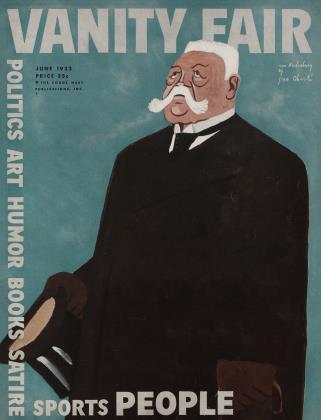
Sign In Not a Subscriber?Join NowHindenburg of Germany
RICHARD VON KÜHLMANN
(EDITOR'S NOTH: Doctor Richard von Kiihlmann was Germany's Foreign Minister during the closing years of the World War.,1
I stood at my window on the Wilhelmstrasse in Berlin facing the fine Eighteenth Century palace which was now the residence of the German President. On the roof opposite, the yellow flag with the black eagle—ensign of the President which so closely resembles the old imperial standard —whipped across the air in a lively breeze. Suddenly it was lowered. I knew what that meant. All day I had been watching for that unhappy signal. Friedrich Ebert, the German Republic's first President, was dead . . .
The night was dark, the Wilhelmstrasse was lined with soldiers; in the black silence one heard the muffled murmur of thousands who had gathered in the street about the palace to see their dead President pass by. It was their President, one of their very own, a man who had worked with his hands, who had kept wartime vigils with them, who had suffered in prison fighting for the workman, who had risen as the leader of the workman's party, swept at last into power by the floods of revolution after the army and the throne had collapsed, lie was gone. One felt in the air the anxiety of that dark, anonymous crowd. What would be Germany's future?
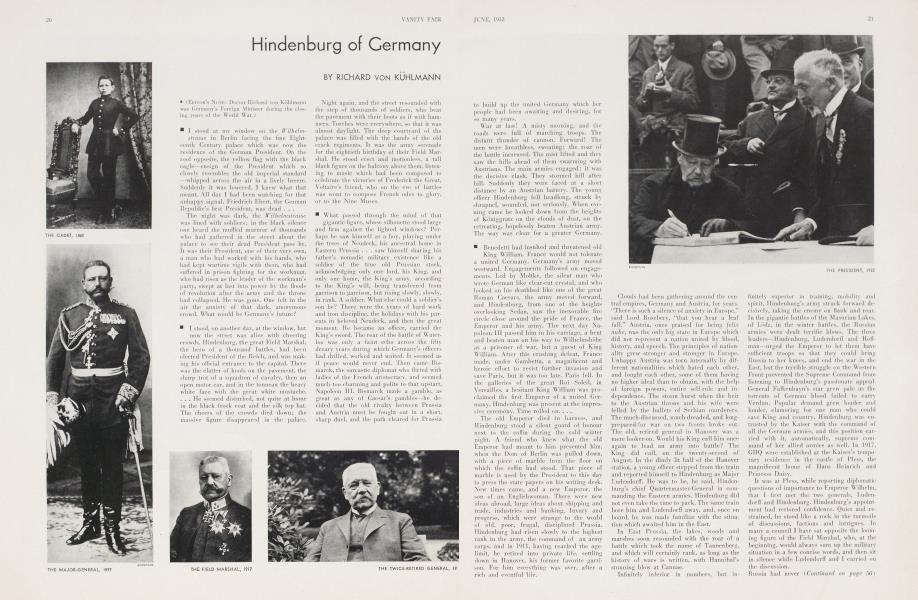
■ I stood, on another day, at the window, but now the street was alive with cheering crowds. Hindenburg, the great Field Marshal, the hero of a thousand battles, bad been elected President of the Reich, and was making his official entrance to the capital. There was the clatter of hoofs on the pavement, the sharp trot of a squadron of cavalry, then an open motor car, and in the tonneau the heavy white face with the great white mustache. . . . He seemed disturbed, not quite at home in the black frock coat and the silk top hat. The cheers of the crowds died down; the massive figure disappeared in the palace. Night again, and the street resounded with the step of thousands of soldiers, who beat the pavement with their boots as if with hammers. Torches were everywhere, so that it was almost daylight. The deep courtyard of the palace was filled with the bands of the old crack regiments. It wras the army serenade for the eightieth birthday of their Field Marshal. He stood erect and motionless, a tall black figure on the balcony above them, listening to music which had been composed to celebrate the victories of Frederick the Great, Voltaire's friend, who on the eve of battles was wont to compose French odes to glory, or to the Nine Muses.
What passed through the mind of that gigantic figure, whose silhouette stood large and firm against the lighted windows? Perhaps he saw himself as a boy, playing under the trees of Neudeck, his ancestral home in Eastern Prussia . . . saw himself sharing his father's nomadic military existence like a soldier of the true old Prussian stock, acknowledging only one lord, his King, and only one home, the King's army, according to the King's will, being transferred from garrison to garrison, but rising slowly, slowly, in rank. A soldier. What else could a soldier's son be? There were the years of hard work and iron discipline, the holidays with his parents in beloved Neudeck, and then the great moment. He became an officer, carried the King's sword. The roar of the battle of Waterloo was only a faint echo across the fifty dreary years during which Germany's officers had drilled, worked and waited. It seemed as if peace would never end. Then came Bismarck, the sarcastic diplomat who flirted with ladies of the French aristocracy, and seemed much too charming and polite to that upstart, Napoleon III. Bismarck made a gamble, as great as any of Caesar's gambles—he decided that the old rivalry between Prussia and Austria must be fought out in a short, sharp duel, and the path cleared for Prussia to build up the united Germany •which her people had been awaiting and desiring, for so many years.
War at last! A misty morning, and the roads were full of marching troops. The distant thunder of cannon. Forward! The men were breathless, sweating; the roar of the battle increased. The mist lifted and they saw the hills ahead of them swarming with Austrians. The main armies engaged; it was the decisive clash. They stormed hill after hill. Suddenly they were faced at a short distance by an Austrian battery. The young officer Hindenburg fell headlong, struck by shrapnel, wounded, not seriously. When evening came he looked down from the heights of Koniggratz on the clouds of dust, on the retreating, hopelessly beaten Austrian army. The way was clear for a greater Germany.
Benedetti had insulted and threatened old King William. France would not tolerate a united Germany. Germany's army moved westward. Engagements followed on engagements. Led by Moltke, the silent man who wrote German like clear-cut crystal, and who looked on his deathbed like one of the great Roman Caesars, the army moved forward, and Hindenburg, from one of the heights overlooking Sedan, saw the inexorable fire circle close around the pride of France, the Emperor and his army. The next day Napoleon III passed him in his carriage, a bent and beaten man on his way to Wilhelmshohe as a prisoner of war, but a guest of King William. After this crushing defeat, France made, under Gambetta, a magnificent and heroic effort to resist further invasion and save Paris, but it was too late. Paris fell. In the galleries of the great Roi Soleil, in Versailles, a hesitant King William was proclaimed the first Emperor of a united Germany. Hindenburg was present at the impressive ceremony. Time rolled on. . . .
The old Emperor died in harness, and Hindenburg stood a silent guard of honour next to the coffin during the cold winter night. A friend who knew what the old Emperor had meant to him presented him, when the Dom of Berlin was pulled down, with a piece of marble from the floor on which the coffin had stood. That piece of marble is used by the President to this day to press the state papers on his writing desk. New times came, and a new Emperor, the son of an Englishwoman. There were new ideas abroad, large ideas about shipping and trade, industries and banking, luxury and progress, which were strange to the world of old, poor, frugal, disciplined Prussia. Hindenburg had risen slowly to the highest rank in the army, the command of an army corps, and in 1911, having reached the agelimit, he retired into private life, settling down in Hanover, his former favorite garrison. For him everything was over, after a rich and eventful life.
Clouds had been gathering around the central empires, Germany and Austria, for years. "There is such a silence of anxiety in Europe," said Lord Rosebery, "that you hear a leaf fall." Austria, once praised for being felix nube, was the only big state in Europe which did not represent a nation united by blood, history, and speech. The principles of nationality grew stronger and stronger in Europe. Unhappy Austria was torn internally by different nationalities which hated each other, and fought each other, some of them having no higher ideal than to obtain, with the help of foreign powers, entire self-rule and independence. The storm burst when the heir to the Austrian throne and his wife were felled by the bullets of Serbian murderers. The much-discussed, much-dreaded, and long-prepared-for war on two fronts broke out. The old, retired general in Hanover was a mere looker-on. Would his King call him once again to lead an army into battle? The King did call, on the twenty-second of August. In the dimly lit hall of the Hanover station, a young officer stepped from the train and reported himself to Hindenburg as Major Ludendorff. He was to be, he said, Hindenburg's chief Quartermaster-General in commanding the Eastern armies. Hindenburg did not even take the time to pack. The same train bore him and Ludendorff away, and, once on board, he was made familiar with the situation which awaited him in the East.
In East Prussia, the lakes, woods and marshes soon resounded with the roar of a battle which took the name of Tannenberg, and which will certainly rank, as long as the history of wars is written, with Hannibal's stunning blow at Cannae.
Infinitely inferior in numbers, but infinitely superior in training, mobility and spirit, Hindenburg's array struck forward decisively, taking the enemy on flank and rear. In the gigantic battles of the Masurian Lakes, of Lodz, in the winter battles, the Russian armies were dealt terrific blows. The three leaders—Hindenburg, Ludendorff and HofTman—urged the Emperor to let them have sufficient troops so that they could bring Russia to her knees, and end the war in the East, but the terrible struggle on the Western Front prevented the Supreme Command from listening to Hindenburg's passionate appeal. General Falkenhayn's star grew pale as the torrents of German blood failed to carry Verdun. Popular demand grew louder and louder, clamoring for one man who could save King and country. Hindenburg was entrusted by the Kaiser with the command of all the German armies, and this position carried with it, automatically, supreme command of her allied armies as well. In 1917, GIIQ were established at the Kaiser's temporary residence in the castle of Pless, the magnificent home of Hans Heinrich and Princess Daisy.
It was at Pless, while reporting diplomatic questions of importance to Emperor Wilhelm, that I first met the two generals, Ludendorff and Hindenburg. Hindenburg's appointment had restored confidence. Quiet and restrained, he stood like a rock in the turmoils of discussions, factions and intrigues. In many a council I have sat opposite the looming figure of the Field Marshal, who, at the beginning, would always sum up the military situation in a few concise words, and then sit in silence while Ludendorff and I carried on the discussion.
Russia had never recovered from the deadly blows which the great Hindenburg campaign and the battle of Gorlitz had inflicted. The prestige of Tsardom had been seriously weakened by defeat in the East. Suddenly the glittering structure of Imperial Russia crashed to the ground. I was able to negotiate and sign the peace of Brest-Litovsk and the peace of Bucharest, thus bringing to a close the war on the Eastern Front. This allowed the Supreme Command to concentrate all its forces in the West for the titan battles of the Spring of 1918. The Kaiser's army fought as well as ever, but, heavily outnumbered by a welltrained, well-fed and well-equipped enemy, suffering cruelly from the effect of the strangling British blockade, it could not replace those whom bullets and sickness tore out of the ranks. It became obvious that all hope of decisive victory had vanished. The suffering of the starving population at home became unbearable. The structure tottered. The Supreme Command of the army was compelled to propose to the Emperor and to the German people that circumstances demanded a speedy diplomatic move for peace, and the wave of revolution no longer found resistance among the despairing population. In Wilhelm II's headquarters, the pretty villa on the slopes of charming woods in Spa, the unanimous advice of all those present was that the Kaiser retreat into Holland. It was here that for the last time the Field Marshal saw his King and Emperor, before he went into exile in Doom. Before leaving, the Emperor entrusted the Field Marshal with the task of leading home and disbanding the proudest army that Germany had ever seen. Steady, efficient, in constant close touch with the powers of revolution which then were supreme in Germany, he fulfilled the task of demobilizing his army. Then he retired to Hanover, where in the Summer of 1919 he wrote bis memoirs.
Continued on page 56
Continued from page 21
Continued on page 64
Continued from page 56
Revolution had ebbed. Ebert, the workman's son, was dead. The old conservative forces in Prussia decided that they would resume the struggle for power, which revolution had wrung from them. Tirpitz, the admiral who had been the secret power behind the throne of Wilhelm II, appeared in Hanover and offered the old Field Marshal the Presidential nomination in the name of the united conservative forces of Germany. The call of duty again. The German people still had confidence in their great leader; he was elected to preside over the gigantic efforts Germany would have to make to rise from ashes and destruction.
The task was a terrifically hard one. Hindenburg had sworn to God and his people that he would use the power of his exalted office strictly according to the Weimar Constitution. That meant he must be scrupulously constitutional. His own sentiment often pointed in a direction which differed from the one that strict parliamentary regime forced upon him. Those to whom he was primarily indebted for his election tried again and again to use the power and prestige of his personality for party ends. Vague schemes of dictatorship, of suppressing the paramount influence of the majority vote, were constantly dangled before his eyes. He had only one guiding star —loyalty to his electoral vows.
April, 1932 .... His term was up. A new Presidential election approached. Again the call to duty. Two and one-half million Germans appealed to him to stand. It was the hardest decision of his long life, because those who stood against him, who denied him, were his friends, his relatives, those with whom common blood and common creed had united him right through eighty years of victory, of glory and of defeat. In a proclamation of manly simplicity the old lion consented to stand again and to do his duty to the end. . . . The world at large hailed his re-election as a guaranty of German stability.
Paul von Hindenburg, when eleven years old, wrote his last will, which concludes, "I want always to have absolute peace and quiet. . . ."
Subscribers have complete access to the archive.
Sign In Not a Subscriber?Join Now


