




Sign In to Your Account
Subscribers have complete access to the archive.
Sign In Not a Subscriber?Join NowSmiles on the faces of tigers
CHARLES FITZHUGH TALMAN
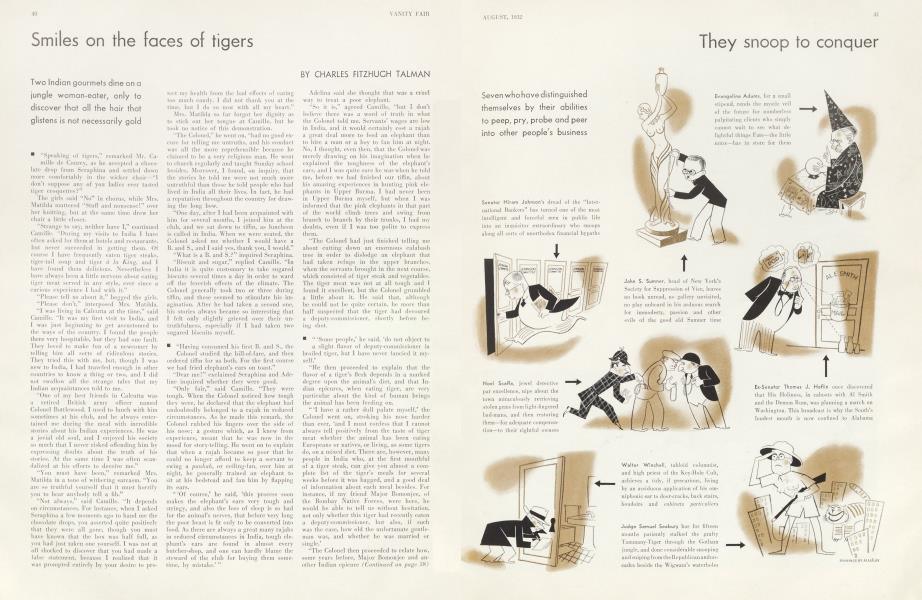
Two Indian gourmets dine on a jungle woman-eater, only to discover that all the hair that glistens is not necessarily gold
"Speaking of tigers," remarked Mr. Camille de Courcy, as he accepted a chocolate drop from Seraphina and settled down more comfortably in the wicker chair—"I don't suppose any of you ladies ever tasted tiger croquettes?"
The girls said "No" in chorus, while Mrs. Matilda muttered "Stuff and nonsense!" over her knitting, but at the same time drew her chair a little closer.
"Strange to say, neither have I," continued Camille. "During my visits to India I have often asked for them at hotels and restaurants, but never succeeded in getting them. Of course I have frequently eaten tiger steaks, tiger-tail soup and tiger a la King, and I have found them delicious. Nevertheless I have always been a little nervous about eating tiger meat served in any style, ever since a curious experience I had with it."
"Please tell us about it," begged the girls.
"Please don't," interposed Mrs. Matilda.
"I was living in Calcutta at the time," said Camille. "It was my first visit to India, and I was just beginning to get accustomed to the ways of the country. I found the people there very hospitable, but they had one fault. They loved to make fun of a newcomer by telling him all sorts of ridiculous stories. They tried this with me, but, though I was new to India, I had traveled enough in other countries to know a thing or two, and I did not swallow all the strange tales that my Indian acquaintances told to me.
"One of my best friends in Calcutta was a retired British army officer named Colonel Bottlewood. I used to lunch with him sometimes at his club, and he always entertained me during the meal with incredible stories about his Indian experiences. He was a jovial old soul, and I enjoyed his society so much that I never risked offending him by expressing doubts about the truth of his stories. At the same time I was often scandalized at his efforts to deceive me."
"You must have been," remarked Mrs. Matilda in a tone of withering sarcasm. "You are so truthful yourself that it must horrify you to hear anybody tell a fib."
"Not always," said Camille. "It depends on circumstances. For instance, when I asked Seraphina a few moments ago to hand me the chocolate drops, you asserted quite positively that they were all gone, though you must have known that the box was half full, as you had just taken one yourself. I was not at all shocked to discover that you had made a false statement, because I realized that it was prompted entirely by your desire to protect my health from the bad effects of eating too much candy. I did not thank you at the time, but I do so now with all my heart."
Mrs. Matilda so far forgot her dignity as to stick out her tongue at Camille, but he took no notice of this demonstration.
"The Colonel," he went on, "had no good excuse for telling me untruths, and his conduct was all the more reprehensible because he claimed to be a very religious man. He went to church regularly and taught Sunday school besides. Moreover, I found, on inquiry, that the stories he told me were not much more untruthful than those he told people who had lived in India all their lives. In fact, he had a reputation throughout the country for drawing the long bow.
"One day, after I had been acquainted with him for several months, I joined him at the club, and we sat down to tiffin, as luncheon is called in India. When we were seated, the Colonel asked me whether I would have a B. and S., and I said yes, thank you, I would."
"What is a B. and S.?" inquired Seraphina.
"Biscuit and sugar," replied Camille. "In India it is quite customary to take sugared biscuits several times a day in order to ward off the feverish effects of the climate. The Colonel generally took two or three during tiffin, and these seemed to stimulate his imagination. After he had taken a second one, his stories always became so interesting that I felt only slightly grieved over their untruthfulness, especially if I had taken two sugared biscuits myself.
• "Having consumed his first B. and S., the Colonel studied tl\e bill-of-fare, and then ordered tiffin for us both. For the first course we had fried elephant's ears on toast."
"Dear me!" exclaimed Seraphina and Adeline inquired whether they were good.
"Only fair," said Camille. "They were tough. When the Colonel noticed how tough they were, he declared that the elephant had undoubtedly belonged to a rajah in reduced circumstances. As he made this remark, the Colonel rubbed his fingers over the side of his nose; a gesture which, as I knew from experience, meant that he was now in the mood for story-telling. He went on to explain that when a rajah became so poor that he could no longer afford to keep a servant to swing a punkah, or ceiling-fan, over him at night, he generally trained an elephant to sit at his bedstead and fan him by flapping its ears.
" 'Of course,' he said, 'this process soon makes the elephant's ears very tough and stringy, and also the loss of sleep is so bad for the animal's nerves, that before very long the poor beast is fit only to be converted into food. As there are always a great many rajahs in reduced circumstances in India, tough elephant's ears are found in almost every butcher-shop, and one can hardly blame the steward of the club for buying them sometime, by mistake.' "
Adelina said she thought that was a cruel way to treat a poor elephant.
"So it is," agreed Camille, "but I don't believe there was a word of truth in what the Colonel told me. Servants' wages are low in India, and it would certainly cost a rajah a great deal more to feed an elephant than to hire a man or a boy to fan him at night. No, I thought, even then, that the Colonel was merely drawing on his imagination when he explained the toughness of the elephant's ears, and I was quite sure he was when he told me, before we had finished our tiffin, about his amazing experiences in hunting pink elephants in Upper Burma. I had never been in Upper Burma myself, but when I was informed that the pink elephants in that part of the world climb trees and swing from branch to branch by their trunks, I had my doubts, even if I was too polite to express them.
"The Colonel had just finished telling me about cutting down an enormous calabash tree in order to dislodge an elephant that had taken refuge in the upper branches, when the servants brought in the next course, which consisted of tiger steak and vegetables. The tiger meat was not at all tough and I found it excellent, but the Colonel grumbled a little about it. He said that, although he could not be quite certain, he more than half suspected that the tiger had devoured a deputy-commissioner, shortly before being shot.
" 'Some people,' he said, 'do not object to a slight flavor of deputy-commissioner in broiled tiger, but I have never fancied it myself.'
"He then proceeded to explain that the flavor of a tiger's flesh depends in a marked degree upon the animal's diet, and that Indian epicures, when eating tiger, are very particular about the kind of human beings the animal has been feeding on.
" 'I have a rather dull palate myself,' the Colonel went on, stroking his nose harder than ever, 'and I must confess that I cannot always tell positively from the taste of tiger meat whether the animal has been eating Europeans or natives, or living, as some tigers do, on a mixed diet. There are, however, many people in India who, at the first mouthful of a tiger steak, can give you almost a complete list of the tiger's meals for several weeks before it was bagged, and a good deal of information about each meal besides. For instance, if my friend Major Bomonjee, of the Bombay Native Forces, were here, he would be able to tell us without hesitation, not only whether this tiger had recently eaten a deputy-commissioner, but also, if such was the case, how old the unfortunate gentleman was, and whether he was married or single.'
"The Colonel then proceeded to relate how, some years before, Major Bomonjee and another Indian epicure had both fallen in love with a lady in Bombay who was celebrated for her beautiful hair and her matchless complexion. The Major had been especially attracted by her hair and the other epicure, whose name was Jeejeebhoy, by her complexion, and they bad frequent disputes as to which of these two features was the more charming.
(Continued on page 58)
(Continued from page 40)
"One day they were dining together, when a particularly juicy tiger steak was set before them. The Major was the first to taste it. As he held a piece on his fork, and even before he had put it into his mouth, he detected a certain aroma about it that caused him to turn pale. When he had swallowed his first mouthful he groaned. Jeejeebhoy then took a bite of the meat, and he groaned too. They exchanged glances, and exclaimed 'Dora!' at the same time.
"Dora was the name of the lady who had the beautiful hair and the matchless complexion. She had gone for a stroll the day before in a neighboring jungle and had never returned, but her two lovers knew nothing of her disappearance until the flavor of the tiger steak revealed to them the dreadful fate that had overtaken her. They were quite overcome with grief to discover that they were partaking of the very tiger who had partaken of Dora. It was almost like eating Dora herself.
"Of course the two gentlemen had often devoured her with their eyes; they had probably told her, on occasions, that she looked good enough Jo eat; and they had certainly often complimented her on her excellent taste. But they were now viewing her charms from an entirely new angle, so to speak. It was this unique experience which presently led them to two startling discoveries.
"The first one was made by the Major. He had been eating his tiger meat in sorrowful silence when suddenly he laid down his knife and fork, bestowed a triumphant look upon his companion, and exclaimed, 'Jeejeebhoy, you're a gazoot!' Jeejeebhoy pretended not to understand what the Major was driving at, hut there was a sheepish expression on his face, and he had to confess that he was a gazoot when the Major declared, in the most positive terms, that Dora's famous complexion had been due entirely to cosmetics. The cosmetical flavor of the tiger's meat was exceedingly faint, hut it was easily detected by the wonderfully acute palates of the two epicures.
"The Major did not crow over his rival long, however. Seized with an idea, Jeejeebhoy selected a bit of the tiger that was somewhat underdone and therefore had not lost much of its original flavor. Placing this in his mouth, he held it there for five minutes, while he tasted with the utmost attention; at the end of which time he swallowed the morsel, sat back in his chair, and gazed gloatingly into the eyes of the Major. 'Bomonjee,' he exclaimed, 'you are another!' By an almost superhuman feat of tasting, he had discovered that Dora's hair, of which the Major had been so much enamoured, was a wig!
"After relating this story, which was, with three or four exceptions, the most incredible I have ever heard in the course of my world-wide travels, the Colonel gave his nose one final stroke, remarked that India is indeed an extraordinary country, and asked me to excuse him as he had to conduct a Bible class at the Y. M. C. A. He then hurried away—and that was the last I ever saw of him.
"A few days later I was much grieved to learn that the Colonel himself had been devoured by a tiger. Almost immediately afterward, the beast was shot by a hunting party, and some steaks and cutlets from it were served up at the same club where I had listened to the Colonel's remarkable narratives. As I happened to be lunching there, I had the sad but interesting experience of eating part of the tiger that had eaten the Colonel.
"I did not notice anything peculiar about the flavor of the meat, but after lunch, while talking with a number of gentlemen in the smoking room, I did something that I have ever since believed was entirely due to the influence of the food I had just eaten, as there does not seem to be any other possible way to account for it. The conversation turned on the subject of snakes. Somebody told a story about an unfortunate boa constrictor that accidentally tied itself in a hard knot and was never able to get untied, and as soon as I heard this improbable tale, a much more remarkable snake story suddenly flashed into my mind.
"Somehow it seemed as if the Colonel had come back to life and was telling it to me. Before I realized what I was doing, I began to relate the story, although there was not a word of truth in it. For the first and last time in my life, I told a deliberate out-and-out falsehood and felt no shame whatever about doing so. While I was telling the story I rubbed my nose so hard that I raised a blister on it, and that is one reason why I have always felt convinced that my untruthfulness on that occasion was the result of eating a small portion of the tiger that had devoured my untruthful friend. Colonel Bottlewood. '
"Wasn't it lucky you didn't eat a large portion?" sneered Mrs. Matilda. "The effects might never have worn off."
"Perhaps so," returned Camille, "but in that case I should have been spared the mortification I felt when they did wear off and I realized how untruthful I had been. I was so much ashamed of the snake story I had told at the club that I afterward looked up all the gentlemen who had beard it and asked them not to believe it. They were kind enough to say they wouldn't, and so, I am glad to say, nobody was deceived by my story.
"The snake in my story mistook its own tail for that of another snake and swallowed itself entirely," said Camille, "but it was an exceptionally absent-minded snake. And besides, as I told you before, my story was not true."
Camille stroked his nose at this point, but it may have been only to brush away a fly.
Subscribers have complete access to the archive.
Sign In Not a Subscriber?Join Now
