Sign In to Your Account
Subscribers have complete access to the archive.
Sign In Not a Subscriber?Join NowTHE EDITOR'S UNEASY CHAIR
Puzzling character
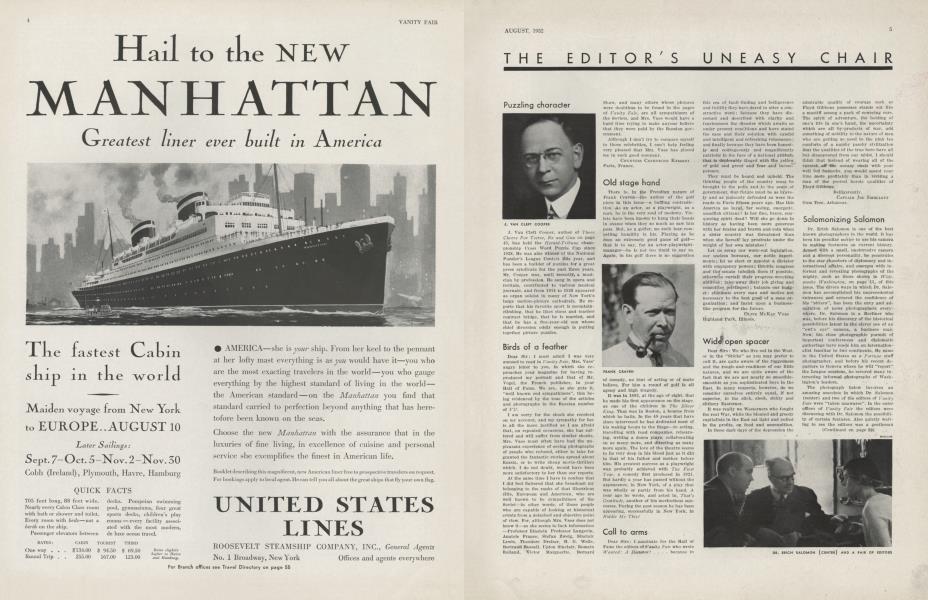
J. Van Cleft Cooper, author of Three Cheers For Tsetse, Ra and Gnu on page 45, has held the Herald-Tribune championship Cross Word Puzzle Cup since 1928. He was also winner of the National Puzzler's League Contest this year, and has been a builder of puzzles for a great press syndicate for the past three years. Mr. Cooper was, until recently, a musician by profession. He sang In opera and recitals, contributed to various musical journals, and from 1914 to 1928 appeared as organ soloist in many of New York's large motion-picture cathedrals. He reports that his favorite sport is mountainclimbing, that he likes chess and teaches contract bridge, that he Is married, and that he has a five-year-old son whose chief diversion oddly enough is putting together picture puzzles.
Birds of a feather
Dear Sir: I must admit I was very amused to read in Vanity Fair, Mrs. Vaes' angry letter to you, in which she reproaches your magazine for having reproduced my portrait and that of Mr. Vogel, the French publisher. In your Hall of Fame. We are, as she puts it, "well known red sympathizers", this being evidenced by the tone of the articles and photographs in the Russian number of VU.
I am sorry for the shock she received on my account, and my sympathy for her is all the more justified as I am afraid that, on repeated occasions, she has suffered and will suffer from similar shocks. Mrs. Vaes must often have had the unpleasant experience of seeing photographs of people who refused, either to take for granted the fantastic stories spread about Russia, or to write cheap movie-thrillers which, I do not doubt, would have been more satisfactory to her than our reports.
At the same time I have to confess that I did feel flattered that she broadcast my belonging to the ranks of that illustrious elite, European and American, who are well known to be sympathizers of the Soviet—in other words, of those people who are capable of looking at historical events from a detached and objective point of view. For, although Mrs. Vaes does not know it—as she seems to lack information —Professor Einstein Professor Langevin, Anatole France, Stefan Zwelg, Sinclair Lewis, Theodore Dreiser, H. G. Wells, Bertrand Russell, Upton Sinclair, Romain Holland. Victor Marguerite, Bernard
Shaw, and many others whose pictures were doubtless to be found in the pages of Vanity Fair, are all sympathizers of the Soviets, and Mrs. Vaes would have a hard time trying to make anyone believe that they were paid by the Russian government.
Although I don't try to compare myself to those celebrities, I can't help feeling very pleased that Mrs. Vaes lias placed me in such good company.
COUNTESS CATHERINE KAKOLYI Paris, France.
Old stage hand
There is. in the Freudtan nature of Frank Craven—the author of the golf piece in this issue—a baffling contradiction. As an actor, as a playwright, as a man, he is the very soul of modesty. Violets have been known to hang their heads in shame when they so much as saw him pass. But, as a golfer, no such tear-compelling humility is his. Playing as he does an extremely good game of golf— that is to say, for an actor-playwrightmanager—he is not too timid to say so. Again, in his golf there is no suggestion
of comedy, no hint of acting or of make believe. For him a round of golf is all agony and high tragedy.
It was in 1883, at the age of eight, that he made his first appearance on the stage, as one of the children in The Silver King. That was in Boston, a bourne from which he hails. In the 49 years that have since intervened he has dedicated most of his waking hours to the Stage—to acting, travelling with road companies, rehearsing. writing a dozen plays, collaborating on as many more, and directing as many more again. The love of the theatre seems to lie very deep in his blood just as it did in that of his father and mother before him. His greatest success as a playwright was probably achieved with The First Year, a comedy first produced in 1921. But hardly a year has passed without the appearance, in New York, of a play that was wholly or partly from his hand. A year ago he wrote, and acted in, That's Gratitude, another of his meritorious successes. During the past season he has been appearing, successfully in New York, in Riddle Me This!
Call to arms
Dear Sirs: I nominate for the Hall of Fame the editors of Vanity Fair who wrote Wanted: A Dictator! .... because in this era of fault-finding and belligerence and futility they have dared to utter a constructive word; because they have discerned and described with clarity and fearlessness the disaster which awaits us under present conditions and have stated the case and their solution with candid and intelligent and refreshing vehemence; and finally because they have been honestly and courageously and magnificently patriotic in the face of a national attitude that is deplorably tinged with the yellow of gold and greed and fear and incompetence.
They must be heard and upheld. The thinking people of the country must be brought to the polls and to the seats of government. Our future must be as bravely and as jealously defended as were the roads to Paris fifteen years ago. Has this America no loyal, far seeing, energetic, unselfish citizens? Is her fine, brave, conquering spirit dead? Will she go down In history as having been more generous with her brains and brawn and coin when a sister country was threatened than when she herself lay prostrate under the weight of her own mistakes?
Let us scrap our worn-out legislation, our useless bureaux, our noble experiments; let us elect or appoint a dictator with emergency powers; throttle congress and the senate (abolish them if possible, otherwise curtail their progress-wrecking abilities; take away their job giving and committee privileges) ; balance our budget; eliminate every man and motive not necessary to the best good of a sane organization ; and Insist upon a businesslike program for the future.
OLIVE MCKAY VYSE Highland Park, Illinois.
Wide open spacer
Dear Sirs: We who live out in the West, or in the "Sticks" as you may prefer to call it. are quite aware of the ruggedness and the rough-and-readiness of our little natures, and we are quite aware of the fact that we are not nearly so smoothiesmoothie as you sophisticated boys in the East. In many respects, however, do we consider ourselves entirely equal. If not superior, to the slick, sleek, sickly and slithery Easterner.
It was really we Westerners who fought the real War, while the bloated and greedy capitalists in the East sat tight and pulled in the profits, on food and ammunition.
In these dark days of tiie depression the admirable quality of courage such as Floyd Gibbons possesses stands out like a mastiff among a pack of cowering curs. The spirit of adventure, the holding of one's life in one's hand, the uncertainty which are all by-products of war, add something of nobility to the nature of men who are getting so used to the pink tea comforts of a namby pamby civilization that the qualities of the true hero have all but disappeared from our midst. I should think that instead of wearing all of the varnish off the uneasy chair with your well fed buttocks, you would spend your time more profitably than in reviling a man of the proved heroic qualities of Floyd Gibbons.
Belligerently.
CAPTAIN JOE SMOLLETT Gum Tree, Arkansas.
Salomonizing Salomon
Dr. Erich Salomon is one of the best known photographers in tiie world. It has been his peculiar metier to use his camera in making footnotes on current history. Armed with a small, unobtrusive camera and a discreet personality, he penetrates to the star chambers of diplomacy and international affairs, and emerges with informal and revealing photographs of tiie mighty, such as those shown in Wideawake Washington, on page 11, of this issue. The divers ways in which Dr. Salomon has accomplished his imprecedented entrances and secured the confidence of his "sitters", has been the envy and admiration of news photographers everywhere. Dr. Salomon is a Berliner who was, before his discovery of the historical possibilities latent in the clever use of an "owl's eye" camera, a business man. Now, his close photographic pursuit of important conferences and diplomatic gatherings have made him an internationalist familiar to two continents. He came to the United States as a Fortune staff photographer, and before his recent departure to Geneva where he will "report" the League sessions, he secured many interesting informal photographs of Washington's leaders.
The photograph below Involves an amusing anecdote in which Dr. Salomon (center) and two of the editors of Vanity Fair were "taken unawares". In the outer offices of Vanity Fair the editors were discussing with Dr. Salomon the possibility of certain features. Also quietly waiting to see the editors was a gentleman who, unobserved, watched them closely. Presently he was gone. . . . The next day the astonished staff received the print of this picture, with a note that Its unknown author was a disciple of Dr. Salomon's who, unexpectedly finding his master, took advantage of the situation to show what he had learned.
(Continued on page 59)
(Continued from page 5)
Happy happy Russia
Mrs. Marjorie Vaes
Madam: In your letter published by Vanity Fair, you state:
1. That I replaced the German word Herr by the French Monsieur. A falsehood.
2. That the ''intellectual expedition" of VU in U. S. S. R. was inspired and paid for by Moscow. Another falsehood.
3. That a million free copies of VU have been distributed. One more falsehood.
My name is, In truth, Vogel (Luclen Antoine Hermann). . . . My grandfather was a Dane from Flensburg and my father became German through the annexation of Schleswig Holstein by Prussia In 1864. He became a German but did not remain so for long, for In 1878 lie chose France as his MotherCountry, and settled there becoming a French citizen in 1892.
As far as my mother is concerned, for she also had something to do with my birth, site was French, a Lorraine from Metz, and bore the good French name of ''Boldin''.
We now come to this famous number (at least it seems it has become famous) of the review founded and directed by me, VU, an issue devoted to an enquiry that I undertook with a certain number of collaborators in U. S. S. R. . . .
Just fancy. Madam, that far from having received money from the Soviets, It is we who have given It to them, because we paid to the Russian tourist organization ''Intourist" to hotels, restaurants and railways of the U. S. S. R. more than 3,500 dollars cash down. Taking into account the trip across Europe and the incidental money spent in the course of this journey, my paper and the members of the group that I formed have put out more than 6.000 dollars. Editorial and travel expenses assumed by VU developing my films and making prints amounted for this special number to 83,968.15 francs.
Yes, will you say, but that does not prevent you from having been financed by the Soviets in the shape of a mass-purchase of copies (one million It seems would have been distributed).
Confronted with such figures, I am rather ashamed to confess that the print order for this number was for 200,000 copies and has not been exceeded. This being so, not a single copy has been distributed free. Each and every one of them has been sold through the medium of Messageries Hachette, apart of course from those sent to our regular subscribers. . . .
As a matter of fact this number of VU was a tremendous success. The total editing cost having amounted to 493,190,10 francs after deduction of general expenses, it left a net profit of 270,774 francs. Very modest figures as you see when compared to the millions you suggest. . . .
Now, see how ignorant I am. I was not aware of the fact that Count and Countess Karolyi had been the heads of our expedition. As a matter of fact my inborn vanity induced me to take this pompous title with its responsibilities for myself as the leader of a host of distinguished collaborators, ail of whom you avoid mentioning. Pierre Lyautey, economist, Marc Chadourne, a talented author. Dr. Leibovici, Surgeon of the Paris hospitals, £111116 Schreiber, director of the periodical Les Echos de I'Exportation, Madame Schreiber. and of course Count Karolyi, a great specialist in agricultural matters, and Countess Karolyi.
You then state that our enquiry "was evidently influenced, partial, and that the admirable photographs (merei cn passant) had evidently been chosen for their radiant Pollyannishness, and that nobody would believe them."
You have certainly not read Knickerbocker's wonderful reportage on the Russia of the Five-Year plan, no more than you know of the regular and clear-headed articles published in the New York Times by their Moscow correspondent Mr. Duranty, or you would not add : "Unfortunately certain credulous souls have not the faintest idea cf what Is actually happening in Russia."
This is one point where I agree with you entirely. That is why, being a good natured soul myself, I have a proposal to make to you in view of your personal enlightenment.
Would you like to make a trip to U.S.S.R. free of charge and be able to denounce me once for all ? If so, I suggest the following:
On the same date as I set out last year, we would both leave for the same journey. We would each pay our own expenses but would deposit In a bank the corresponding amount of money. (You will understand why.)
During tills trip I will take photos only in your presence, be It cn my own initiative or on yours. These films will be developed and proofs pulled in Moscow, then numbered in order to make sure that none will be missing on our arrival in Paris. We will then submit them to the chief editor of Vanity Fair whose verdict I am ready to accept as final.
Should the photos taken In the above mentioned manner differ from those published in the incriminated number of VU, you will be credited with the money deposited by me in the bank and you would be refunded of your travelling expenses. But should the contrary take place, I would have made a magnificent and exciting trip through Russia free of cost. Confess that I will have deserved it. And as I am certain of winning, I am playing a safe game. I wish to add, being a good sport, that apart from the places already visited by me you can choose any other spot that will please you.
You must also admit. Madam, that I am courageous in risking a five weeks tete-atete trip with you; but for the sake of truth, what would I not do? (And I do not even ask to see your photograph beforehand.)
LUCIEN VOGEL
Paris, France.
Chiding Mr. Nathan
Dear Sir:
", . . have something to say for themselves, even if they do not seem to know clearly how to say It."
No matter how much he may know about The Theater does a critic who uses "refocillated" and "incalescent" in one sentence "know clearly how to say it?" Both words are listed as obsolete in a footnote in IVcbster's Unabridged Dictionary. There are. I believe, more than four hundred thousand words in the main body of the dictionary. Can't Mr. Nathan express himself with that vocabulary? Can his readers be expected to have a larger one ? If Vanity Fair's "style" allows the use of obsolete words can it consistently bar obsolete spellings?
C. S. DUNNING
Los Angeles, California
P.S. "Olidous" is the only other word of Mr. Nathan's that Is outside my vocabulary. The same dictionary gives it. also in a footnote, as an obsolete form of "Olid". So it has no more authority than my father's 1870 pronunciation of Roo-shah, or the original Nay-ther, has it ?
The Editors have indicated to Mr. Nathan his piaculous addiction to obsoletion. which appears so idiotistical to Purist Dunning: and Mr. Nathan promises an attempt at reform, as he admits that this is a habit, the only word for which is—pediculous.
Subscribers have complete access to the archive.
Sign In Not a Subscriber?Join Now
