Sign In to Your Account
Subscribers have complete access to the archive.
Sign In Not a Subscriber?Join Now"Recovery" revised
SIR ARTHUR SALTER
The British author of an American bestseller on the Depression points again to possible roads out
I have been asked to say how far subsequent events have modified the opinions I expressed in Recovery, and what changes I should now make in my diagnosis and proposed remedies.
Recovery was published in April, 1932. and it was in fact almost all written in the last months of 1931. It is therefore nearly two years old and these two years have been years of unprecedentedly rapid developments. Inevitably it "dates" in certain respects. All short-term prophecies are necessarily obsolete because they have by this time been either falsified or fulfilled. Changed conditions call for a new judgment on some of the proposals for the future. It is these in particular that I propose now to discuss.
■ There is one preliminary remark, however, that needs to be made. It applies to Recovery and all books that have a similar object. Economics can never be an exact science, and in particular can never possess that mark of an exact science, the power of forecasting future events with certainty and precision, for one simple reason. The course of economic events is frequently determined, to an important extent, by the judgments and actions of a few men, sometimes a single man. This introduces an inescapable element of incalculability. The motives and actions of multitudes may be brought within the scope of a science, for among masses caprices may cancel out. Rut the action of an individual in a key position can only he guessed; it cannot be known. The greatest economic events of this year, the banking crash in the U. S. A. in March, the fall of the dollar from gold in April, the main movements of prices since then, were none of them predictable—in the sense in which an exact science predicts—because they were none of them inevitable.
This remark applies to some, hut of course by no means to all. of the main developments (d the last two years. It is interesting in looking back to discriminate between those which were due to a few acts of individuals, and those which were due to factors outside any single individual's control. It is only in the latter sphere that the economist can do more than guess, and is culpable if he is wrong.
Underneath all the detailed criticisms and proposals in Recovery, there are two main issues. The first is this. Can, and should, the capitalist (or. as I prefer to call it, the "competitive") system be adapted to modern needs and conditions, or must it be replaced by a system which leaves no room for political or economic freedom? The second is equally fundamental. Will, and should, economic activity develop within a world system or in a series of closed national units? It will be well first to comment on these two main issues in the light of later events.
I still believe that it is much better that the capitalistic system should be reformed than that it should be replaced by a completely different system; and I still believe that it is possible so to reform it as to avoid the present waste of our resources and productive capacity and still leave us with the essentials for both political and economic freedom.
I outlined in Recovery the kind of new structure of society which I thought would achieve this purpose. Briefly. I wanted to see the institutions which have grown up under our existing private system extended and adapted so that (encouraged but not in detail directed by the Government) they could, each in its own sphere, correct the abuses and defects which have developed, and. duly co-ordinated, could introduce the measure of general planning of economic effort which is now required. My conception was of "institutional self-government" regulating and directing competitive activities.
I imagined, for example, stock exchange and banking authorities co-operating to discourage speculation on margins with borrowed money in time of booms, issuing houses combining to render certain classes of loans (especially those to foreign governments) impossible except under conditions which would secure that the loans were devoted to productive purposes and the investor safeguarded against avoidable risks, industrialists in the great key industries consulting as to their productive programmes at different stages of the trade cycle and (for example) reducing demand and production at a dangerous stage of a boom by curtailing facilities for instalment purchase and so on. In all this system I conceived of the State as exercising a function of stimulating and co-ordinating rather than compelling or directing in detail.
■ I still believe that a system of this kind represents a practicable transformation of our present capitalist structure, and is indeed the only alternative to chaos or a system incompatible with representative government and economic freedom. But I think I underestimated the extreme difficulty of such a transformation being effected by the spontaneous or willing action of those trained in a competitive society, the time such a process would take except under direct compulsion, and the urgency imposed by present discontents and distresses. Subsequent events have both enforced the need and demonstrated the improbability of such a development without extensive and powerful State action, and at the same time shown the extreme difficulty of securing such State action under representative government functioning in the way to which we have been accustomed. In Great Britain we have been reasonably successful in repairing some of the specific defects in our economic and financial position, but we have done little to transform or even reform that system itself; the same is true of France; and these are perhaps the two best instances of representative government functioning normally. In Germany the representative system has been swept aside, and a dictatorship involving a suppression of freedom has come into power, as already in Italy and in Russia.
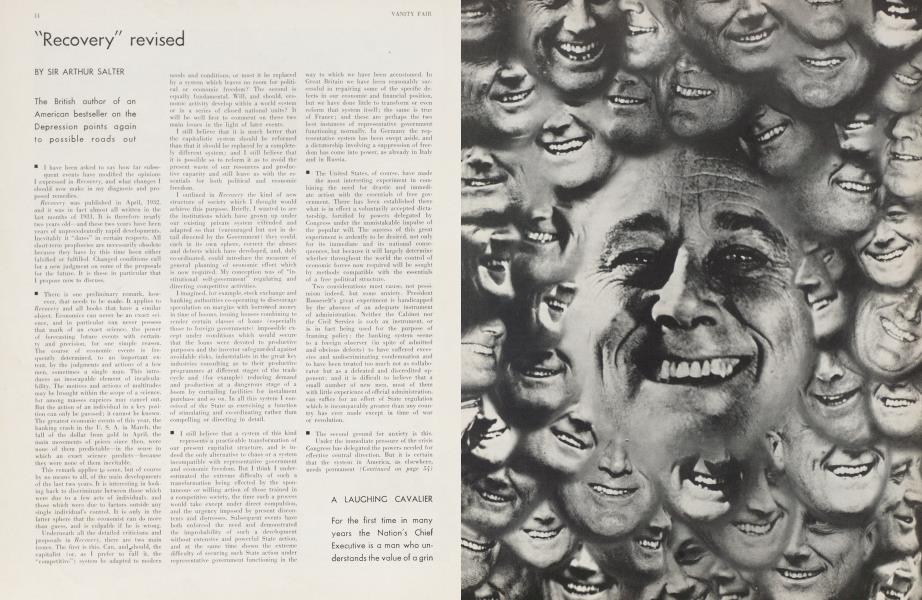
• The United States, of course, have made the most interesting experiment in combining the need for drastic and immediate action with the essentials of free government. There has been established there what is in effect a voluntarily accepted dictatorship. fortified by powers delegated by Congress under the unmistakable impulse of the popular will. The success of this great experiment is ardently to be desired, not only for its immediate and its national consequences, but because it will largely determine whether throughout the world the control of economic forces now required will be sought by methods compatible with the essentials of a free political structure.
Two considerations must cause, not pessimism indeed, but some anxiety. President Roosevelt's great experiment is handicapped by the absence of an adequate instrument of administration. Neither the Cabinet nor the Civil Service is such an instrument, or is in fact being used for the purpose of framing policy; the banking system seems to a foreign observer (in spite of admitted and obvious defects) to have suffered excessive and undiscriminating condemnation and to have been treated too much not as collaborator but as a defeated and discredited opponent; and it is difficult to believe that a small number of new men, most of them with little experience of official administration, can suffice for an effort of State regulation which is incomparably greater than any country has ever made except in time of war or revolution.
■ The second ground for anxiety is this. Under the immediate pressure of the crisis Congress has delegated the powers needed for effective central direction. But it is certain that the system in America, as elsewhere, needs permanent transformation, not merely temporary adaptation to passing needs. Is it likely that, when the immediate crisis is past. Congress will continue to delegate sufficient powers to the Executive for these longer-term reforms? In any case it is certainly a defect in Recovery that it did not sufficiently recognize the need for a drastic change in the methods of free representative government if that government is to be preserved in its essentials. I have tried to do something to fill this now obvious gap in The Framework of an Ordered Society, but the fact is that much more work on this problem is required.
(Continued on page 54)
(Continued from page 14)
The second great underlying issue in Recovery is that of world trade as against economic nationalism. Subsequent events have not changed my views as to the overwhelming advantages of the first, or as to the methods by which I think we should attempt to restore it. But in describing the causes which explain the growth of protectionism, I certainly placed too little emphasis upon the use of tariffs as a counterpart to economic planning (though I did mention it). The need for deliberate planning is more and more obvious. The instrument at once available for such planning is the national government of each country. International government is still in a very elementary, indeed rudimentary, state. International planning is indeed not impossible, but it is extremely difficult, and in these circumstances it has to be recognized that the increasing demand for a planned system makes for economic nationalism.
(Continued on page 61)
(Continued from page 54)
In these circumstances, if I were rewriting Recovery. while I should not change my main thesis, I should add an important passage to my chapter on Commercial Policy. I should take the hypothesis that the world will for some time to come maintain substantially high tariffs which will make their economic activities national to a larger extent than in the pre-war period. And on that hypothesis I should discuss at length upon what conditions such a system could he made as little injurious as possible to regular expansion of productive enterprise.
Let me pass now from the two dominant issues to my more specific proposals. These fall into three categories; proposals first for the immediate crisis, second for the permanent reform of our economic and financial system, third for the improvement of the world's political system.
As regards the first, I proposed immediate "reflation," designed to correct a large part of the fall of prices during the depression. This result was to be secured by a combination of monetary policy, which would include the provision of cheap and abundant money through open-market operationand otherwise, and of economic policy including national development and the expansion of public work. The policy and on the whole the methods proposed have been those since adopted by America, and professed, though only in part pursued, by Great Britain and other countries.
I will not, however, spend any time in recalling where I think I was right, hut will confine myself to saying where I think I was wrong. I did not at the time realize to how great an extent the need for reflation differs in the different countries. The reason for reflation is quite simple. The depression consists in the fact that—owing to numerous causes—prices have fallen below costs over a large range of potential activity, and activity is therefore stopped. This disparity can he theoretically removed by a reduction of costs or by an increase of prices. The extent to which the former is practicable depends greatly on the internal debt structure, which differs greatly in different countries. In a word, the need for "reflation" was greatest in America and least in countries like France and Germany (where large previous inflation had wiped out much internal indebtedness and also left memories and resentments which make renewed inflation specially dangerous) whereas in Great Britain and other countries the "sterling area" occupies an intermediate position.
In these circumstances I think now that the right policy is some reflation everywhere, hut most in the U. S. A., less in Great Britain and the "sterling" countries, and less still in France and the gold countries; and that this difference in monetary policy should he reflected in different exchange ratios for the currencies. This is the most important change I should now make in my proposals for immediate remedies.
As regards permanent reforms, I have already indicated in what respects I think my proposals were seriously defective as regards the reform of government and economic policy. For the rest I think experience has confirmed me in my opinions. The proposals as to the conditions of a return to the gold standard and of its satisfactory working in future are very closely similar to the scheme since advocated by the Preparatory Commission for the World Economic Conference and favourably discussed by the Conference itself. If indeed the dollar is to he permanently a "commodity dollar," the whole scheme would need substantial modification, but until the President's declaration of July 1st there seemed a good prospect of general agreement upon the essential conditions for managing a reformed gold standard so as to maintain a reasonable future stability in the general price level. Subsequent experience has also confirmed me in my other opinions. I would in particular stress my suggestions as to tin* restriction of Stock Exchange speculation.
There remain the suggestions in Recovery for strengthening the machinery for settling international disputes and assuring peace. This in large measure depends on an effective collaboration between the United States and members of the League of Nations. The actual methods and principles of collaboration which have developed during the last two years have been along the lines which I had anticipated and hoped. Unhappily, even with this collaboration, international difficulties have increased more rapidly than the power of the peace machinery to cope with them. My proposals would, however, remain the same. What is needed now is not so much that the peace machinery should be amended as that all the principal countries should sup port and use it with determination.
Some of the prophecies and proposals made in Recovery have, then, been falsified, others fulfilled. Most, how ever, are still neither the one nor the other, and the issue remains uncertain. In their main outline I should not now change either the diagnosis or the scheme of reforms there outlined. But the greater part of the task remains to he done. In this respect I wish that Recovers were more out-of-dale than it is.
Subscribers have complete access to the archive.
Sign In Not a Subscriber?Join Now

