Sign In to Your Account
Subscribers have complete access to the archive.
Sign In Not a Subscriber?Join NowThe inside story
LEONARD McTAGGART
Movie Magazines: the second in a series of articles on the different types of contemporary American magazines
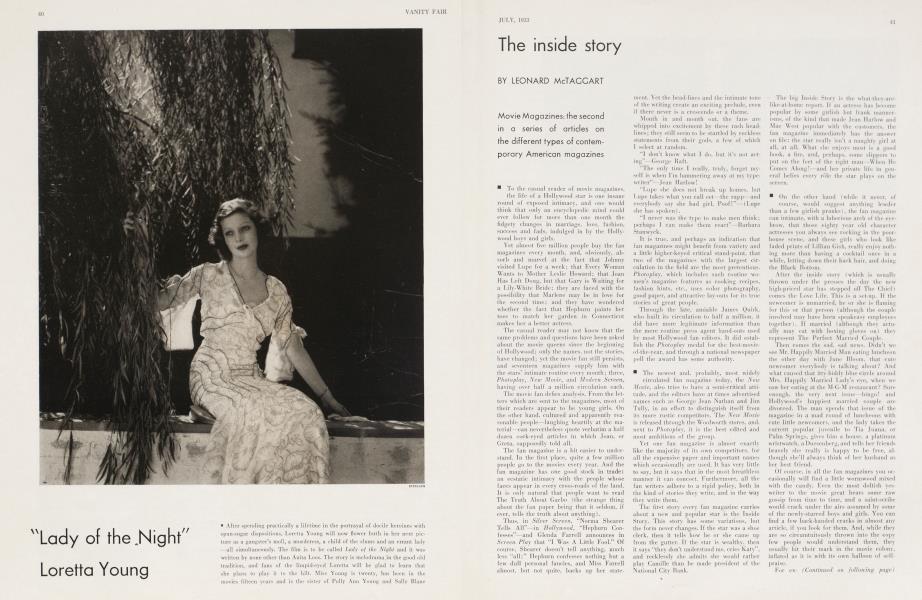
To the casual reader of movie magazines, the life of a Hollywood star is one insane round of exposed intimacy, and one would think that only an encyclopedic mind could ever follow for more than one month the fidgety changes in marriage, love, fashion, success and fads, indulged in by the Hollywood hoys and girls.
Yet almost five million people buy the fan magazines every month, and, obviously, absorb and marvel at the fact that Johnny visited Lupe for a week; that Every Woman Wants to Mother Leslie Howard; that Joan Has Left Doug, but that Gary is Waiting for a Lily-White Bride; they are faced with the possibility that Marlene may be in love for the second time; and they have wondered whether the fact that Hepburn paints her toes to match her garden in Connecticut makes her a better actress.
The casual reader may not know that the same problems and questions have been asked about the movie queens since the beginning of Hollywood; only the names, not the stories, have changed; yet the movie fan still persists, and seventeen magazines supply him with the stars' intimate routine every month; three, Photoplay, New Movie, and Modern Screen, having over half a million circulation each.
The movie fan defies analysis. From the letters which are sent to the magazines, most of their readers appear to be young girls. On the other hand, cultured and apparently reasonable people—laughing heartily at the material—can nevertheless quote verbatim a half dozen cock-eyed articles in which Joan, or Greta, supposedly told all.
The fan magazine is a bit easier to understand. In the first place, quite a few million people go to the movies every year. And the fan magazine has one good stock in trade: an ecstatic intimacy with the people whose faces appear in every cross-roads of the land. It is only natural that people want to read The Truth About Garbo (the strange thing about the fan paper being that it seldom, if ever, tells the truth about anything).
Thus, in Silver Screen, "Norma Shearer Tells All"—in Hollywood, "Hepburn Confesses"-—and Glenda Farrell announces in Screen Play that "I Was A Little Fool." Of course, Shearer doesn't tell anything, much less "all;" Hepburn confesses nothing but a few dull personal fancies, and Miss Farrell almost, but not quite, backs up her statement. Yet the head-lines and the intimate tone of the writing create an exciting prelude, even if there never is a crescendo or a theme.
Month in and month out. the fans are whipped into excitement by these rash headlines; they still seem to be startled by reckless statements from their gods, a few of which I select at random.
"I don't know what I do, but it's not acting"—George Raft.
"The only time I really, truly, forget myself is when I'm hammering away at my typewriter"—Jean Harlow!
"Lupe she does not break up homes, but Lupe takes what you call eet—the rapp—and everybody say she bad girl. Poof!"—(Lupe she has spoken).
"I never was the type to make men think; perhaps I can make them react"—Barbara Stanwyck.
It is true, and perhaps an indication that fan magazines might benefit from variety and a little higher-keyed critical stand-point, that two of the magazines with the largest circulation in the field are the most pretentious. Photoplay, which includes such routine women's magazine features as cooking recipes, fashion hints, etc., uses color photography, good paper, and attractive lay-outs for its true stories of great people.
Through the late, amiable James Quirk, who built its circulation to half a million, it did have more legitimate information than the mere routine press agent hand-outs used by most Hollywood fan editors. It did establish the Photoplay medal for the best-movie-of-the-year, and through a national newspaper poll the award has some authority.
® The newest and, probably, most widely circulated fan magazine today, the New Movie, also tries to have a semi-critical attitude. and the editors have at times advertised names such as George Jean Nathan and Jim Tully, in an effort to distinguish itself from its more rustic competitors. The New Movie is released through the Woolworth stores, and. next to Photoplay, it is the best edited and most ambitious of the group.
Yet one fan magazine is almost exactly like the majority of its own competitors, for all the expensive paper and important names which occasionally are used. It has very little to say, but it says that in the most breathless manner it can concoct. Furthermore, all the fan writers adhere to a rigid policy, both in the kind of stories they write, and in the way they write them.
The first story every fan magazine carries about a new and popular star is the Inside Story. This story has some variations, but the form never changes. If the star was a shoe clerk, then it tells how he or she came up from the gutter. If the star is wealthy, then it says "they don't understand me, cries Katy", and recklessly she admits she would rather play Camille than be made president of the National City Bank.
The big Inside Story is the what-they-are-like-at-home report. II an actress has become popular by some girlish but frank mannerisms, of the kind that made Jean Harlow and Mae West popular with the customers, the fan magazine immediately has the answer on file: the star really isn't a naughty girl at all, at all. What she enjoys most is a good book, a fire, and, perhaps, some slippers to put on the feet of the right man -When He Contes Along!—and her private life in general belies every role the star plays on the screen.
On the other hand (while it never, of course, would suggest anything lewder than a few girlish pranks), the fan magazine can intimate, with a laborious arch of the eyebrow, that those eighty year old character actresses you always see rocking in the poorhouse scene, and these girls who look like faded prints of Lillian Gish, really enjoy nothing more than having a cocktail once in a while, letting down their back hair, and doing the Black Bottom.
After the inside story (which is usually thrown under the presses the day the new high-priced star has stepped off The Chief I comes the Love Life. This is a set-up. If the newcomer is unmarried, he or she is flaming for this or that person (although the couple involved may have been speakeasy employees together). If married (although they actually may eat with boxing gloves on) they represent The Perfect Married Couple.
Then comes the sad, sad news. Didn't we see Mr. Happily Married Man eating luncheon the other day with June Bloom, that cute newcomer everybody is talking about? And what caused that itty-biddy blue circle around Mrs. Happily Married Lady's eye, when we saw her eating at the M-G-M restaurant? Sure enough, the very next issue—bingo! and Hollywood's happiest married couple are divorced. The man spends that issue of the magazine in a mad round of luncheons with cute little newcomers, and the lady takes the current popular juvenile to Tia Juana, or Palm Springs, gives him a house, a platinum wristwatch, a Duesenberg, and tells her friends bravely she really is happy to be free, although she'll always think of her husband as her best friend.
Of course, in all the fan magazines you occasionally will find a little wormwood mixed with the candy. Even the most doltish yes-writer to the movie great hears some raw gossij) from time to time, and a saint-scribe would crack under the airs assumed by some of the newly-starred boys and girls. You can find a few back-handed cracks in almost any article, if you look for them. And. while they are so circumtuitously thrown into the copy few people would understand them, they usually hit their mark in the movie colony, inflated as it is with its own balloon of self-praise.
For example, I quote from an article written by Mr. Moak for Screen Hook (owned by the Fawcett Publishing Company). The article concerns the queen of the studios at present: Mae West. Under the headline Mae West is Married, Mr. Moak goes on to say in his article that her husband, Mr. Timmoney, or "Timmie," as he is hailed by his friends, is the behind-the-scenes generalissimo who directed the campaign that lifted Mae from the obscurity of cheap vaudeville to a throne as the world's Queen of Sex. . . . Mae West is the Jekyll-Hyde of the theatre. She does everything possible to spread the conviction that she is the hardest of hardboiled characters, but . . . behind the protective walls of her home . . . (note inside-story motif) — she is a sentimentalist— no longer Diamond Lil when she greets her Timmie at the door of their abode and cries out with a voice laden with deep and sincere affection:
(Continued on following page)
"Hello. Apple Dumpling!"
® Mr. Moak, who wrote this biographical gem, then proceeds to tell admiringly how Mae had been wrestling with "frowning Fates" until one day she came into Timmie's office and asked him to read over a contract. "On her second visit the attorney chatted with her for two hours. She had been a hula dancer, she told him, but she wanted to get ahead in dramatics . . . star in a play she already was writing. . . .
"When she completed her play she took it to him and . . . he summoned one of his clients. That man," says Mr. Moak, "I always have understood to be Owney MadWen."
Mr. Moak then finishes his article with a laudatory list of Miss West's accomplishments. I quote:
"And so it was she wrote and produced— with the assistance of Timmie—such startling offerings as Sex, which brought her a ten-day sentence in the city prison on Blackwell's Island; The Drag, which she removed under orders from the authorities; Pleasure Man, which was raided; and Diamond Lil, which got her into no serious difficulties, despite its daring theme.
" 'I'd guess you'd say I have an animal personality. Something that's right out—appeals to the primitive in man. . . .' But that was Mae West, the actress talking. One mustn't confuse her with the Mrs. James Timmoney so few people know."
■ This pretty toast by Mr. Moak contains about all the classic nuances of the fan piece. Miss West did not like it, strangely enough, and I understand Mr. Moak is not in good favor at the Paramount studios right now.
Yet the arch little references to cheap vaudeville and hula dancing and jail in this article are not unusual. In almost any ecstatic fan piece, you can find a few thoughtless innuendos which mean no harm—what, harm our little Mitzi?-—but which indicate only that the fan writer is so glad to see that the little girl hasn't been taking dope for three whole days and it certainly will come as pleasant surprise to little Mitzi's old father who only last week got out of jail because the mean old district attorney said he had burned his tailoring shop just to get the insurance.
It is rather easy to understand these innocent asides when you consider the fan writer. He is caught between the terrific wealth and local prestige of the stars, the restraining hand of the studio press departments, and the wretched pay he gets from the magazine. He cannot write about anything but the stars; the magazine is put together in the East, and the publisher in a pinch can get enough pictures and hand-outs to put his book together with little or no help from the Hollywood worker.
Then, too, one can hardly blame him for being sadistic from time to time, however indirectly, simply because the stars, as surely as baseball players and gangsters, depend almost entirely upon publicity for their livelihood.
It is true that, more than ever, good actors are being recognized for their ability rather than their personal habits, yet the best of them have found that they need the fan magazine. One or two stars in the past have tried to ignore the fan magazine, to their sorrow, because when the public lost interest, the studio quickly followed suit. Garbo stands alone as the only queen of the industry who has successfully and consistently refused an interview with the press.
The fan writer can not go too far, of course, because the studios could kill off a publisher by refusing pictures or information of any kind (and the studios work much closer together on such problems than the publishers) ; on the other hand, the studios don't care very much what is done or said about their stables as long as it helps business.
The women writers have always caused trouble, not because of real criticism, so much as the fact that they frequently sought personal advancement at the expense of both the studios and the magazines. Recently, however, practically all the staff women have been replaced by men, most of whom are newspaper men working part-time for two or three publications. (Ivan St. John is now correspondent for Photoplay and Shadowplay Walter Ramsey for Modern Screen; John Mitchel for New Movie; James Fiddler for Screenland; and Edwin Shallert, dramatic critic for the Los Angeles Times, writes for Picture Play.)
While the fan magazine never varies its material; while it obviously can not talk about the real show that goes on: the chicaneries of the owners, or their personal habits; and while not one of them dares furnish the customers with even a directory of current pictures that has any judgment about it; unwittingly, it provides a good mirror of Hollywood Kulture.
No matter who the artist, once in movie-land he is "Our Jimmy." If he takes a girl to luncheon it is as public and agitating as an opening night. Once sold to the art of the masses, he is dragged grimly to their level; to talking, acting, and loving, in their vulgate.
And he is measured with the yardstick of the box office. There are no artists in Hollywood. His life is X-rayed morning and night; if he clicks, he is "one of ours"; if he fails he is "poor Jimmy". To Hollywood there is no other world. And if the artist's face is being shown in every cross-roads of the land (thereby bringing him a banker's ransom), the fan magazine throws hint, complete with lovelife, pajamas, favorite menus, Small talk and hobbies, into every girls' dormitory and beauty parlor in the country. Like it or not, he belongs to them the minute he goes to Hollywood.
• Yet, while the fan magazine grimly drags the artist to the level of the mass, it does serve him. and the movie industry by making him, by virtue of his folksiness to the readers, a glamorous fellow. After all, a majority of the celluloid workers are simple people. Real artists are exceptions: most of the boys and girls lead no more imaginative or exotic lives than so many plumbers: certainly they work as hard and play as simply.
But, by its hints, its furious exaggeration, its intense intimacy, the fan magazine does make them terribly important to its readers, and that is half the battle in the theatre. Regardless of their true merit, Greta. Gary, Norma, and Marion are known, intimately, to the fan family circles; and the families will continue to push their nickels over the box-office counters for that reason, if for no other. It is the same psychology which underlies the success of the recent trend in "intimate" historical biographies, in stories "exposing" every racket from Wall Street to burlesque, and in "confessions" of ex-burglars, hobos and scarlet women—the universal fascination of being "in the know."
Subscribers have complete access to the archive.
Sign In Not a Subscriber?Join Now
