




Sign In to Your Account
Subscribers have complete access to the archive.
Sign In Not a Subscriber?Join NowTHE EDITOR'S UNEASY CHAIR
Fun in the subway
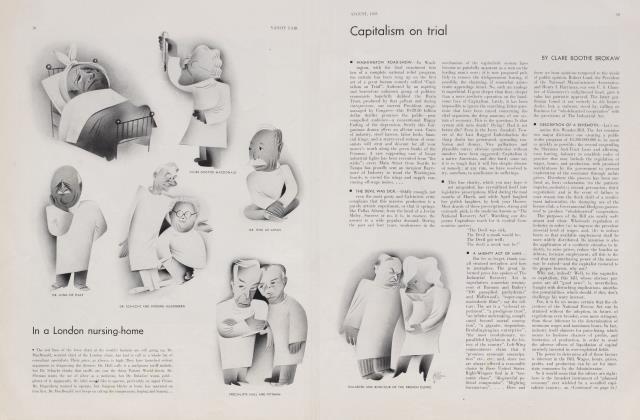
William Steig. whose group of drawings. Symbolic Soul Portraits, appear on page 27. writes concerning hiimself:
"I was born in 1907 and have always followed the line of least resistance.
"In 1926 I got so tired of college I went to the National Academy of Design. Finding my painting did not create a perverse ripple on the ordered academic waters, I took to humorous drawing. For three years 1 have been a contributor to various magazines, mainly the New Yorker.
"I think fitter material for social satire than all the political activities in the world is the man who breathes on your neck in the subway, because here you are getting at the root of the
"I like drawing funny people but best of all I like to lie flat on my back and think of the beautiful things that could happen."
Those naked girls
Dear Sir: Although Robert Garland, IVorld-Telegram dramatic critic, mentions among his recommendations the photographs of burlesque by Remie Lohse in your June issue, and since, as Mr. Garland himself has asserted, dramatic critics should be read, not agreed with, I fail to agree with him.
Vanity Fair usually concerns itself with motivating photographic studies. There is nothing of this quality to be found in burlesque ; it is monotonous and lewd.
Ex-Mayor McKee's dauntless fight to close all burlesque houses in the city of New York was looked upon in the editorials of our better newspapers as one of the most intelligent and fearless moves by any administration to rid the city of such emporiums of moral defilement. His was an unsuccessful fight, however.
On that occasion, if memory serves me right, the court ruled that with certain restrictions burlesque could continue to thrive. This legal arrangement proved a success for a while, but as public sentiment quieted down the restrictions gradually were lifted— not by the court, but by the burlesque owners themselves—and the shows became as corrupt as they had been before the ban and are at present.
And so it was with a strong feeling of contempt for your taste that 1 looked upon Remie Lohse's photographs. They are indeed most unbecoming to the high standards that Vanity Fair has invariably maintained in the past.
Your photography has always been superb; this cannot be said of your current excursion into the world of the camera, since anything that is bawdy cannot be said to be superb.
In anticipatory embarrassment, lest some friend of mine, unfamiliar with the high calibre of your journal, should casually choose to run through my copy of the June issue, and come across this lewd display, I made a neat cutting job of the page and put a match to it.
WILLIAM S. PFRIF.NDER.
Note on a German theme
Dear Sir: When I received my copy of the June number of Vanity Fair, I was so overcome by the photograph. "Herr Hitler and the Immemorial Moses," that I was moved to tears. 1 cannot resist telling you that I consider this the most telling and effective expression of the German situation and the Jews which has been printed. I wish the page might be reproduced and sent broadcast throughout this nation.
I have distributed many copies to my friends, Jew and Gentile alike, who unanimously join in my appreciation of the distinguished contribution to right thinking and feeling today. MRS. M. C. SLOSS.
San Francisco, Cal.
The editorial suspicion that "Herr Hitler and the Immemorial Moses" expressed the opinion of a great number of people was borne out by the fact that it was reprinted or discussed in journals throughout the country.— THE EDITORS.
Liquor and revolution
Dear Sir: Your letters printed on the contributors' page of the magazine are always, I take it, letters from the living. They deal with profound topics such as correct spelling, word-order, and the crisis in the split infinitive. It seems to me. therefore, that since living people seem unable to write you letters on topics that are interesting to other people than quibblers and grammarians, I had better supply you with a letter from one long dead. Its timeliness will not, at this juncture, be questioned. It might even be forwarded to the Quartermaster's Office of the Army, in hopes that immediate action may be taken upon it, the moment Repeal is carried.
The letter is addressed to John Hancock :
"I do myself the honor of addressing a few lines to Congress upon a subject which appears to me of infinite importance. . . . Since our imports of spirits have become so precarious— nay, impracticable—on account of the enemy's fleet which infests our whole coast, .1 would beg leave to suggest the propriety of erecting public distilleries in different states. The benefits arising from the moderate use of strong liquors hare been experienced in all armies and are not to be disputed. In the present situation of affairs, our soldiery cannot obtain such supplies as are absolutely necessary, and if they are fortunate enough to get any. it is from the settlers at most extravagant rates. This is a source of much complaint and. I should hope, may be removed by appointing proper persons to buy grain and distill it. . . .
GEORGE WASHINGTON. August 16, 1777"
Roses all the way
Dear Sir: Allow me to unburden myself. I have waited anxiously for someone to apply the ultimate correction to the dispute raging in your Uneasy Chair page over Rbslein Auf der Ileiden and have waited in vain. It is just that, and neither Rosen Auf der IJeide as Mr. Nathan would have it. nor Rbslein Auf der Heide as the more correct Mr. Loomis supposes. Ungrammatical perhaps, but the fact, nevertheless.—as Goethe wrote it.
/leidenrbslein is the title of the song of which the above forms part of the refrain.
SAMUEL E. Q. ASHLEY. Princeton, N. J.
Veteran cannoneer
Henry Morton Robinson, author of Loony-bin on page 26, describes him self as "a child of the last century, just a pressed flower of the nineties. Born outside the stockade at Boston. Massachusetts, September 7, 1898.
Fought his way upward to 3rd class gunner's mate in the Navy during the War. thence by easy gradations got an A.B. degree from Columbia Col lege, 1923. Found ill-paid employment 1924-26 as instructor in Beautiful Letters at his alma mater ; went to spend a week-end in Woodstock, New York, seven years ago and has stayed there ever since. Has published two volumes of verse. Children of Morning side and Buck Fever, also biographies of Cortez and John Ken Ion (ex-fire chief of New York City)." During his long residence at Woodstock Mr. Robinson has been three times a father, written hundreds of magazine articles, and has thus gained much of the material for his forthcoming Studies in Madness.
Trouble in Yugoslavia
John Bakeless, author of Aristocrat* of Publishing on page 42. knows the magazine field as an insider : he has been editor of numerous publications, such as the Living . \ge, the Forum. the old Independent, and contributing editor to several others. A man of highly varied interests, he has spent years pursuing post-graduate studies at Harvard and also making trips throughout Europe and the Near East reporting the adventures of the mo ment. His biggest magazine story so far washis interview with Ivan Miehailoff, the famous bandit chieftain in the Balkans, who kept him as a prisoner in his camp in the middle of the Bulgar ian mountains after the interview had been granted. On the way back to safety, he was nearly shot on the Bulgar-Yugoslav border by the Yugo slav army. He understands that he is never to be permitted to enter Yugo slavia again, but is not, apparently, depressed by the fact.
An inordinate winner of prizes in a whole list of subjects, he was graduated with honors from Williams in 1918, just in time to get into an officer's uniform. More prizes followed from his Harvard studies, including one for his first book. The Economic Causes of Modern War. His next work was the much-discussed The Origin of the Next JVar, published in 1926. Another special interest to which he has given much time is the study of magazines and their history. His book Magazine Making is now regarded as a standard work and is used in many colleges and magazine offices.
Champion of the pulps
Dear Sir: This is a mild note in answer to Mr. Marcus Duffield's recent contribution to your pages concerning the despised wood-pulp magazines.
An article on that fascinating subject should be interesting and Mr. Duffield's is certainly no exception, but there are certain things about it that call for comment.
Mr. Duffield. despite his statement near the Conclusion of his article, is supercilious and that, probably, is all right. One can easily and comfortably be supercilious about the pulps. It is, I think anyone will agree, a rather obvious attitude and one not hard to attain, but if one is to write a sound exposition on the theme it is well not to overdo it. For thereby, if real analysis be the goal, the writer will stumble.
Continued on page 7
Continued from page 5
Mr. Duffield, from his supercilious peak, lumps all the pulps together and that is not wise. It cannot be done. There are pulps as terrible as he indicates, but there are others with a high degree of literary value. And where Mr. Duffield once deigns to discriminate. he falls into error.
He says, for instance, that All Story, Argosy and Adventure are the aristocrats of the field, but he does not know, perhaps, that Argosy appeals to a strictly juvenile audience, that All Story is as terrible as he implies most of the pulps are, and that Adventure is strictly an adult magazine. designed for adults and drawing its circulation largely from professional men. He does not know, perhaps, that it is required reading in a number of high schools, that a professor of literature at Williams declared it to be a publication of such high literary standards as to be one of the hardest magazines to sell to in the country.
In dealing with the authors and editors, Mr. Duffield probably is unaware that a young man named Sinclair Lewis once helped to direct the destinies of Adventure and that, if you examine his books with a technical eye. his style seems to have sprung from the stories he read there. Mr. Duffield probably is not aware either that T. S. Stribling, until he won the Pulitzer Prize, never published serially except in pulps. The list can go on. Jack London, Gouverneur Morris. Achmed Abdullah, Konrad Bercovici, Leonard Nason all sprang from the pulps. II. G. Wells serialized TonoBungay in Street and Smith's Popular; Conrad serialized The Rescue in the old Romance, a sister of Adventure. It was in Romance, incidentally —in both the original and the revived version—that, other than Conrad and most of the above, there appeared such literary hacks and upstarts as James Branch Cabell. Edgar Lee Masters, the Bencts. Mazo de La Roche and others of like stripe. Oddly enough, now that T. S. Stribling has won the Pulitzer Prize and is in a position to take the best of many offers, he has yet seen fit to serialize a new novel of his in a lowly pulp. The novel is Railroad and the magazine is Argosy.
This proves nothing, of course, except that frequently first rate stuff is found in the despised newsprint.
As to Mr. Driffield's implication that pulp writers are ignorant of their locales—I refer to his allusion to the Kentuckian who decided to do some sea stories—I would like to call to his attention such men as Robert Carse. Albert Richard Wetjen, Captain Dingle and Jacland Marmur, who write of the sea : to Leonard Nason and Ared White, who write of the war; to Edgar Young and George Allan England, who write of the tropics; to Georges Surdez and J. D. Newsom, who write of the Foreign Legion and North Africa ; to Talbot Mundy, who writes of India and Egypt; to W. C. Tuttle, who writes of the ranches. These men and many more like them have lived and worked in the milieu about which they write.
Now it is undeniable that, against such as these, there are others who obtain their background synthetically, but even then it must be accurate and even Mr. Duffield doubtless knows of the eagle eyes of pulp readers. If you arc writing of automatic pistols, for instance, and mention that a Ltiger possesses a mechanism peculiar to a Colt, you will have enough sarcastic correspondence on your hands to occupy you for weeks. This stickling on technical accuracy can be feebleminded at times and I wouldn't deny it ; it is cited only to amend Mr. Duffield's generalities.
As to the language of heroes and heroines and the use of words, Mr. Duffield has taken single cases and implied that they are the rule, when he should know that they are not. Language and style are neither more nor less standardized than among any other types of publications widely read, and therefore closely watched, by the public. Indeed, in many cases the language of the pulps is not as much standardized as it is in the more dignified magazines.
In short, the pulps are not nearly so feeble-minded as Mr. Duffield would have us believe; they are much more complex* than he indicates and therefore should be given a better exposition than be has made for them. It is indicates true that they manufacture day dreams for the masses ; it is also true than many of them are not worth the paper they are printed on, hut it is also true that in many cases there is more honest writing to the square inch in their pages than to the square yard in some of the bigger and better known slicks. It is also true that they have provided a haven and a living for sincere writers whose efforts were scorned at first by the bigger books and later grabbed with avidity.
I do not know where Mr. Duffield got his material for the article, hut probably his journalistic duties interfered with deeper researches into his subject. C. E. MULLF.N.
New York City.
Tiger, tiger, burning bright
(Sriit by telegraph)
Dear Sir: Mr. Pringle's article Tammany on the Spot in the June issue of your magazine is in the main sheer and abominable nonsense. Any intelligent political observer understands that the Mitchell and Morgan disclosures before the Senate Commit tee have completely dwarfed in the public mind Judge Seahury's findings of last year. In truth the hankers have caused the Tammany Hall leaders of tin box fame to appear as paragons of public virtue. In comparison Mayor O'Brien has made such an excellent impression on the citizenry of New York that all potential candidates including Holy Joe McKee and the angelic Seabury himself have lied from the scene. Mr. Curry is today more strongly in the saddle as far as genuine political power is concerned than either Murphy or Croker were at the zeniths of their careers. Even if Tammany were denied any Federal patronage whatsoever it should he remembered that the organization received none from either Cleveland or Wilson and was able to persist in its local influence nevertheless. If Mr. Pringle were a profound student of history lie would also recall that Mr. McAdoo lost two chances at the Presidency because of his antagonism toward Tammany Hall during the Wilson administration and that a similar political oblivion awaits Mr. Farley when his brief moment of power has passed. Tammany will last forever.
PATRICK H. SULLIVAN. New York City.
Subscribers have complete access to the archive.
Sign In Not a Subscriber?Join Now
