Sign In to Your Account
Subscribers have complete access to the archive.
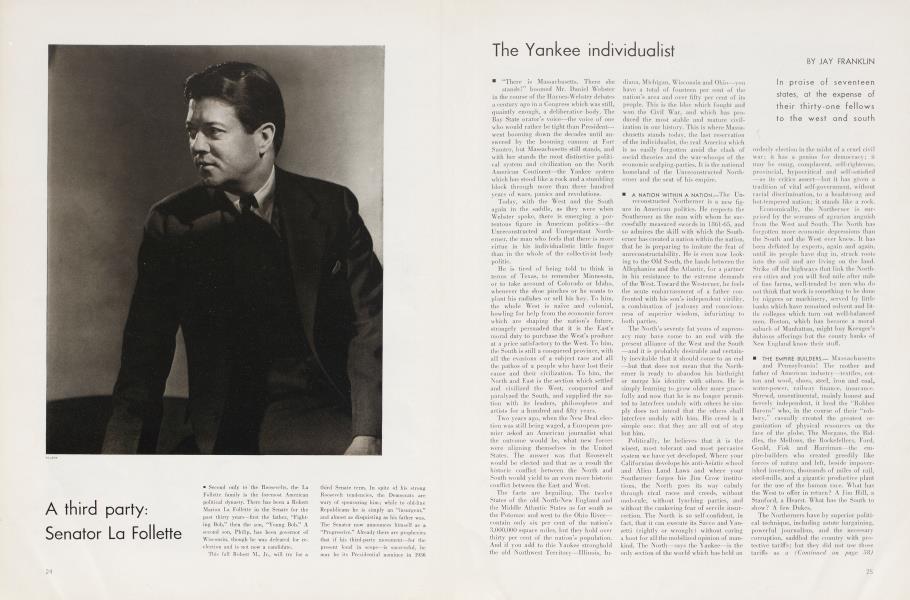
Sign In Not a Subscriber?Join NowThe Yankee individualist
In praise of seventeen states, at the expense of their thirty-one fellows to the west and south
JAY FRANKLIN
"There is Massachusetts. There she stands!" boomed Mr. Daniel Webster in the course of the Haynes-Webster debates a century ago in a Congress which was still, quaintly enough, a deliberative body. The Bay State orator's voice—the voice of one who would rather be tight than President— went booming down the decades until answered by the booming cannon at Fort Sumter, but Massachusetts still stands, and with her stands the most distinctive political system and civilization on the North American Continent—the Yankee system which has stood like a rock and a stumbling block through more than three hundred years of wars, panics and revolutions.
Today, with the West and the South again in the saddle, as they were when Webster spoke, there is emerging a portentous figure in American politics—the Unreconstructed and Unrepentant Northerner, the man who feels that there is more virtue in his individualistic little finger than in the whole of the collectivist body politic.
He is tired of being told to think in terms of Texas, to remember Minnesota, or to take account of Colorado or Idaho, whenever the shoe pinches or he wants to plant his radishes or sell his hay. To him, the whole West is naive and colonial, howling for help from the economic forces which are shaping the nation's future, strangely persuaded that it is the East's moral duty to purchase the West's produce at a price satisfactory to the West. To him, the South is still a conquered province, with all the evasions of a subject race and all the pathos of a people who have lost their cause and their civilization. To him, the North and East is the section which settled and civilized the West, conquered and paralyzed the South, and supplied the nation with its leaders, philosophers and artists for a hundred and fifty years.
Two years ago, when the New Deal election was still being waged, a European premier asked an American journalist what the outcome would be, what new forces were aligning themselves in the United States. The answer was that Roosevelt would be elected and that as a result the historic conflict between the North and South would yield to an even more historic conflict between the East and West.
The facts are beguiling. The twelve States of the old North-New England and the Middle Atlantic States as far south as the Potomac and west to the Ohio River— contain only six per cent of the nation's 3,000,000 square miles, but they hold over thirty per cent of the nation's population. And if you add to this Yankee stronghold the old Northwest Territory—Illinois, Indiana, Michigan, Wisconsin and Ohio—you have a total of fourteen per cent of the nation's area and over fifty per cent of its people. This is the bloc which fought and won the Civil War, and which has produced the most stable and mature civilization in our history. This is where Massachusetts stands today, the last reservation of the individualist, the real America which is so easily forgotten amid the clash of social theories and the war-whoops of the economic scalping-parties. It is the national homeland of the Unreconstructed Northerner and the seat of his empire.
A NATION WITHIN A NATION.—The Unreconstructed Northerner is a new figure in American politics. He respects the Southerner as the man with whom he successfully measured swords in 1861-65, and so admires the skill with which the Southerner has created a nation within the nation, that he is preparing to imitate the feat of unreconstructability. He is even now looking to the Old South, the lands between the Alleghanies and the Atlantic, for a partner in his resistance to the extreme demands of the West. Toward the Westerner, he feels the acute embarrassment of a father confronted with his son's independent virility, a combination of jealousy and consciousness of superior wisdom, infuriating to both parties.
The North's seventy fat years of supremacy may have come to an end with the present alliance of the West and the South —and it is probably desirable and certainly inevitable that it should come to an end —but that does not mean that the Northerner is ready to abandon his birthright or merge his identity with others. He is simply learning to grow older more gracefully and now that he is no longer permitted to interfere unduly with others he simply does not intend that the others shall interfere unduly with him. His creed is a simple one: that they are all out of stop but him.
Politically, he believes that it is the wisest, most tolerant and most pervasive system we have yet developed. Where your Californian develops his anti-Asiatic school and Alien Land Laws and where your Southerner forges his Jim Crow institutions, the North goes its way calmly through rival races and creeds, without mob-rule, without lynching parties, and without the cankering fear of servile insurrection. The North is so self-confident, in fact, that it can execute its Sacco and Vanzetti (rightly or wrongly) without caring a hoot for all the mobilized opinion of mankind. The North—says the Yankee—is the only section of the world which has held an orderly election in the midst of a cruel civil war; it has a genius for democracy; it may be smug, complacent, self-righteous, provincial, hypocritical and self-satisfied —as its critics assert—but it has given a tradition of vital self-government, without racial discrimination, to a headstrong and hot-tempered nation; it stands like a rock.
Economically, the Northerner is surprised by the screams of agrarian anguish from the West and South. The North has forgotten more economic depressions than the South and the West ever knew. It has been deflated by experts, again and again, until its people have dug in, struck roots into the soil and are living on the land. Strike off the highways that link the Northern cities and you will find mile after mile of fine farms, well-tended by men who do not think that work is something to be done by niggers or machinery, served by little banks which have remained solvent and little colleges which turn out well-balanced men. Boston, which has become a moral suburb of Manhattan, might buy Kreuger's dubious offerings but the county banks of New England know their stuff.
THE EMPIRE BUILDERS.— Massachusetts and Pennsylvania! The mother and father of American industry textiles, cotton and wool, shoes, steel, iron and coal, water-power, railway finance, insurance. Shrewd, unsentimental, mainly honest and fiercely independent, it bred the "Robber Barons" who, in the course of their "robbery," casually created the greatest organization of physical resources on the face of the globe. The Morgans, the Biddles, the Mellons, the Rockefellers, Ford, Gould, Fisk and Harriman—the empire-builders who created greedily like forces of nature and left, beside impoverished investors, thousands of miles of rail, steel-mills, and a gigantic productive plant for the use of the human race. What has the West to offer in return? A Jim Hill, a Stanford, a Hearst. What has the South to show? A few Dukes.
The Northerners have by superior political technique, including astute bargaining, powerful journalism, and the necessary corruption, saddled the country with protective tariffs; but they did not use those tariffs as a means of preventing production. Today there is scarcely a Northerner who is not secretly shocked and scandalized by the program of paying farmers not to produce wealth.
Continued on page 58
Continued from page 25
The North went through the Panic of 1818, the Panic of 1837, and the Panics of 1857, of 1873, 1893, 1903, 1907, and 1921 without whimpering. The North suffered far more keenly than the West and South have ever suffered from depressions. The North learned to take its medicine and is surprised that it should now lie considered necessary to interpose legal harriers between economic cause and effect. The North would accept universal bankruptcy or general revolt philosophically, but sees no reason why these simple, practical methods of readjustment to supply and demand should be feared or scorned. Free men and responsible individuals, the North feels, should not shrink from the consequences of an economic miscalculation or the true character of political reform. But it does not feel that either these consequences or this reform should take place at the expense of other people. "Let the farmers lose their land!" says the Northerner. "Our farmers lost theirs until they learned how not to lose it. Let hanks and businesses go to the wall, without government loans. Our banks used to go broke, too, and our businesses went bankrupt until we mastered the necessary caution and cunning."
FOUNT OF AESTHETICS.—Culturally, the Unreconstructed Northerner thinks he knows how to create the right environment for genius. New England has been the center of American education for over two hundred years and so remains. The theatre, music, painting, sculpture, critical appreciation is almost exclusively confined to Boston. New York, and Philadelphia, with a precarious outpost in Chicago, while the South still thinks in terms of politics, dogs and horses and the West in terms of the no longer Silent Screen and the Hollywooden age. New York is the center of literature for the United States and to it flock all geniuses and prophets without honor in the province". The East, too, has never gone native in matters cultural. In the face of artistic chauvinism, it has maintained hospitable contacts with Europe and has slowly leavened our artistic provincialism with the maturity and vitality of the old world.
Your Unreconstructed Northerner loves his geography. Me likes clear little streams, little lakes, purposeful rivers which flow from mountains to the sea, instead of meandering in chocolaty-curves through flat, lush lowlands. He likes the names of his rivers: Penobscot, Merrimac, Connecticut, Housatonic, Hudson, Delaware, Susquehanna. He does not like the drooping landscapes of the South or the picture-postcard grandeurs of the West. To him the Grand Canyon is a tasteless exaggeration and California as showy as a Burbank giant vegetable. He likes the tradition of live and let live which makes the North the only place in America where a man can develop his own character, good or bad, and still live in peace with his neighbors. He likes the little colleges in the hills where they still teach Latin and Greek and prepare country boys for the Presbyterian ministry. He likes the Italians, Portuguese, Poles, and French Canadians who have come in to till the soil and who have absorbed the North's peculiar rural tradition more rapidly than the transplanted Northerners have forgotten it.
This spirit is, no doubt, reprehensibly anti-social. The efficiency and energy of the Iowa farmer, the moral fervor of Kansas, the flashing intellect of the Southern politician, and the gargantuan optimism of the Far Westerner are undeniably needed by this nation. The Northerner does not despise them. He simply feels that the North, too, has something to contribute to the nation, aside from tax-money and stock salesmanship.
The Unreconstructed Northerner feels that the North has courage, wisdom, experience and civilization; that the North is the ultimate custodian of American democracy and American individualism; that the North possesses tolerance as well as power, and guts as well as wealth. And the Northerner does not propose to allow these contributions to be blown away by any political windstorm or to be thrown into the jack-pot of any economic brainstorm. The North is doubtless arrogant, narrow, provincial and stiff-necked in this attitude, but the North believes that the human race has never got anywhere on any other terms. The race which built Faneuil Hall built Gary, Indiana, and the breed which created Harvard College also created the Standard Oil Company, but it has done so without political witch-burning or social lynching-parties.
The Unreconstructed Northerner looks at the New Deal, sympathizes with its purposes and dislikes its methods. He believes there are other ways of doing the same thing and that there is still merit in the old Yankee custom of taking your medicine like a man, accepting the consequences of your own actions and preferring the rights of common men to any theory of social distribution. Under that impulse, the Northerner will not hinder the will of the majority (for he is used to majorities and abides by their decisions), but if he is driven by that majority too far from his instincts for work, thrift and production, he will secede spiritually from the American Union and will concentrate on cultivating his own garden, let the heathen rage as they will and the prophets of disaster threaten him with hell-fire to their hearts' content. For the seed of the Puritans have no fear of verbal flames. They have passed through the fire before now and have helped to create a great nation by sheer perseverance and force of character. That is the North's historic mission. "There is Massachusetts! There she stands!" And there she will stand for generations to come, no matter what the South and West may think about it.
Subscribers have complete access to the archive.
Sign In Not a Subscriber?Join Now
