Sign In to Your Account
Subscribers have complete access to the archive.
Sign In Not a Subscriber?Join NowThe rising tide of color in sports
An answer to Tommy Armour's article in last month's Vanity Fair in which he deplored the growing lack of color in sport
PAUL CALLICO
A kind friend has called my attention to an article published in Vanity Fair (I very rarely get beyond True Confessions and the Police Gazette) by a fellow named Thomas Armour (said to be a good golfer though I doubt it; he sounds more like a writer to me), deploring the falling tide of color in sports, and praying for the return of drama and color as it flourished in the good old days in boxing, golf, tennis and baseball.
I do not know anything about this Thomas Armour who is probably just some fresh young punk coming up in the writing business, or maybe he is an old gaffer who can't see beyond the good old days, but whoever he is, I know that he was not present at the recent weighing-in party involving Max Baer, the new heavyweight champion of the world, and Primo Camera whom he whipped in the Garden Bowl in Astoria the night of June 14. That was the occasion, both men being stripped to the waist, when Baer marched over to where Primo was preparing to step on the scales, and carelessly plucked from his enormous chest a long and wiry black hair.
"She loves me," quoth Master Baer, tossed it aside and plucked another, "She loves me not. . . . She loves me. . .
"Hey! yelled Primo, "Worra marra you? You wanna give me cancer? You beeg clown, no?"
"Shut up and hold still," said Baer, calmly plucking another hair—"She loves me, she loves me not . . . she LOVES ME!"
I do not know where this Armour was during the recent prizefight involving Baer and Camera which stood 55,000 people on their ears, but if he had been at the ringside instead of home reading back files of the New York Timeshe would have heard this same Baer say to Camera after knocking him down the third time in the second round and having the toppling Camera drag him down with him each time —"Last one up is a sissy!"
If this is Tommy Armour, the Black Scot, I would say that he himself is one of the most colorful figures of modem golf. Why doesn't he go out on the links and watch himself playing those magnificent iron shots of his, shots that hit a target 200 yards away with more accuracy than many a man could with a rifle?
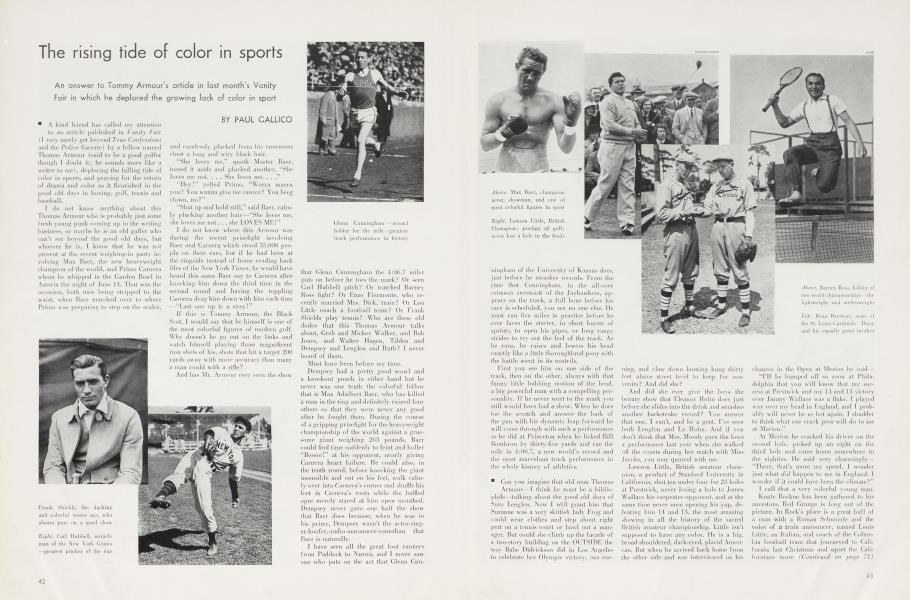
And has Mr. Armour ever seen the show that Glenn Cunningham the 4:06.7 miler puts on before he toes the mark? Or seen Carl Hubbell pitch? Or watched Barney Ross fight? Or Enzo Fiermonte, who recently married Mrs. Dick, train? Or Lou Little coach a football team? Or Frank Shields play tennis? Who are these old dodos that this Thomas Armour talks about, Greb and Mickey Walker, and Bob Jones, and Walter Hagen, Tilden and Dempsey and Lenglen and Ruth? I never heard of them.
Must have been before my time.
Dempsey had a pretty good scowl and a knockout punch in either hand but he never was one tenth the colorful fellow that is Max Adalbert Baer, who has killed a man in the ring and definitely ruined four others so that they were never any good after he fought them. During the course of a gripping prizefight for the heavyweight championship of the world against a gruesome giant weighing 263 pounds, Baer could find time suddenly to feint and holler "Boooo!" at his opponent, nearly giving Camera heart failure. He could also, in the tenth round, before knocking the giant insensible and out on his feet, walk calmly over into Cameras corner and shuffle his feet in Camera's rosin while the baffled ogre merely stared at him open mouthed. Dempsey never gave one half the show that Baer does because, when lie was in his prime, Dempsey wasn't the actor-singer-hoofer,-radio-announcer-comedian that Baer is naturally.
I have seen all the great foot runners from Paddock to Nurmi, and I never saw one who puts on the act that Glenn Cunningham of the University of Kansas does, just before he smashes records. From the time that Cunningham, in the all-over crimson sweatsuit of the Jayhawkers, appears on the track, a full hour before his race is scheduled, you see no one else. He must run five miles in practice before he ever faces the starter, in short hursts of sprints, to open his pipes, or long rangy strides to try out the feel of the track. As he runs, he raises and lowers his head exactly like a little thoroughbred pony with the battle scent in its nostrils.
First you see him on one side of the track, then on the other, always with that funny little bobbing motion of the head, a big powerful man with a compelling personality. If he never went to the mark you still would have had a show. When he does toe the scratch and answer the hark of the gun with his dynamic leap forward he will come through with such a performance as he did at Princeton when he licked Bill Bonthron by thirty-five yards and ran the mile in 4:06.7, a new world's record and the most marvelous track performance in the whole history of athletics.
Can you imagine that old man Thomas Armour—I think he must he a bibliophile—talking about the good old days of Suzy Lenglen. Now I Will grant him that Suzanne was a very skittish lady Frog and could wear clothes and step about right pert on a tennis court or bawl out a manager. But could she climb up the facade of a two-story building on the OUTSIDE the way Babe Didrickson did in Los Angeles to celebrate her Olympic victory, one evening, and claw down bunting hung thirty feet above street level to keep for souvenirs? And did she?
And did she ever give the boys the beauty show that Eleanor Holm does just before she slides into the drink and smashes another backstroke record? You answer that one. I can't, and be a gent. I've seen both Lenglen and La Holm. And if you don't think that Mrs. Moody gave the boys a performance last year when she walked off the courts during her match with Miss Jacobs, you may quarrel with me.
Lawson Little, British amateur champion, a product of Stanford University in California, shot ten under four for 23 holes at Prestwick, never losing a hole to James Wallace his carpenter-opponent, and at the same time never once opening his yap, defeating him 14 and 13, the most amazing showing in all the history of the sacred British amateur championship. Little isn't supposed to have any color. He is a big, broad-shouldered, dark-eyed, placid American. But when he arrived back home from the other side and was interviewed on his chances in the Open at Merion he said—"I'll be bumped oil so soon at Philadelphia that you will know that my success at Prestwick and my 14 and 13 victory over Jimmy Wallace was a fluke. I played way over my head in England, and I probably will never be as hot again. I shudder to think what our crack pros will do to me at Merion."
At Merion he cracked his driver on the second hole, picked up an eight on the third hole and came home somewhere in the eighties. He said very charmingly— "There, that's more my speed. I wonder just what did happen to me in England. I wonder if it could have been the climate?
I call that a very colorful young man. Knute Rockne has been gathered to bis ancestors, Red Grange is long out of the picture. In Rock's place is a great bull of a man with a Roman Schnozzle and the voice of a train announcer, named Louis Little, an Italian, and coach of the Columbia football team that journeyed to California last Christmas and upset the Californians more than the last three earthquakes by beating Stanford University in the Rose Bowl game on New Year's Day.
Continued on page 71
Continued from page 43
And do you want to see a colorful football player who will make you forget all about Red Grange? Then get a load of a little man named Cotton Warburton who plays for the University of Southern California. You can catch him when he comes east to play Pittsburgh on October 13th, and the rest of the time he is scuttling about amazingly on the California gridirons.
Lou Little's technique differs from Rockne's hut is just as colorful. Where the great Knute surrounded his work with as much mystery as a Dalai Lama, Little operates with both sleeves rolled up showing his arms to prove there is nothing concealed. He teaches the boys simple football, drills them on fundamentals and bawls at them like the Bull of Bashan when his Italian temper explodes, and the next moment is cheering them on, his eyes afire.
There are colorful figures scattered all through baseball, despite the disappearance from the headlines of the sport's self-confessed great man, Arthur Shires. If this man Thomas Armour, who is no doubt connected with the Chicago Packing family, is looking for skill I will recommend that he investigate the left handing of one Carl Hubbell, who is employed by the New York Giants, on an afternoon when Carlos is hot and bearing down. Or, if he is looking for nonsense he shouldn't miss the Dean Brothers who work for the St. Louis Cardinals,—Dizzy, who was not named that for nothing, and his brother Paul. Dizzy's most recent escapade which broke into headlines was a one man strike for more pay— for his brother Paul. When they wouldn't pay Paul more than $3000 per annum, brother Dizzy refused to pitch until they did. But if it is downright color that you want, don't pass up the sinister William Terry, first baseman of the Giants and manager to boot, the man with the big black cigar in his face when he isn't playing ball and who may be well on his way to rivalling the fame of the late John McGraw whom he superseded. Terry is as outspoken as McGraw was, and he is the best story in baseball today.
Benny Leonard has passed from the picture and in his stead there is a little Jewish boy who worships his mother, wears the Tzitzes around his neck, goes to Tabernacle and Temple, trains at a Jewish hotel -where the food is Kosher and writes his mother a letter in Hebrew every day. His name is Barnet Rassofsky, but he fights under the name of Barney Ross. He holds two world's championships, the lightweight title and the welterweight championship, the first pugilist in the history of boxing to do so. Not even the Golden Decade of super-champions could produce a Barney Ross who could whip Tony Canzoneri for the lightweight crown, and then outsmart and outfight the great Jimmy McLarnin for the heavier title. You may go back a long way into history to find a young boxer as capable and as popular with every race and sect as the quiet little Jewish boy with the Irish name.
Tennis is a game I do not know very much about and I regret the passing of William Tatum Tilden 2d, because I used to love to hear him scream "Sugar," and go "tsk-tsk-tsk-tsk," when he missed a shot, but 1 will still take a ride out to Forest Hills whenever I hear that Frank Shields is going to play. These boys do not get into quite such a state of pet, bother and dither as old Mr. Tilden used to. hut you will go far to find a more dashing, handsome and colorful figure than that long, lanky Mr. Shields with his black hair wringing wet and plastered all over his face, and his wide shoulders showing through his soaked tennis shirt. Yes, when he is having a good day he is something of an heroic figure and I am afraid that the young ladies who attend fiestas of that sort will give you a whole hatful of Tildens and all the rest of the passe heroes for one good look at young Shields taking a manly swipe at the tennis ball, and muttering something stronger than "Dear me!" when lie lets one go by.
Mr. Sarazen is still a great showman on the links, and the spic-and-span and very meticulous Paul Runyan doesn't put up a bad show himself when the chips are up and he is wandering over the course like Hawkshaw the Detective, examining every blade of grass with a microscope before hitting his shot to the green, or taking a short chip or putt. As far as colorful behavior on the links is concerned, it was my great joy to be present at the twelfth hole at Merion, the scene of the recent open championship annexed by one Olin Dutra, a big Spanish guy who is not exactly colorless himself. A party by the name of Wilfred (Wifify) Cox from Brooklyn was coming up the twelfth fairway with a good chance to win himself the championship. He played a long iron out of the rough. It bounced on the green and darted on with much too much energy. The people massed around the back edge of the green scrambled out of the way quickly and let the hall roll on and over and out of bounds.
The behavior of Master Cox at that point was most satisfying to the seeker after pure color. He flung his golf stick far away from him and when after playing another ball he arrived at the green, he harangued the crowd on the back edge as follows—"Say, what was the matter with you people? Why couldn't you sit still and let the hall hit you. Whadja have to get up for and let it roll out of bounds? If that had been Bobby Jones's ball you'd have all broke your necks falling on it so it wouldn't roll out. Don't kid me."
Well, I guess I am all through with this Thomas Armour, and the reason I know he does not know what he is talking about in his article in Vanity Fair is that in it he describes himself as being an old man, which is laughable. The Black Scot—Armour Dim, Major Armour of the Tank Corps, if you please—may have a few gray hairs upholstering his noggin, hut he will out-play and out-color practically anybody in the field and then sit up and heat them at bridge all night. When I am on a golf assignment covering a big match, and -want some copy, I follow Tommy Armour. I wonder what that writer, Armour, has against him.
Subscribers have complete access to the archive.
Sign In Not a Subscriber?Join Now

