

Sign In to Your Account
Subscribers have complete access to the archive.
Sign In Not a Subscriber?Join NowThe white despot of Borneo
GEORGE SEDDON
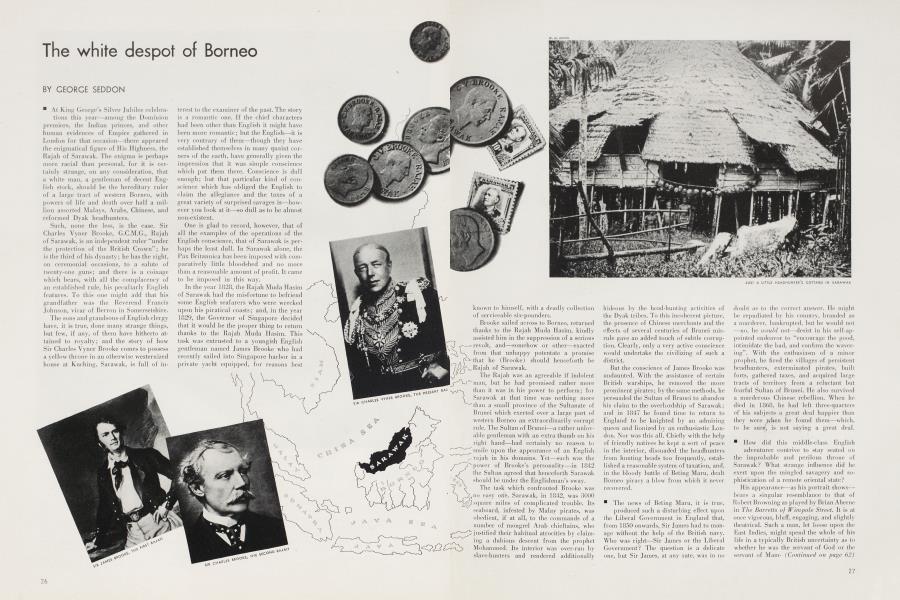
At King George's Silver Jubilee celebrations this year—among the Dominion premiers, the Indian princes, and other human evidences of Empire gathered in London for that occasion—there appeared the enigmatical figure of His Highness, the Rajah of Sarawak. The enigma is perhaps more racial than personal, for it is certainly strange, on any consideration, that a white man, a gentleman of decent English stock, should be the hereditary ruler of a large tract of western Borneo, with powers of life and death over half a million assorted Malays, Arabs, Chinese, and reformed Dyak headhunters.
Such, none the less, is the case. Sir Charles Vyner Brooke, G.C.M.G., Rajah of Sarawak, is an independent ruler "under the protection of tin; British Crown"; he is the third of his dynasty; he has the right, on ceremonial occasions, to a salute of twenty-one guns; and there is a coinage which bears, with all the complacency of an established rule, his peculiarly English features. To this one might add that his grandfather was the Reverend Francis Johnson, vicar of Berron in Somersetshire.
The sons and grandsons of English clergy have, it is true, done many strange things, but few, if any, of them have hitherto attained to royalty; and the story of how Sir Charles Vyner Brooke comes to possess a yellow throne in an otherwise westernized house at Kuching, Sarawak, is full of interest to the examiner of the past. The story is a romantic one. If the chief characters had been other than English it might have been more romantic; but the English—it is very contrary of them—though they have established themselves in many quaint corners of the earth, have generally given the impression that it was simple conscience which put them there. Conscience is dull enough; but that particular kind of conscience which has obliged the English to claim the allegiance and the taxes of a great variety of surprised savages is—however you look at it—so dull as to be almost non-existent.
One is glad to record, however, that of all the examples of the operations of the English conscience, that of Sarawak is perhaps the least dull. In Sarawak alone, the Pax Britannica has been imposed with comparatively little bloodshed and no more than a reasonable amount of profit. It came to be imposed in this way.
In the year 1828, the Rajah Muda Hasim of Sarawak had the misfortune to befriend some English seafarers who were wrecked upon his piratical coasts; and, in the year 1829, the Governor of Singapore decided that it would be the proper thing to return thanks to the Rajah Muda Hasim. This task was entrusted to a youngish English gentleman named James Brooke who had recently sailed into Singapore harbor in a private yacht equipped, for reasons best known to himself, with a deadly collection of serviceable six-pounders.
Brooke sailed across to Borneo, returned thanks to the Rajah Muda Hasim, kindly assisted him in the suppression of a serious revolt, and—somehow or other—exacted from that unhappy potentate a promise that be (Brooke) should henceforth be Rajah of Sarawak.
The Rajah was an agreeable if indolent man, but he had promised rather more than it was in his power to perform; for Sarawak at that time was nothing more "than a small province of the Sultanate of Brunei which exerted over a large part of western Borneo an extraordinarily corrupt rule. The Sultan of Brunei—a rather unlovable gentleman with an extra thumb on his right hand—had certainly no reason to smile upon the appearance of an English rajah in his domains. Yet—such was the power of Brooke's personality—in 1842 the Sultan agreed that henceforth Sarawak should be under tbe Englishman's sway.
The task which confronted Brooke was no easy one. Sarawak, in 1842, was 3000 square miles of complicated trouble. Its seaboard, infested by Malay pirates, was obedient, if at all, to the commands of a number of mongrel Arab chieftains, who justified their habitual atrocities by claiming a dubious descent from the prophet
Mohammed. Its interior was over-run by slave-hunters and rendered additionally hideous by the head-hunting activities of the Dyak tribes. To this incoherent picture, the presence of Chinese merchants and the effects of several centuries of Brunei misrule gave an added touch of subtle corruption. Clearly, only a very active conscience would undertake the civilizing of such a district.
But the conscience of James Brooke was undaunted. With the assistance of certain British warships, he removed the more prominent pirates; by the same methods, he persuaded the Sultan of Brunei to abandon his claim to the overlordship of Sarawak; and in 1847 he found time to return to England to be knighted by an admiring queen and lionized by an enthusiastic London. Nor was this all. Chiefly with the help of friendly natives he kept a sort of peace in tbe interior, dissuaded the headhunters from hunting heads too frequently, established a reasonable system of taxation, and, in the bloody battle of Beting Maru, dealt Borneo piracy a blow from which it never recovered.
The news of Beting Maru, it is true, produced such a disturbing effect upon the Liberal Government in England that, from 1850 onwards, Sir James had to manage without the help of the British navy. Who was right—Sir James or the Liberal Government? The question is a delicate one, but Sir James, at any rate, was in no doubt as to the correct answer. He might be repudiated by his country, branded as a murderer, bankrupted, but he would not no, he would not—desist in his self-appointed endeavor to "encourage the good, intimidate the bad, and confirm the wavering". With the enthusiasm of a minor prophet, he fired the villages of persistent headhunters, exterminated pirates, built forts, gathered taxes, and acquired large tracts of territory from a reluctant but fearful Sultan of Brunei. He also survived a murderous Chinese rebellion. When he died in 1868, he had left three-quarters of his subjects a great deal happier than they were when he found them—which, to be sure, is not saying a great deal.
How did this middle-class English adventurer contrive to stay seated on the improbable and perilous throne of Sarawak? What strange influence did he exert upon the mingled savagery and sophistication of a remote oriental state?
His appearance—as his portrait shows— bears a singular resemblance to that of Robert Browning as played by Brian Aherne in The Barretts of IVimpole Street. It is at once vigorous, bluff, engaging, and slightly theatrical. Such a man, let loose upon the East Indies, might spend the whole of his life in a typically British uncertainty as to whether he was the servant of God or the servant of Maminon; might end his days in a typically British compromise of being both simultaneously; and he might perform this difficult feat with an extra flair which would command the veneration of an alien people. It is not impossible to understand the success of Rajah James Brooke. But his heir, Charles Brooke, appears to have been distinguished by no other qualities than cold blood, conscientiousness, and a complete lack of humor.
Continued on page 62
Continued from page 27
Charles Brooke (né Johnson) was one of two nephews, sons of the vicar of Berron, whom Sir James had summoned to assist him. The elder nephew, having unwisely rebelled against his uncle, was disinherited; but Charles performed his often sanguinary duties with a cold and single-minded fervor which was little short of apostolic. As second Rajah, he settled down to establish the beauties of peace and the benefits of reform; and from his capital of Kuching, exorcised over his domain of flowering forests and manysounding rivers a more and more business-like rule, He was assisted by a Supreme Council of English subordinates and native chiefs; but he was a despot, lord of life and death.
Slavery was gradually suppressed, piracy ceased. And such was the pacific reputation of Sarawak (and such, too, its possibilities as a field for British capital) that in 1888 the English government experienced a change of heart. Rajah Brooke was accorded the protection of tlu? English Crown and received the honor of knighthood.
That the Rajah should have found time to visit England and marry an English wife is, on the whole, rather surprising than otherwise; hut it is not surprising that he should soon have found the lady an inconvenience, and sent her hack to England with their two small sons. He was not a family man. In due course of time Charles Yyner Brooke and Bertram Brooke—the products of Winchester and Oxford—returned to Sarawak to assist their father.
In 1904, Sir Charles was officially recognized as an independent sovereign, enjoying the same status as a vassal sovereign of the first class.
In 1917. he died and was succeeded by Sir Charles Vyner Brooke, and, at tins point, the story of Sarawak settles into a simple tale of peace and prosperity. The Sultanate of Brunei—such are the inevitable effects of befriending shipwrecked Englishmen—has now shrunk to eighty square miles of discouraged territory; Sarawak has acquired the other fifty-seven thousand. In addition to this, owing to a fortunate discovery in 1911, she produces 5,000,000 tons of petroleum annually. In other words, though the present Rajah possesses the conscience which animated his father and great-uncle, it is a conscience which has received a substantial earthly reward.
In their westernized palace at Kuching, the Brookes (she is a great-granddaughter of Joshua Bates of Boston, Mass.) live a life of benevolent autocracy, varied by occasional descents upon London society.
Some day the Rajah's yellow throne will he occupied by his brother Bertram or one of his brother Bertram's sons. Nor is there any reason to suppose that the inhabitants of Sarawak will object to an indefinite continuance of the Brooke rule. Englishmen should take heart at this. Their Empire may, at the impact of another war. crumble into the dust of Nineveh and Tyre; hut so long as there is one remote island left in this diminishing planet, so long may the conscientious Anglo-Saxon find Ins way there, to pacify the ingenuous natives at some profit to himself. This, if any, is the moral of Sarawak.
Subscribers have complete access to the archive.
Sign In Not a Subscriber?Join Now

