Sign In to Your Account
Subscribers have complete access to the archive.
Sign In Not a Subscriber?Join NowFreedom for the child?
GEORGE SEDDON
In which the new trends in education for young people are shown to have rather sad possibilities
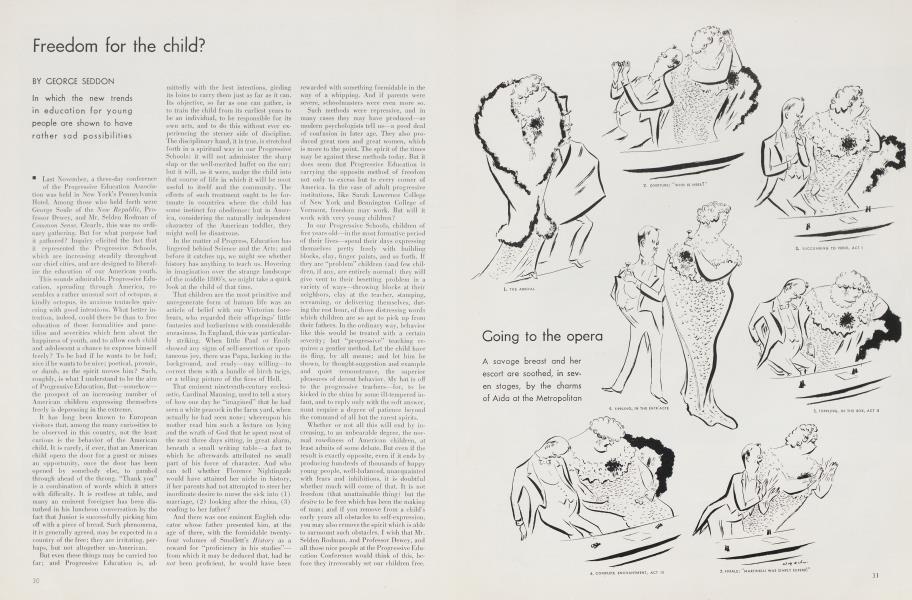
Last November, a three-day conference of the Progressive Education Association was held in New York's Pennsylvania Hotel. Among those who held forth were George Soule of the New Republic, Professor Dewey, and Mr. Selden Rodman of Common Sense. Clearly, this was no ordinary gathering. But for what purpose had it gathered? Inquiry elicited the fact that it represented the Progressive Schools, which are increasing steadily throughout our chief cities, and are designed to liberalize the education of our American youth.
This sounds admirable. Progressive Education, spreading through America, resembles a rather unusual sort of octopus, a kindly octopus, its anxious tentacles quivering with good intentions. W hat better intention, indeed, could there he than to free education of those formalities and punctilios and severities which hem about the happiness of youth, and to allow each child and adolescent a chance to express himself freely? To be bad if he wants to be bad; nice if he wants to be nice; poetical, prosaic, or dumb, as the spirit moves him? Such, roughly, is what I understand to be the aim of Progressive Education. But—somehow— the prospect of an increasing number of American children expressing themselves freely is depressing in the extreme.
It has long been known to European visitors that, among the many curiosities to be observed in this country, not the least curious is the behavior of the American child. It is rarely, if ever, that an American child opens the door for a guest or misses an opportunity, once the door has been opened by somebody else, to gambol through ahead of the throng. "Thank you" is a combination of words which it utters with difficulty. It is restless at table, and many an eminent foreigner has been disturbed in his luncheon conversation by the fact that Junior is successfully picking him off with a piece of bread. Such phenomena, it is generally agreed, may he expected in a country of the free; they are irritating, perhaps, but not altogether un-American.
But even these things may be carried too far; and Progressive Education is, admittedly with the best intentions, girding its loins to carry them just as far as it cat). Its objective, so far as one can gather, is to train the child from its earliest years to he an individual, to be responsible for its own acts, and to do this without ever experiencing the sterner side of discipline. The disciplinary hand, it is true, is stretched forth in a spiritual way in our Progressive Schools: it will not administer the sharp slap or the well-merited buffet on the ear; but it will, as it were, nudge the child into that course of life in which it will be most useful to itself and the community. The effects of such treatment ought to be fortunate in countries where the child has some instinct for obedience: but in America, considering the naturally independent character of the American toddler, they might well be disastrous.
In the matter of Progress, Education has lingered behind Science and the Arts; and before it catches up, we might see whether history has anything to teach us. Hovering in imagination over the strange landscape of the middle 1800's, we might take a quick look at the child of that time.
That children are the most primitive and unregenerate form of human life was an article of belief with our \ ictorian forebears, who regarded their offsprings' little fantasies and barbarisms with considerable uneasiness. In England, this was particularly striking. When little Paul or Emily showed any signs of self-assertion or spontaneous joy, there was Papa, lurking in the background, and ready—nay willing—to correct them with a bundle of birch twigs, or a telling picture of the fires of Hell.
That eminent nineteenth-century ecclesiastic, Cardinal Manning, used to tell a story of how one day he "imagined" that he had seen a white peacock in the farm yard, when actually he had seen none; whereupon his mother read him such a lecture on lying and the wrath of God that he spent most of the next three days sitting, in great alarm, beneath a small writing table—a fact to which he afterwards attributed no small part of his force of character. And who can tell whether Florence Nightingale would have attained her niche in history, if her parents had not attempted to steer her inordinate desire to nurse the sick into (1) marriage, (2) looking after the china, (3) reading to her father?
And there was one eminent English educator whose father presented him, at the age of three, with the formidable twentyfour volumes of Smollett's History as a reward for "proficiency in his studies"— from which it may be deduced that, had he not been proficient, he would have been rewarded with something formidable in the way of a whipping. And if parents were severe, schoolmasters were even more so.
Such methods were repressive, and in many cases they may have produced—as modern psychologists tell us—a good deal of confusion in later age. They also produced great men and great women, which is more to the point. The spirit of the times may be against these methods today. But it does seem that Progressive Education is carrying the opposite method of freedom not only to excess but to every corner of America. In the case of adult progressive institutions, like Sarah Lawrence College of New York and Bennington College of Vermont, freedom may work. But will it work with very young children?
In our Progressive Schools, children of five years old—in the most formative period of their lives—spend their days expressing themselves pretty freely with building blocks, clay, finger paints, and so forth. If they are "problem ' children (and few children, if any, are entirely normal) they will give vent to their besetting problem in a variety of ways—throwing blocks at their neighbors, clay at the teacher, stamping, screaming, or delivering themselves, during the rest hour, of those distressing words which children are so apt to pick up from their fathers. In the ordinary way, behavior like this would be treated with a certain severity; but "progressive" teaching requires a gentler method. Let the child have its fling, by all means; and let him be shown, by thought-suggestion and example and quiet remonstrance, the superior pleasures of decent behavior. My hat is off to the progressive teachers—for, to be kicked in the shins by some ill-tempered infant, and to reply only with the soft answer, must require a degree of patience beyond the command of all but the rarest spirits.
Whether or not all this will end by increasing, to an unbearable degree, the normal rowdiness of American children, at least admits of some debate. But even if the result is exactly opposite, even if it ends by producing hundreds of thousands of happy young people, well-balanced, unacquainted with fears and inhibitions, it is doubtful whether much will come of that. It is not freedom (that unattainable thing) but the desire to be free which has been the making of man; and if you remove from a child's early years all obstacles to self-expression, you may also remove the spirit which is able to surmount such obstacles. I wish that Mr. Selden Rodman, and Professor Dewey, and all those nice people at the Progressive Education Conference would think of this, before they irrevocably set our children free.
Subscribers have complete access to the archive.
Sign In Not a Subscriber?Join Now