Sign In to Your Account
Subscribers have complete access to the archive.
Sign In Not a Subscriber?Join NowThe Theatre
George Jean Nathan
INDUCTION.—The late Charles Frohman frequently stated that no play could richly succeed save its appeal were primarily to women. Since Frohman's time so great a change has come over the ladies that it is today pretty safe to say that it is a rare play that can richly succeed save its appeal be primarily to men. In the altered modern world the tastes of women in the various departments of life—art, morals, sport, literature, drama and alcoholic liquor—have not only approached closer and closer to those of their hoy friends, but in several of the aforesaid departments, to put it delicately, have exceeded them. One of the results is that what some years ago would have been regarded as a distinctly man's play nowadays finds its auditorium so full of the girls that it is all a man can do to horn in.
The new plays produced thus far this season that have done relatively well at the box-office have been, with a single possible exception, essentially men's plays and the theatres containing them have been chockfull of women. W inter set, which in Frohman's day doubtless wouldn't have had even a Wednesday matinee house one-fourth full, presently draws the gum-molls in large numbers not only at matinees but in even larger at nights. A Slight Case of Murder. with its gruesome humors about corpses, Night of January 16, with its loud murder mystery stuff, and Blind Alley, with its gangster gun-play—all presumably and primarily meat for men—have during their respective runs appealed to a sizeable quota of females. And there are other examples, the most outstanding and most convincing of which is Dead End. If Frohman could hear the nightly chortles of the attending ladies over its lavish gutter delicatessen he would roll over in his grave so violently that his old and equally sentimental colleagues, Belasco, Fielder, et al., would be pushed right out of the cemeterv.
NORMAN CONQUEST.—Mr. Sidney Kingsley finds himself in the unfortunateh embarrassing position of having first-rate dramatic ideas and a second-rate dramatic equipment. But he was apparently born with a rabbit's foot in his mouth, for his indifferent play scripts seem to have a way of falling into hands that are able to gloss over their incapacities and make them pass muster as something relatively gustful. Thus, two seasons ago, his Men in White profited from the beneficent dramatic editorial advice of Mr. Sidney Phillips, to whose attention he first brought it and who helped the author to guide it into the faint semblance of merit that illaqueated a Pulitzer prize committee. And thus, this season, his Dead End, alluded to above, lias profited from the visual legerdemain of Mr. Norman Bel Geddes, who—like some apt couturiere with an anatomically platonic figure—has laid hold of its skimpy and knock-kneed dramaturgy and given it an aspect of seductive grace and fluid line.
As a dramatic manuscript Dead End suggests a virtuoso cornet solo by Jane Addams periodically interrupted by a Harry Von Tilzer nickel piano, with a mandolin attachment. Every now and again as its picture of wretched tenement urchins headed irrevocably for life's criminal sting begins to penetrate into the emotions, the author chills the effect by introducing such slices of shameless stage hokum as the love of a poor tenement boy (and a cripple, to boot) for a girl of the luxe upper classes, to say nothing of speeches, wistfully recited in the moonlight, comparing life to a little paper boat floating helplessly down the gutter and hopeless love to a drowning star. As a dramatic poet, one fears, Mr. Kingsley is in the Eddie Guest class. What is more, while his understanding of the lowl\ and humble is often remarkably acute, his knowledge of the economically and socially more loft\ has evidently been gathered from the kind of novels that the maids of the latter read on their Thursdays oil. As his play presumes seriously to contrast the lile and condition of the upper and lower classes, this is hardly auspicious. There is something refractorily humorous about his bon tons wholeheartedly accepting obvious and self-confessed kept women into their aristocratic circle, his amorous rendezvous of eveningclad feminine riches with lowl\ masculine rags in alleys and on slum waterfronts, and his elaborate yachting dance parties ostensibly attended—aside from two outside couples—exclusively by the occupants of his fashionable apartment dwelling, whether supposedly River House or not.
This bizarre chowder Mr. Geddes has, with uncommon investiture skill and hold showmanship, so tricked and pointed that there actually emerges from it some of the warm steam of moving drama which even its ridiculous passages cannot altogether dissipate. To Kingsley's youthful slum spawn, spitting, scratching, cursing and fighting its vain battle against the world's odds, he brings with his scenic and lighting art so valid and vital a hackground of relevant realism that it ceases to be a mere scenic and lighting obbligato, as is often the case, but an integral and evocative part of the drama's emotion. His handling of the play's last moments, incidentally, with the forlorn little guttersnipes huddled about the remains ol their alley potato bake, still sizzling and wet from the indignant hose of a servant of the neighboring rich, and derisively singing a song about angels' wings that they learned at the reformatory, is one ol the more recent stage s finest hits of producing: eloquence. In less adept hands, this and other of the better episodes in the script would have gone for nothing. For what Kingsley has written is, at bottom, a play not so much for actors as for a producer. And in Geddes he has found his man.
WOMEN'S PLAYS.—That women no longer generally relish plays written with a deliberate eye to a massaging of their vanities, whether actual or theoretical, is to be perceived from the mediocre reception of various recent exhibits having that boxoffice purpose in view. As one illustrative instance out of a number, we may point to Mr. Joseph Kesselring's There s Wisdom In II omen. (Parenthetically, the producers of such rococo drool might meditate that a certain revived classic showing a husband beating the tar out of an ill-tempered wife and making her eat humble-pie has drawn more delighted women this season than all the pro-female pieces put together, just as a certain play showing a husband brusquely giving bis vain, spoiled spouse the gate and making off happily with a more amiable woman last year did the same thing.) When we were all considerabh vounger, the kind of plav in which Miss Grace George or some other actress, symbolizing the transcendent sagacity of women, succeeded shrewdly and handsomely in putting Mr. Frank Worthing or some other actor, in turn symbolizing tin' pathetic doltishness of men, in his place, was a sure bet with women audiences. That was the sentimental era of woman's dominance both in drama and in the seats out front. It was best at the time described by Shaw when he observed that even in dramas dealing with military life it was, of course, usual for all army commanders to be superseded at critical moments by their daughters. But tempora mutantur, et the damsels mutamur in i 11 is. in the drama as well as out front. So. when the grandpa Kesselrings these days belatedly again trot out the old romantic whiffle, the increased intelligence of modern women is affronted and thev grab at their cigarette cases and make a bee-line out of the theatre for the sidewalk, where they may enjo\ the consoling and comforting spectacle, more often than not, of some gangster gentleman inducing in his girl a wholesome and devout yearning for him by kicking her puissantlv in the slats.
The mothv sexual philosophy of the Kesselrings is even more obnoxiously sillv to the observant modern woman theatregoer than the Kesselrings romantic. When the Kesselrings note with a profound show of experience and cunning, as they do in such a hackspiel as There's Wisdom In Women. that the moment a man gets what lie wants from a woman he begins to tire of her and that the only way for a woman to win and hold a man is to keep him at an arm's length, any such observant modern woman slumps accordingly down in her seat, yawns sleepily, and politeh mutters "Noisettes!"
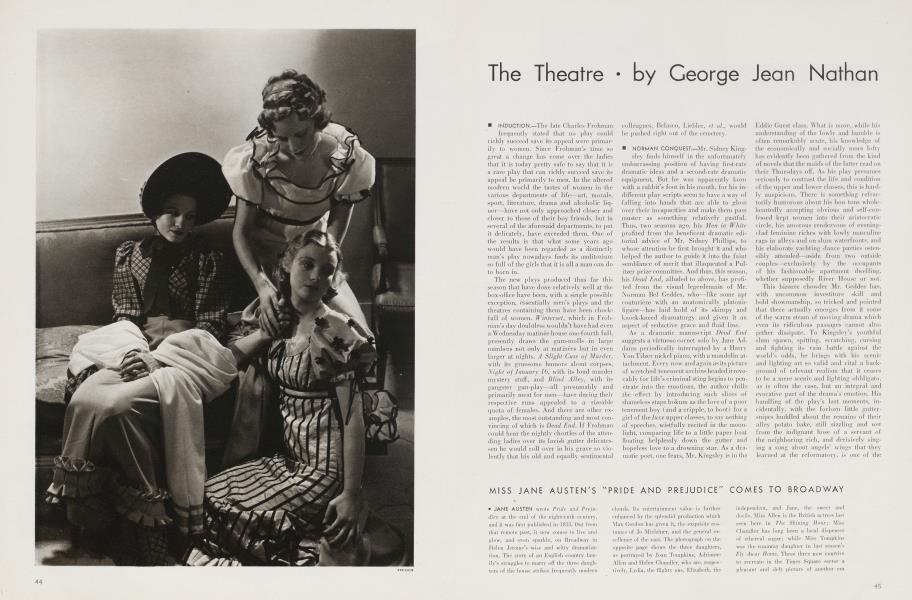
THE EXCEPTION?—The single possible exception mentioned in our second opening paragraph is the dramatization of Jane Austen s Pride and Prejudice which, though perhaps admissible into the record as a woman s play, is at this writing a box-office success. Although a tricky prosecutor might seek to make out a case by arguing that the enthusiastic notices given the play by all the male reviewers in New York, to say nothing of those, antecedently, in Washington and Philadelphia, would indicate that it is, after all. a man s play, and although it is a well-known associated fact that sentimental drama invariably exercises an even greater influence upon most men than upon most women, w'e shall not dodge the issue. For, 1>\ the definition in mind, the Austen exhibit falls under the head of a woman's play and yet it appears to appeal to women. The reasons may be guessed at. The pla\. more or less faithfully transcribing the novel save in the reduction of the number of Bennet daughters from five to three, presents a picture of women's customs, conduct. morals and humors in a bygone age and hence allows the modern woman to pleasure her vanity in a contrasting meditation of her present liberalized and theoretically much more gala estate.
In almost every season, furthermore, there comes along a play which departs sentimentally from the character of the general run of popular plays at the moment and which achieves a measure of popularity on its own simply hy virtue of its departure. This season that play seems to he Pride and Prejudice. In another season it may he The Old Maid and in still another One Sunday Afternoon. Nor is the popularity predicated upon quality. Good or had though tin' play ma\ be. it is its sentimental innocence that appeals to audiences, both male and female, who crave a respite from what passes pervadinglv for sophistication. For in whichever wavs the theatre may change, it is this sentimental innocence that down the ages continues to do business at the ticket window. It may fail now and then, hut give it half a chance and you will find the faces of the hardboiled box-ofliee hoys light up with joy. All the gangsters, harlots, sweating warriors, professors of metaphysics and sex-philosophers of all the adroit playwrights of any day have never, with all their hard and superior laughter, been able to ridicule out of the simple hearts of theatregoers the Old Homesteads and Way Doa n Easts and Peg o My Hearts and Cinder el-las that criticism similarly scoffs at.
The Max Gordon production of the Austen exhibit does a great deal to fasten its effect upon the trade. For all the possible merit of such critical notes as have been indited above, it is yet doubtful if the play could have got where it has with its customers had its presentation been a sparser one. The one strange thing about the exhibit is that the English actress cast for the role of Daughter Elizabeth actually seems very much less in the British Austen picture than the two American actresses cast as Daughter Jane and Daughter Lydia. And it isn t that the English actress in point. .Miss Adrianne Allen, isn't competent, either.
(Continued on page 57)
(Continued from page 47)
THE BIOGRAPHICAL PLAY.—The latest example of the historical-biographical drama to come before us i Housman's I ictoria Regina is in the immediate offing) is the late Mrs. Elsie Schauffler's Parnell. Although it is a very considerable improvement over the species in which the immutable Mr. George Arliss used vaingloriously to convert an historical eminento into the self-considered immensely more eminent Mr. George Arliss. it nevertheless suffers from the faults seemingly inherent in the species in general.
It is a peculiarity of the type of drama in question that the more faithfully it sticks to the facts of its protagonist's life, speech and deportment, the more bogus it often seems in the theatre. Only when fact and history are more or less adulterated does the exhibit take on a measure of conviction. For it is the way of audiences, even the best, to demand that personages of history reflect their own imagined picture of them, albeit the picture he largely fanciful, rather than any real and accurate picture. Moreover. a too factual duplication of some bygone celebrity's utterance and a too obedient record of his personal comportment seldom hold hands with the acted drama and give off an impression of histrionic maladjustment. In a chronicle play, fact may play safe, hut in the more compact biographical play form it often rebelliously takes on an air of fraud.
Parnell. save in slight and negligible detail, adheres too closely to the real Parnell to come closely through the proscenium. That is. as a manuscript. In the 'tage version, the actor selected to play the Irish martyr is so obviously a mere actor playing Parnell, and playing him rather idiotically at that, that audiences are disposed to wave the protagonist aside and to concentrate upon Kitty O'Shea (handsomeK interpreted by Miss Margaret Rawlings i. accept her instead as the protagonist, and thus divert the manuscript into a comfortable theatrical acceptance. If the play achieves any degree of popularity, accordingly, it will he because it deals with Mrs. O'Shea rather than because it deals with Charles Stewart Parnell. The Parnell facts may he forgotten in the person of Actor George Curzon and theatrical romance assimilated in the person of Actress Rawlings. It may he silly, hut critical observation detects it to lie true. The Parnell that Mr. Curzon proffers is a mere miniature Lou Tellegen periodically striking the other of the two familiar Napoleonic attitudes —head dejected, right leg forward, right fist upon belly, left hand (palm outward) at the small of the hack. For Mr. Curzon's safety's sake, may they never show the play in Dublin!
JUMBO.— That the circus which comes to New York annually and shows itself in Madison Square Garden has become. with its persistent lack of variety, something of a bore, hardly calls for restatement. Year in and year out it presents much the same features that we engaged in our short-pants days. Now and then the operating Messrs. Ringling may import a group of saucerlipped l bangis or some German with a yen for being shot out of a cannon to lend a momentary bit of novelty to the affair, hut the rest of the ring remains imbedded in the circus tradition of the 1890's, now grown so sadlv mouldy. It has remained for Mr. Billy Rose and his associate spirits to correct the situation. In the beautifully refurbished Hippodrome they have produced a rich and imaginative circus to end circuses. Jumbo is its name.
Into this Jumbo there have been injected almost all the elements not only of the circus but of the music hall and the theatre. Ben Hecht and Charles MacArthur have written words for it: Richard Rodgers and Lorenz Hart have composed tunes: Arthur Sinclair, quondam foremost comedian of the Abbey Theatre, cracks the ringmaster's whip: the great Jimmy Durante, the Duse of American burlesque, lies in the sawdust and when Big Rosie, the Duse of American elephants, walks over him and his attention is loudly called to the fact that an elephant is walking over him, looks up in dazed wonder and demands to know what elephant: acrobats swing by their toes from circling airplanes and gymnasts perform above an open cage of roaring and leaping lions: and Paul W biteman's band is in the place where always in other circuses we find merely a lot of tin cornets, ten pairs of cymbals and a bass-drum with a Beeman's Pepsin Chewing Gum advertisement painted on it. In short. Jumbo has everything in it but Jock Whitney making a high dive into a tank of flaming kerosene—and even that is promj ised by the management for the New T ear's Eve performance.
1 here may be some who, with critical justification, will point out that dramatic dialogue and zebras do not with comfortable logic go any too well together. And they will recall that the late f red Thompson, the original genius of Hippodrome spectacles, was forced eventually to see that you couldn't altogether successfully have someone, with tears in his eyes, passionately declare to someone else that love was the only thing in the world I while six giraffes were hopping around ! the stage and three rhinoceri were making noises suggestive of the art of George Anthiel. And they will further I recall that when Thompson learned his lesson and wanted to mix dialogue | with a circus atmosphere he did it in ; a theatre play and moved it onto the stage of a regular theatre. But it doesn't seem to matter seriously in the present exhibit, for just as the dialogue approaches the danger point not only have the Messrs. Hecht and Mac\rthur got out the unsparing axe on it but the ring directorate have hustled on enough antelopes, clowns, ironjawed men, fire-eaters, Boscos and pretty girls to silence the qualms of even a William Winter. In short and in six well-chosen .words: a show that's worth the money!
Subscribers have complete access to the archive.
Sign In Not a Subscriber?Join Now


