
Sign In to Your Account
Subscribers have complete access to the archive.
Sign In Not a Subscriber?Join NowHollywood on parade
HELEN BROWN NORDEN
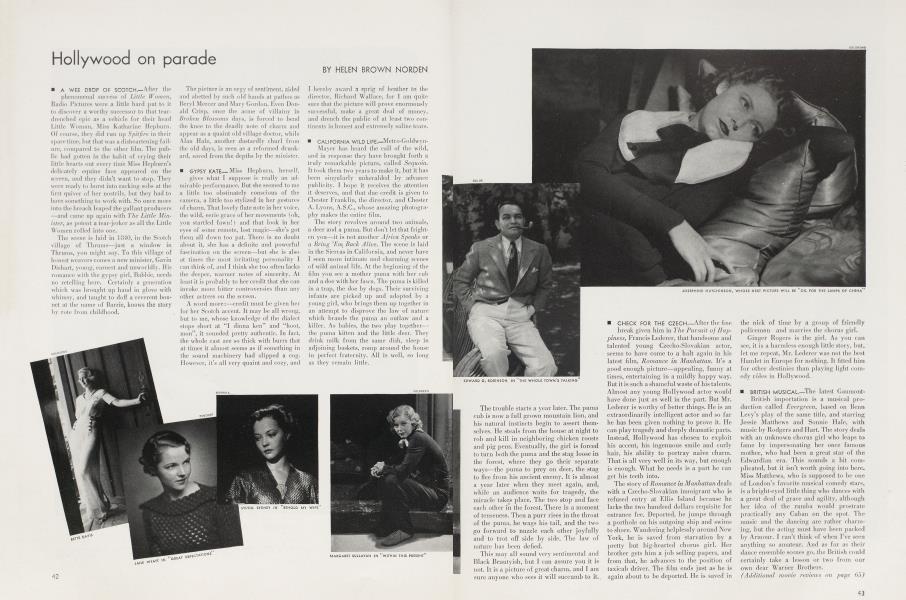
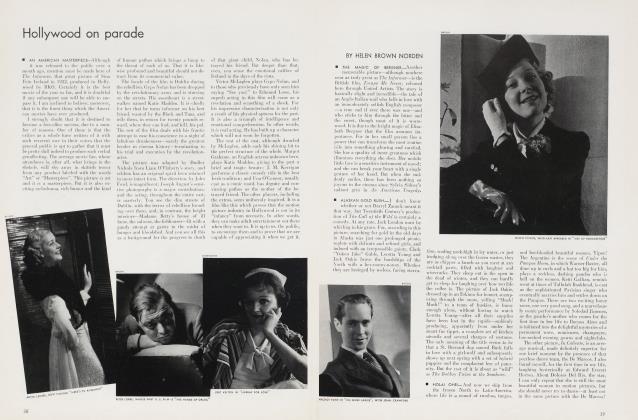
A WEE DROP OF SCOTCH.— After the phenomenal success of Little Women, Radio Pictures were a little hard put to it to discover a worthy successor to that tear-drenched epic as a vehicle for their head Little Woman, Miss Katharine Hepburn. Of course, they did run up Spitfire in their spare time, but that was a disheartening failure, compared to the other film. The public had gotten in the habit of crying their little hearts out every time Miss Hepburn's delicately equine face appeared on the screen, and they didn't want to stop. They were ready to burst into racking sobs at the first quiver of her nostrils, hut they had to have something to work with. So once more into the breach leaped the gallant producers —and came up again with The Little Minister, as potent a tear-jerker as all the Little Women rolled into one.
The scene is laid in 1840, in the Scotch village of Thrums—just a window in Thrums, you might say. To this village of honest weavers comes a new minister, Gavin Dishart, young, earnest and unworldly. His romance with the gypsy girl, Babbie, needs no retelling here. Certainly a generation which was brought up hand in glove with whimsy, and taught to doff a reverent bonnet at the name of Barrie, knows the story by rote from childhood.
The picture is an orgy of sentiment, aided and abetted by such old hands at pathos as Beryl Mercer and Mary Gordon. Even Donald Crisp, once the acme of villainy in Broken Blossoms days, is forced to bend the knee to the deadly note of charm and appear as a quaint old village doctor, while Alan Hale, another dastardly churl from the old days, is seen as a reformed drunkard, saved from the depths by the minister.
GYPSY KATE.—Miss Hepburn, herself, gives what I suppose is really an admirable performance. But she seemed to me a little too obstinately conscious of the camera, a little too stylized in her gestures of charm. That lovely flute note in her voice, the wild, eerie grace of her movements (oh, you startled fawn!) and that look in her eyes of some remote, lost magic—she's got them all down too pat. There is no doubt about it, she has a definite and powerful fascination on the screen—but she is also at times the most irritating personality I can think of, and I think she too often lacks the deeper, warmer notes of sincerity. At least it is probably to her credit that she can invoke more bitter controversies than any other actress on the screen.
A word more:—credit must be given her for her Scotch accent. It may be all wrong, but to me, whose knowledge of the dialect stops short at "I dinna ken" and "hoot, mon", it sounded pretty authentic. In fact, the whole cast are so thick with burrs that at times it almost seems as if something in the sound machinery had slipped a cog. However, it's all very quaint and cozy, and I hereby award a sprig of heather to the director, Richard Wallace, for 1 am quite sure that the picture will prove enormously successful, make a great deal of money, and drench the public of at least two continents in honest and extremely saline tears.
CALIFORNIA WILD LIFE.—Metro-GoldwynMayer has heard the call of the wild, and in response they have brought forth a truly remarkable picture, called Sequoia. It took them two years to make it, but it has been singularly unheralded by advance publicity. I hope it receives the attention it deserves, and that due credit is given to Chester Franklin, the director, and Chester A. Lyons, A.S.C., whose amazing photography makes the entire film.
The story revolves around two animals, a deer and a puma. But don't let that frighten you—it is not another Africa Speaks or a Bring 'Em, Back Alive. The scene is laid in the Sierras in California, and never have I seen more intimate and charming scenes of wild animal life. At the beginning of the film you see a mother puma with her cub and a doe with her fawn. The puma is killed in a trap, the doe by dogs. Their surviving infants are picked up and adopted by a young girl, who brings them up together in an attempt to disprove the law of nature which brands the puma an outlaw and a killer. As babies, the two play together— the puma kitten and the little deer. They drink milk from the same dish, sleep in adjoining baskets, romp around the house in perfect fraternity. All is well, so long as they remain little.
The trouble starts a year later. The puma cub is now a full grown mountain lion, and his natural instincts begin to assert themselves. He steals from the house at night to rob and kill in neighboring chicken roosts and pig pens. Eventually, the girl is forced to turn both the puma and the stag loose in the forest, where they go their separate ways—the puma to prey on deer, the stag to lice from his ancient enemy. It is almost a year later when they meet again, and, while an audience waits for tragedy, the miracle takes place. The two stop and face each other in the forest. There is a moment of tenseness. Then a purr rises in the throat of the puma, he wags his tail, and the two go forward to nuzzle each other joyfully and to trot off side by side. The law of nature has been defied.
This may all sound very sentimental and Black Beautyish, but I can assure you it is not. It is a picture of great charm, and I am sure anyone who sees it will succumb to it.
CHECK FOR THE CZECH.—After the fine break given him in The Tar suit of Happiness, Francis Lederer, that handsome and talented young Czecho-Slovakian actor, seems to have come to a halt again in his latest film, Romance in Manhattan. It's a good enough picture—appealing, funny at times, entertaining in a mildly happy way. But it is such a shameful waste of his talents. Almost any young Hollywood actor would have done just as well in the part. But Mr. Lederer is worthy of better things. He is an extraordinarily intelligent actor and so far he has been given nothing to prove it. He can play tragedy and deeply dramatic parts. Instead, Hollywood has chosen to exploit his accent, his ingenuous smile and curly hair, his ability to portray naive charm. That is all very well in its way, but enough is enough. What he needs is a part he can get his teeth into.
The story of Romance in Manhattan deals with a Czecho-Slovakian immigrant who is refused entry at Ellis Island because he lacks the two hundred dollars requisite for entrance fee. Deported, he jumps through a porthole on his outgoing ship and swims to shore. Wandering helplessly around New York, he is saved from starvation by a pretty but big-hearted chorus girl. Her brother gets him a job selling papers, and from that, he advances to the position of taxicab driver. The film ends just as he is again about to be deported. He is saved in the nick of time by a group of friendly policemen and marries the chorus girl.
Ginger Rogers is the girl. As you can see, it is a harmless enough little story, but, let me repeat, Mr. Lederer was not the best Hamlet in Europe for nothing. It fitted him for other destinies than playing light comedy roles in Hollywood.
BRITISH MUSICAL—The latest GaumontBritish importation is a musical production called Evergreen, based on Benn Levy's play of the same title, and starring Jessie Matthews and Sonnie Hale, with music by Rodgers and Hart. The story deals with an unknown chorus girl who leaps to fame by impersonating her once famous mother, who had been a great star of the Edwardian era. This sounds a hit complicated, but it isn't worth going into here. Miss Matthews, who is supposed to he one of London's favorite musical comedy stars, is a bright-eyed little thing who dances with a great deal of grace and agility, although her idea of the rumba would prostrate practically any Cuban on the spot. The music and the dancing are rather charming, hut the acting must have been packed by Armour. I can't think of when I've seen anything so amateur. And as far as their dance ensemble scenes go, the British could certainly take a lesson or two from our own dear Warner Brothers.
(Additional movie reviews on page 05)
Subscribers have complete access to the archive.
Sign In Not a Subscriber?Join Now
