

Sign In to Your Account
Subscribers have complete access to the archive.
Sign In Not a Subscriber?Join NowThe growing cruelty of the law
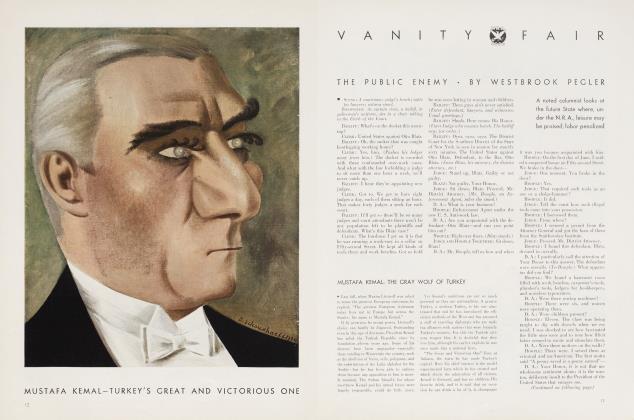
WESTBROOK PEGLER
In which it is elfishly suggested that our imprisoned class has been incorrectly judged by the federal boys
It is my contention that Society ought to set a good example to its mischievous members and that the current policy of shooting down head-strong boys of the John Dillinger type ill-becomes a Government which proclaims a determination to stamp out crime. It suggests a Reign of Anger rather than of Law and a descent from the high purpose of reform to the unkind and scarcely laudable purpose of summary extermination.
After all, John Dillinger, for example, was not a murderer under the law, and his life was his own up to the time that the agents of the United States Department of Justice shot him down without warning. The Law is a beautiful thing. It had promised such men as Dillinger that in the event of his being accused of wrong he would be tried before a jury of his peers and given an opportunity to explain all. Relying on this assurance, the boy was walking down the street one summer evening, chatting with a girl in red, when a group of officers in civilian dress opened fire and laid him in the gutter, a lifeless mass of clay. He did not have time to call his attorneys.
In his dying instant, the Dillinger hoy must have had some cynical thoughts about the sanctity of his Constitutional rights.
And his death in this abrupt and informal manner can hardly he expected to arouse a respect for Law in other young men of like disposition who may he criminals hut deserve their chance to argue to the contrary and, if convicted, should be encouraged to reform and, one day, rejoin Society as useful and honor =able members.
I always like to think of the good that is in people and to try to understand why it is that a Dillinger goes around the country holding up police stations and stealing machine-guns from the gallant officers.
Did he know this was stealing or was lie merely roguish?
This much we know of the Dillinger hoy: That he suffered from a disease called claustrophobia or the dread of being conlined.
From that I would argue that the lad was sick and deserved scientific treatment. I would bespeak for him, too late, alas! the sort of understanding which a great, humane statesman, Governor "Alfalfa Bill Murray, of Oklahoma, evinced in his handling of the murderer in his State Prison who was recently released for a week of duck-hunting. Governor Murray's prisoner did not like to he locked up. It made him nervous and there was no telling but that, under the ordinary course of treatment, his condition would have become acute.
But Governor Murray turned him out for a week's holiday, let him have a gun and ammunition and, by this wise hut obvious course of treatment, cleared up the young man's condition. On his return to prison the physicians examined him for claustrophobia and were happy to be able to write upon his medical record, "Claustrophobia—negative."
What happens in an acute case of claustrophobia?
What happened in the case of John Dillinger when the old sickness came over him again in the Crown Point, Indiana, jail? lie had to get out.
Then what happened?
The Law, to its shame and to the humiliation of all citizens who like to regard the Law as above rancor and too noble to entertain the base and passionate motive of Revenge, determined to abrogate itself and take his precious life without due process of Law.
What has happened in the case of Harvey Bailey, a noted claustrophobe who led a dozen fellow victims of this illness in their outing from the Kansas State Penitentiary?
Mr. Bailey was captured, asleep, in a peaceful barnyard in Texas. To their credit, he it said that the Agents, in this crisis, showed a due respect for the subject's Constitutional rights and did not shoot him. A short time later, being confined in jail in Dallas, Bailey felt again the overwhelming desire to get out. So, brandishing a pistol which he happened to find in his cell, he started for Elsewhere in an automobile.
Recaptured on the road to Elsewhere, he was returned to Kansas and, in brutal disregard of his symptoms, was locked in solitary confinement in the hope that he would tell where the missing portion of theUrschel ransom money was hidden. Still later, Bailey was taken to San Francisco and locked away on Alcatraz Island, the most confining prison in America.
Is this a way to deal with a man who is suffering from a disease?
If a man breaks a leg, the prison doctors paint it with iodine. If he has heart-disease they give him Epsom salts. For every human ill the medical service administers the latest scientific remedy with the exception of claustrophobia. But the worse Harvey Bailey feels about confinement in limited surroundings, the more closely they confine him. Would you treat head-ache with a ball-bat?
I look for no reform in Harvey Bailey s case. His soul will spoil, he will think nothing but unkind thoughts about our country and our President and Sistie and Buzzie Dall and the good that is in him will eventually be contaminated by the bad.
It sometimes seems hopeless to argue for Dignity and a Good Example on the part of the Law in its dealings with unfortunate members of Society. But in moments of despair I am heartened by the courageous example of the criminal lawyers, a noble-hearted class whose great humanity may one day be acknowledged by an enlightened race. For the present, however, they have only their principles to sustain them against the storms of suspicion, ridicule, insult and contempt.
The criminal lawyer understands the claustrophobe, many of them being secret sufferers whose dread of being locked up is often-times more urgent than people suspect. The criminal lawyer remains calm when the public and even the Government, in a rage most unbecoming, would shoot to kill on sight in utter disregard of the true purpose of the Law. which is to protect the rights of all men, including the accused, and to admonish, not punish: to salvage, not destroy, the fineness that God has put in the "worst of us.
(Continued on page 58)
(Continued from page 16)
The criminal lawyer looks at the evidence.
On what ground was Dillinger denied his right of trial by jury?
On the assumption that lie had killed several men and could not he taken alive.
But had he ever been convicted?
No. He had an attack of claustrophobia while awaiting trial and had to leave jail.
In that case, then, he was still innocent under the Law?
No doubt about it. John Dillinger, an innocent citizen, was foully murdered in the name of the Law.
He should have been brought in whole. How? That is the Government's job. What is the Government paid for?
There should have been a trial.
Now the appeal to the Supreme Court. An "i" wasn't dotted. The grand jury which indicted him was drawn out of a hat, not a wheel. A policeman on the stand had said "ain't got no" when he should have said "I have none".
Then the new trial.
Then the newly discovered evidence.
Then claustrophobia again and another flight from jail.
Throughout this process, Dillinger's colleagues were busy robbing more banks to pay the attorneys' fees.
But attorneys have a right to their fees. They are not endowed, you know. Moreover, lawyers pay income taxes on their fees, so the boys who rob banks to pay their fees are really robbing banks for the United States Treasury. The lawyers are entitled to the business opportunities presented by a Dillinger trial. As matters stand now, they are paying taxes to support Government agents who assassinate their clients and obviate trials.
At this point, however, we lose sight of Dillinger and go into a series of trials for his colleagues charged with robbing all those further banks in order to pay for his trials.
Our claustrophobe, in turn, is off robbing still more banks to pay for their trials.
I admit the difficulties of Law Enforcement under this orderly procedure. But Life is not easy and the breakdown becomes a serious thing when the Law, itself, loses its temper and its dignity and goes out assassinating people in flagrant violation of their Constitutional rights. It ought to set the Dillingers a better example.
Encouraging signs occur here and there.
The Robinson boy, who kidnapped Mrs. Stoll of Louisville, had been locked up in an insane asylum for robbing some people a few years before. He recovered, however, and was released.
It was unfortunate that he abducted the Louisville lady whom he first tapped over the head with a blunt instrument in a polite, though firm, manner.
But the Stoll incident, I should say, came under the head of new business. His old insanity had been cured. It says so in tbe records. This, then, obviously was a new attack. Should he recover once more he should be released again for, surely, you wouldn't wish to confine a sane man for an act committed while he was nuts.
The precedent stands, majestic and serene, on the law-books in the case of Harry K. Thaw. He killed Stanford White while mentally ill but became sane through long and expensive court proceedings. Then, whup! Mr. Thaw slipped again and flogged a boy by the name of, believe it or not, Gump, while out of his mind. Once more he was cured and at large, thanks to the passion for justice of the attorneys who represented him. He is now officially sane and will have to be regarded as sane by all persons having the proper respect for Law unless he kills or flogs someone else.
The most cheerful news of all comes from Arizona, however, where two citizens have recently enjoyed the full protection of their constitutional rights in a murder case.
It was shown that they wanted to rob a man and torture him to death by fire in the effort to make him say where his money was hidden.
Convicted of second degree murder, they were plainly victims of a terrible injustice. No second degree murder had occurred. It was a first degree murder. To the everlasting honor of the appellate court be it recorded that the jurists detected this wrong and reversed the verdict on the ground of error. For, better that a thousand first degree murders should escape admonition than two of them should be convicted of a crime which didn't occur.
I wish I could follow the careers of those two boys. I know, at least, that they will leave jeopardy with a higher respect for the Law which saved their lives. I fancy I can hear them telling their attorneys, "The Law is okay."
Subscribers have complete access to the archive.
Sign In Not a Subscriber?Join Now
