










Sign In to Your Account
Subscribers have complete access to the archive.
Sign In Not a Subscriber?Join Now"Planes leaving for Shanghai-Paris-"
PAUL GALLICO
When the Sunday supplement artist has nothing better to do, he draws up a half page of fantastic-looking flying machines landing and taking off from the rooftops of 25th-Century buildings. The designs of these flying machines of the future are practically standard and are quite impractical. A bored rewrite man dishes up five columns of quotes from some local crackpot scientist to go with the pictures, visualizing flights to Europe accomplished in five hours or less, excursions into the stratosphere, dazzling speed, et cetera, most of it eighteen karat baloney, and journalism has made its biannual contribution to science and aviation. In the meantime, Pan American Airways is preparing to fly you safely from Los Angeles to China in three days and nights. That is no dream. That is a practical job.
Within five years, if the world is at peace and diplomats strike their bargains, you may leave New York at eight o'clock of a Sunday morning, rain or shine, and glide to a landing in London at 1:05 P. M. Monday afternoon, with a half a day left for business. The flying time will be around twenty-four hours. And you will do this for the first time in the history of aviation in the utmost luxury and comfort. The designers have stopped fretting about speed. The ship of tomorrow is being built on totally different lines with two main considerations—passenger comfort and fuel capacity. In the past, aviation engineers and designers used to judge the passenger capacity of their ships by the lift, or wrhat the wings could raise off the ground. It won't do anymore. Speed is no longer the object. The world has become accustomed to speed. When the Hornet-powered Pan American Clipper Ship made its recent flight to Honolulu and return, the thrill lay not in the fact that it made the flight thither in 17 3/4 hours, but that it arrived threequarters of an hour ahead of schedule, and when it slid into a landing, the crew stepped out of the cabin, fresh, rested, neatly shaven and their clothes immaculate.
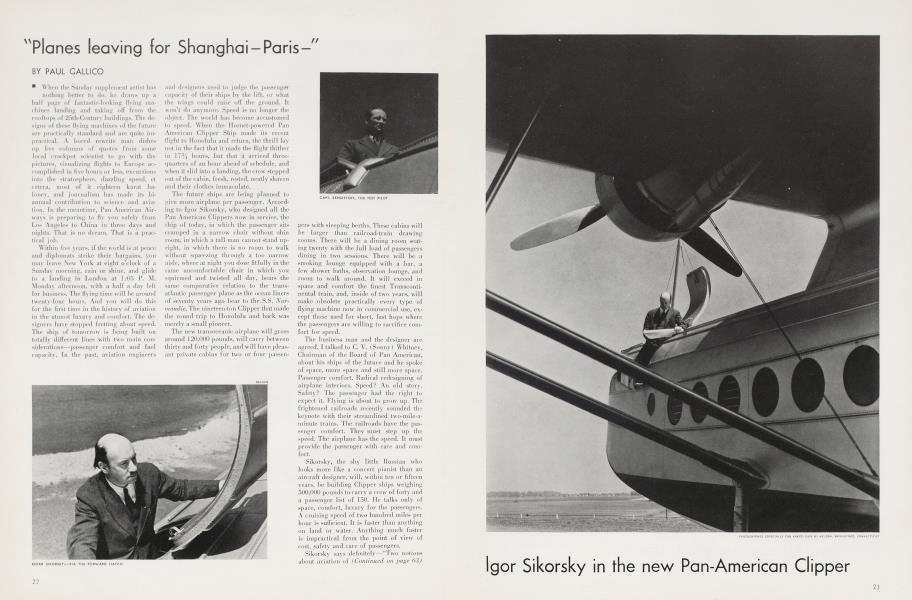
The future ships are being planned to give more airplane per passenger. According to Igor Sikorsky, who designed all the Pan American Clippers now in service, the ship of today, in which the passenger sits cramped in a narrow chair without shin room, in which a tall man cannot stand upright, in which there is no room to walk without squeezing through a too narrow aisle, where at night you doze fitfully in the same uncomfortable chair in which you squirmed and twisted all day, bears the same comparative relation to the transatlantic passenger plane as the ocean liners of seventy years ago bear to the S.S. Normandie. The nineteen-ton Clipper that made the round trip to Honolulu and back was merely a small pioneer.
The new transoceanic airplane will gross around 120,000 pounds, will carry between thirty and forty people, and will have pleasant private cabins for two or four passengers with sleeping berths. These cabins will be larger than railroad-train drawing rooms. There will be a dining room seating twenty with the full load of passengers dining in two sessions. There will be a smoking lounge equipped with a bar, a few shower baths, observation lounge, and room to walk around. It will exceed in space and comfort the finest Transcontinental train, and, inside of two years, will make obsolete practically every type of flying machine now in commercial use, except those used for short, fast hops where the passengers are willing to sacrifice comfort for speed.
The business man and the designer are agreed. I talked to C. V. (Sonny) Whitney, Chairman of the Board of Pan American, about his ships of the future and he spoke of space, more space and still more space. Passenger comfort. Radical redesigning of airplane interiors. Speed? An old story. Safety? The passenger had the right to expect it. Flying is about to grow up. The frightened railroads recently sounded the keynote with their streamlined two-mile-aminute trains. The railroads have the passenger comfort. They must step up the speed. The airplane has the speed. It must provide the passenger with care and comfort.
Sikorsky, the shy little Russian who looks more like a concert pianist than an aircraft designer, will, within ten or fifteen years, be building Clipper ships weighing 500,000 pounds to carry a crew of forty and a passenger list of 150. He talks only of space, comfort, luxury for the passengers. A cruising speed of two hundred miles per hour is sufficient. It is faster than anything on land or water. Anything much faster is impractical from the point of view of cost, safety and care of passengers.
Sikorsky says definitely—"Twm notions about aviation of the future you may be prepared to discard—the stratosphere flight for passenger traffic, and the five-hundredmiles-per-hour flight. The stratosphere flight is a possibility but the sacrifices are too great. The cabin of the stratosphere ship must be a small, hermetically sealed, windowless metal box. Loss of pressure at 50,000 or 60,000 feet of altitude would be instantly fatal to everyone on board. For what? To bring Europe within a span of ten hours? The twenty-hour ship will fly at a reasonable height, between twelve and twenty thousand feet, above all atmospheric disturbances, above the dangerous ice formation strata. The passengers, free from air sickness, will smoke, drink, play, exercise, dance in the recreation hall, walk up and down the glass observation galleries in the leading edge of the seven-foot-high wing, sleep comfortably, eat the finest cooking, travel, in short, in all the luxury that the finest transatlantic liner can provide.
Continued on page 63
Continued from page 22
"The larger the ship, the greater the safety factor. Ships can be constructed to withstand the worst tempests of which the great and limitless ocean of the air is capable. These same ships with their strong, high, duraluminum hulls will ride out the worst storms on the surface of the ocean, if forced to descend. We will sacrifice a few hours of speed and instead give you safety. For by reducing speed, we can increase fuel capacity, and therein lies the real safety factor of the long distance airplane. Is London fogged or storm lashed? Then Hamburg, Bremen, Bordeaux, Lisbon, Marseilles, or Genoa will be clear and safe.
"The flying boats of the very near future will have a flying range of 5000 miles. A word from the radio despatcher at the port of destination, and the pilot presses his rudder pedals, or turns his wheel, or nods to his steersman, depending upon the size of his ship, and the craft flies to clear weather and safe harbor. Taxi planes await the passengers wherever the landing is made. Little time is lost."
Sikorsky believes that for long distance, the oversea flying boat, as it is being developed, will always be the type. For short distances on land, he does not know. It may be the helicopter, or it may be some entirely new design. But fifty years from now, our children will be looking at one of the few existing models of the present-day transcontinental plane, and they will say with considerable awe—"My God, did Grandpa ride in THAT?"
International jealousy and politics permitting, the flying boats which, late this summer, or at the latest, next, will ply regularly between Los Angeles and Shanghai could make a transatlantic crossing with ridiculous ease. The transpacific flight is possible not because of some sudden mysterious advance or discovery in aviation, but because the refueling stops and overnight rests may be made on American territory: Honolulu, Midway Island, Wake Island, Guam and Manila. For the same type of ships, it would not be hard to fly with a full pay-load from New York to Bermuda, to the Azores, to where you will.
But the next step omits the kissing of these island shores. It will be nonstop to Europe on four giant, roaring motors. Two of them will suffice to keep her flying. For all four of the engines of the flying boat of the future to quit will be as strange as if all the turbines of an ocean liner should cease to function at once.
And the final step in the aviation of the immediate future, both Pan-American's Whitney and designer Sikorsky realize, is the maintenance of schedule, come wind or weather. Once or twice a week across the ocean won't do. The mails and the passengers must leave daily on schedule, and arrive on schedule, or as near to schedule as modern organization and engineering can contrive. Nor will aviation be expected to perform miracles here. Certainly, the steamships do not. What inveterate ocean traveller has not spent from twenty-four to forty-eight hours marooned in a fog in the Lower Bay, listening to the muffled clangor of the harbor buoys, and the lowing of the foghorns?
Flying kills and injures no more people proportionately than railroads and automobiles. It merely finishes them off more dramatically. I am as frightened in an automobile driving at sixty miles an hour over a narrow, uneven road, or aboard a ship, groaning and heaving through a gale-lashed sea, as I am in an airplane with a sputtering motor, or flying through the soup of black clouds; and I am just as liable to meet my end in any of them. Transportation can never be anything but hazardous to a degree. That's what travel insurance is for. Even a horse can step on a stone and break your neck for you.
But when the big flying boats of the next ten or twenty years to come declare their schedules, they will maintain them, as Pan-American has maintained its amazing South American schedule—120,000 passengers delivered without so much as a bloody nose.
There is practically no limit to the size to which they may be built, and the larger they are the safer they are, in the air, or on the surface of the water. There will probably be no active competition between sea and land planes, simply because of geography. The land transports of the future will certainly be larger than the present ones, but the small size of flying fields and the desirability of frequent schedules will prevent the creation of giant planes. But the oversea flying boats will be as big as houses, as comfortable, and certainly more beautiful.
There is one more thing these big seaplanes of tomorrow make one regret, and that is the lives lost by those magnificently brave pioneers who went batting blindly across the ocean alone, or in pairs, in single-motored landships. It wasn't necessary. The bigwinged boats were already impulses in the brain of the little mt.n with the soft voice, the wispy hair and the bulging forehead, Igor Sikorsky. They were on the way. They would have come anyway. And when they were ready, they would have crossed the ocean, safely, smoothly, on schedule, as they did yesterday, as they 'will do tomorrow.
Subscribers have complete access to the archive.
Sign In Not a Subscriber?Join Now
