Sign In to Your Account
Subscribers have complete access to the archive.
Sign In Not a Subscriber?Join NowThe great fortunes of Japan
UPTON CLOSE
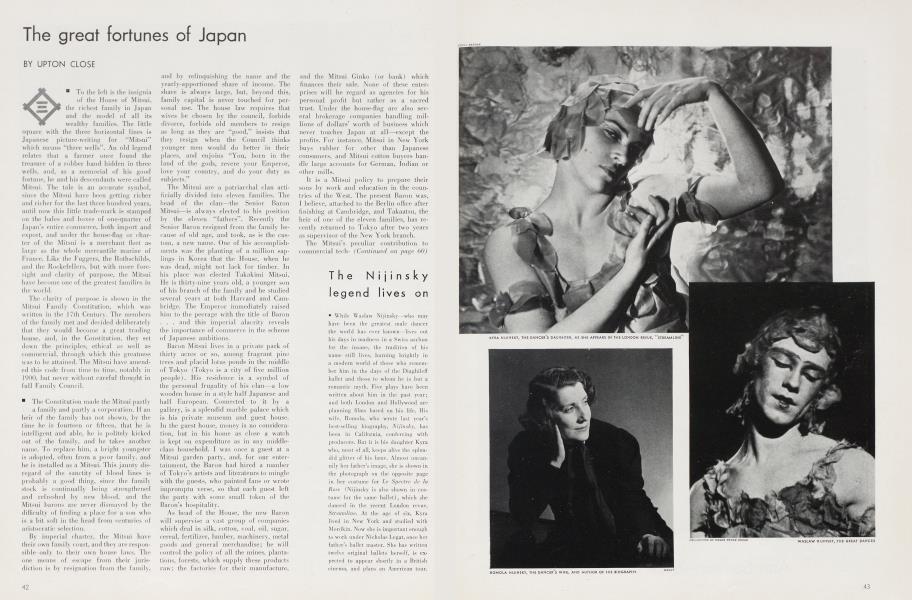
To the left is the insignia of the House of Mitsui, the richest family in Japan and the model of all its wealthy families. The little square with the three horizontal lines is Japanese picture-writing for "Mitsui" which means "three wells". An old legend relates that a farmer once found the treasure of a robber band hidden in three wells, and, as a memorial of his good fortune, he and his descendants were called Mitsui. The tale is an accurate symbol, since the Mitsui have been getting richer and richer for the last three hundred years, until now this little trade-mark is stamped on the bales and boxes of one-quarter of Japan's entire commerce, both import and export, and under the house-flag or charter of the Mitsui is a merchant fleet as large as the whole mercantile marine of France. Like the Fuggers, the Rothschilds, and the Rockefellers, but with more foresight and clarity of purpose, the Mitsui have become one of the greatest families in the world.
The clarity of purpose is shown in the Mitsui Family Constitution, which was written in the 17th Century. The members of the family met and decided deliberately that they would become a great trading house, and, in the Constitution, they set down the principles, ethical as well as commercial, through which this greatness was to be attained. The Mitsui have amended this code from time to time, notably in 1900, but never without careful thought in full Family Council.
The Constitution made the Mitsui partly a family and partly a corporation. If an heir of the family has not shown, by the time he is fourteen or fifteen, that he is intelligent and able, he is politely kicked out of the family, and he takes another name. To replace him, a bright youngster is adopted, often from a poor family, and he is installed as a Mitsui. This jaunty disregard of the sanctity of blood lines is probably a good thing, since the family stock is continually being strengthened and refreshed by new blood, and the Mitsui barons are never dismayed by the difficulty of finding a place for a son who is a bit soft in the head from centuries of aristocratic selection.
By imperial charter, the Mitsui have their own family court, and they are responsible-only to their own house laws. The one means of escape from their jurisdiction is by resignation from the family, and by relinquishing the name and the yearly-apportioned share of income. The share is always large, but, beyond this, family capital is never touched for personal use. The house law requires that wives be chosen by the council, forbids divorce, forbids old members to resign as long as they are "good," insists that they resign when the Council thinks younger men would do better in their places, and enjoins "You, born in the land of the gods, revere your Emperor, love your country, and do your duty as subjects."
The Mitsui are a patriarchal clan artificially divided into eleven families. The head of the clan—the Senior Baron Mitsui—is always elected to his position by the eleven "fathers". Recently the Senior Baron resigned from the family because of old age, and took, as is the custom, a new name. One of his accomplishments was the planting of a million saplings in Korea that the House, when he was dead, might not lack for timber. In his place was elected Takakimi Mitsui. He is thirty-nine years old, a younger son of his branch of the family and he studied several years at both Harvard and Cambridge. The Emperor immediately raised him to the peerage with the title of Baron . . . and this imperial alacrity reveals the importance of commerce in the scheme of Japanese ambitions.
Baron Mitsui lives in a private park of thirty acres or so, among fragrant pine trees and placid lotus ponds in the middle of Tokyo (Tokyo is a city of five million people). His residence is a symbol of the personal frugality of his clan—a low wooden house in a style half Japanese and half European. Connected to it by a gallery, is a splendid marble palace which is his private museum and guest house. In the guest house, money is no consideration, but in his home as close a watch is kept on expenditure as in any middleclass household. I was once a guest at a Mitsui garden party, and, for our entertainment, the Baron had hired a number of Tokyo's artists and literateurs to mingle with the guests, who painted fans or wrote impromptu verse, so that each guest left the party with some small token of the Baron's hospitality.
As head of the House, the new Baron will supervise a vast group of companies which deal in silk, cotton, coal, oil, sugar, cereal, fertilizer, lumber, machinery, metal goods and general merchandise; he will control the policy of all the mines, plantations, forests, which supply these products raw; the factories for their manufacture, and the Mitsui Ginko (or bank) which finances their sale. None of these enterprises will he regard as agencies for his personal profit but rather as a sacred trust. Under the house-flag are also several brokerage companies handling millions of dollars' worth of business which never touches Japan at all—except the profits. For instance, Mitsui in New York buys rubber for other than Japanese consumers, and Mitsui cotton buyers handle large accounts for German, Indian or other mills.
It is a Mitsui policy to prepare their sons by work and education in the countries of the West. The present Baron was, I believe, attached to the Berlin office after finishing at Cambridge, and Takaatsu, the heir of one of the eleven families, has recently returned to Tokyo after two years as supervisor of the New York branch.
The Mitsui's peculiar contribution to commercial technique was the first "Fixed-price, Spot Cash, No Credit" store in Japan, and probably in the world. In the 18th century Hachirobei Mitsui (later called "The Great") founded a dry goods store where he sold cloth in any length desired, whereas others would only sell "kimono lengths"—enough to make a garment for a large person but too much for most people. He introduced the family name into popular novels and plays. When it rained, he loaned his patrons oiled paper umbrellas boldly inscribed with the Mitsui trade-mark. A later head of the house induced the famous Hokusai to include the Mitsui drapery store in the foreground of a painting of Mount Fuji. By this enterprise, frugality and foresight, the Mitsui have made themselves the very pattern of the Japanese wealthy family.
Continued on page 60
Continued from page 42
There are five of these family corporations which are reputed to own more than half Japan's actual wealth, barring the fortune of the Imperial House and the money in the National Treasury, and they control nine-tenths of the nation's industry and shipping. Of these, three—the Mitsui, Iwasaki, (whose trade name is Mitsubishi) and Sumitomo are as conspicuous as are the Fords, Rockefellers and Mellons here. Most of these corporations, unlike the Mitsui, are newly come to power, two or three generations ago, since the introduction of machinery into Japan, but all of them are the result of pure trade and finance. None came solely from political graft, as in the case of the old fortunes of China, or through combined religious and political mulcting as did the wealth of the princes of India.
In Japan, all the important instruments of power and opinion are wielded for one end—the greater glory of the nation. There is no opposition, real or implied, between "big business" and the government as there is here. Business, partly out of reverent patriotism, and partly by command of the Emperor and the military clique, is conducted in subservience to a unified national policy. No rich man is criticised for making too much money, since by tradition he lives simply, and his profits are put into things that mean national glory, whether they be art treasures, or new factories. Thus no Mitsui owns a yacht.
Taxes are low. But in return for this leniency, the rich are expected to buy bonds to balance the budget. Since there are no pink slips attached to Japanese income tax blanks, it is difficult to gauge the wealth of these men. The largest fortune is, of course, that belonging to the Imperial House. I once asked the Minister of the Household if the estimate of the privy wealth at forty five billion yen—a figure set by some Japanese journalists —were approximately correct. I was told, courteously but firmly, that the Emperor's wealth had never been reckoned, never would be, and that it was hoped that no one would ever again be so brash as to ask for the figure. The Emperor owns much city property, including Tokyo's Imperial Hotel; all of Japan's timber land; and blocks of stock in all reputable concerns. In fact, it is by imperial participation that Japanese enterprises are made reputable.
Despite the emphasis thrown by oriental religions on the sanctity of poverty, wealth has always been respected in Japan as anywhere else, but, until 1860, it was the wealth of feudal barons measured in bushels of rice. The mere trader was despised. It was not until 1900, when Shibusawa was granted a barony, that the stigma attached to "business" finally disappeared.
Now, the Emperor recognizes trade as one of the chief props of his Empire, and it is the great commercial houses that he delights to honor, for it is through their shrewd exploitation of their products, as well as through the long swords of the military, that Japan is achieving her great place among the nations.
Subscribers have complete access to the archive.
Sign In Not a Subscriber?Join Now
