



Sign In to Your Account
Subscribers have complete access to the archive.
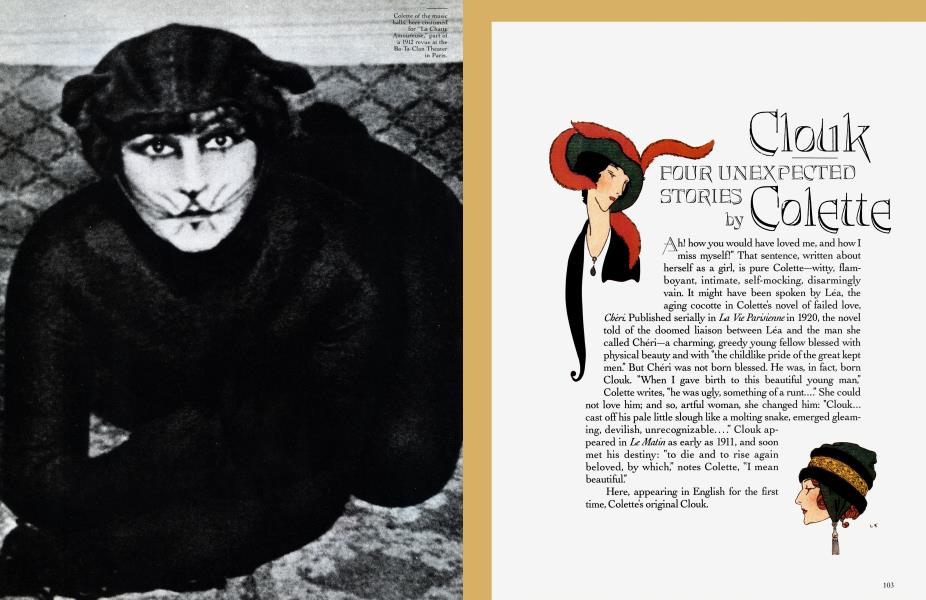
Sign In Not a Subscriber?Join NowClouk FOUR UNEXPECTED STORIES by COLETTE
h! how you would have loved me, and how I miss myself!" That sentence, written about herself as a girl, is pure Colette—witty, flamboyant, intimate, self-mocking, disarmingly vain. It might have been spoken by Lea, the aging cocotte in Colettes novel of failed love, Cheri Published serially in La Vie Parisienne in 1920, the novel told of the doomed liaison between Lea and the man she called Cheri—a charming, greedy young fellow blessed with physical beauty and with "the childlike pride of the great kept men." But Cheri was not bom blessed. He was, in fact, bom Clouk. "When I gave birth to this beautiful young man," Colette writes, "he was ugly, something of a runt...." She could not love him; and so, artful woman, she changed him: "Clouk... cast off his pale little slough like a molting snake, emerged gleaming, devilish, unrecognizable...." Clouk appeared in Le Matin as early as 1911, and soon met his destiny: "to die and to rise again beloved, by which," notes Colette, "I mean beautiful."
Here, appearing in English for the first time, Colettes original Clouk. nd what if I do look at them? They're not going to eat me. Anyway, they really are characters. What happens to some women . . . it's not funny! The fattest one is...what's her name? Yes, I remember, I've seen pictures of her; even with hairstyles the way they were back then, she was very pretty. No, no champagne, it makes me bloated. Besides, we're not setting up shop here: when I think I have to be at my singing lesson at nine in the morning, it's not funny!"
THE OTHER TABLE
Clouk says nothing. He wipes his monocle with the corner of his handkerchief and at the same time closes his bad eye, which the lights in the restaurant, so white they are mauve, sting to the point of tears. It is only midnight, it is raining; the manager can tell there won't be many for supper and divides his attention between the corner where Clouk has just sat down opposite the dazzling Lulu and the table where four women are noisily eating away. . .
"Clouk, your nose!" prompts Lulu peremptorily. "I'm forever having to stop you from sniffling, and it's not funny!"
Pearls and more pearls, a white
"I wonder what she does think is funny," muses Clouk. But he keeps quiet, like a good little boy, docile and loving, and sighs cautiously, through his mouth, so as to avoid the imperceptible, irritating nasal "clouk" to which he owes his nickname. He looks at Lulu. She is all black fire, dark sheen; she makes one think of jet, of deepred rubies. She took the time, after leaving the stage, to take off her makeup and then reapply it outrageously, as if ashamed of the freshness of her twenty-four years. Her eyes, her rather thick hair, which she does not dye, her teeth, all shine with insolent strength.
dress which, in the style of the day, combines Louis XV panniers, a Directoire-style sash, Byzantine decolletage, and Japanese sleeves; on her head is a little black glengarry, which looks as if it is worth four sous, from which there rises an aigrette worth fifty louis. Her feet are not happy under the table because of two purple shoes with gold heels. But she no longer pays them any attention. Good heavens, one's feet are always what hurt most when, for three hours every night, one treads the boards of a raked stage, when one is subjected to spiked heels during the day and to unyielding ballet shoes in the morning.
For Lulu works. Four years have been enough to transform an undernourished dressmaker's assistant into a highly paid star of the music hall. In order to become rich she acquired the taste for money, and hard work gave her a sense of pride. Lulu is as proud as any locksmith or electrician. Like them she says in a tough voice and with mock simplicity, "I'm not afraid to work." She also says, "I didn't know how to do anything, but I learned how to do everything!" She in fact sings, dances, and acts with a cinematographic spirit and swiftness that is already being called "the Lulu style. . . "
"Now who's looking at those silly women! Clouk, you must have some old relative in the crowd!"
Clouk laughed stupidly into his glass and glanced at the neighboring table where there was some rather loud shouting going on over a broken glass. Two operetta singers, once notorious, were laughing through all their jovial wrinkles, across from a poor, graying bit player with a healthy appetite. The fourth woman is Lea de Lonval, overripe, enormous, and magnificent as a heavy fruit fallen beneath a tree...All four have given themselves over to the pleasure of eating a good supper unescorted, and drinking a champagne as celebrated as themselves. They form a wellheeled and cordial group of jewelbedecked matrons. Clouk, listening
to Lulu, turns his sickly little boy's smile toward them, without doing it on purpose...
"So, you see, Clouk, I'm not saying this play they're bringing out for me this winter isn't a marvelous play, not at all. But they're telling me that if I do it, I'll be considered a great actress overQfnight. . .As if I need them to be considered great. .. Which doesn't change the fact that it's a hopeless play."
"Hopeless. I read it. For example, at one point it says that Linda— Linda, that's my role—Linda 'feverishly paces the living room with long strides,' and a little further on, 'She runs after him, panic-stricken,' and a little further than that, 'Linda, raising her arms to the sky in a wide, imploring gesture. . . ' "
"Yes?"
"Yes?"
"What do you mean, 'yes'? Oh, my poor dear, I can be talking to you about the theater, or literature, or anything serious, and you always have the same silly look on your face! You must understand that that scene, the way it is, can't be done! Can you see me, in a day dress, pacing the stage 'with long strides'? Can you see me, in that same dress, running after my lover 'panic-stricken'? And then try, just try raising your arms 'in a wide, imploring gesture' with sleeves nowadays not having any seams at the shoulders! So I told them, I said to the authors, 'I don't care if your play flops, but / do not want to fall flat on my face, nor do I want to dress like Raymond Duncan! There would have to be changes, a lot of changes!' "
"Yes..."
" 'Yes'... There's one thing no one can take away from you, you are a gifted conversationalist!"
Clouk keeps himself from sniffling and adjusts the monocle which he uses to hide a weak eye, smaller and paler than the other. He remains silent. What could he say? Lulu's metallic voice, her gemlike dazzle overwhelm him. That is how she is, vigilant, merciless, with a tough youthfulness nothing can penetrate. ☺She is not a monster, she is one of those terrible young girls of today, hard and narrow-minded. He has seen her cry, but with rage, during her lessons. He has seen her laugh, to make fun of him or a friend. She is thought of as sensual, but he knows very well that she displays her beautiful skin, white and blue like milk in shadow, coldly, and that this too is part of her "job."
Clouk can hear, striking against the lace-covered windows, the hissing of a winter downpour which has almost turned to sleet. He is thinking about getting home, about Lulu's conjugal silence, the voice teacher coming at nine o'clock tomorrow morning, the masseuse who comes after him...As she does every day, Lulu will have that set, stern look on her face, darkened by important matters. As he does every day, he will wait until it is time for her to make her entrance, when her charming mouth flowers into fresh, aggressive laughter. He feels cold, a little ill. What he needs is. . .
Clouk stares at the other table, the table with the old ladies. They laugh constantly, and perhaps for no reason, with that lightheartedness which comes to a woman when the peril of men has at last left her. Lea de Lonval, a colorful woman beneath her white hair, looks like Louis XV, and the older of the operetta singers has the sauciness of a racy grandmother. If Clouk dared, he would slip over to their table, all frail and small, squeeze in between those fat gossips' arms, amid the rustling skirts and the doughy knees, and lean up against the ample shoulders, lost, drowned in that melting warmth of slightly senile nannies; he would warm himself, console himself for being the envied lover of Lulu, sparkling there in front of him like a frosty little tree. . .
no piece of flypaper; and his circle of friends, rising up as one, scorned Clouk to the point of dropping him altogether. Only the sisterly and melancholy friend named Eva stood by the sniffling, phlegmy Clouk, calling him "poor thing."
"You poor thing, I can't stand seeing you like this anymore. Let's go have a smoke."
"A smoke of what?"
"Opium."
"Oh, m opium."
Clouk still remembered , after one try— three pipes following a heavy dinner—a severe case of indigestion.
But his consoler's authority left him no room to argue, and less than an hour later Clouk, undressed, shivering under a kimono, was lying down on a thin mattress covered with a white mat, cold and smooth to the touch like the skin of a lizard.
Across from him, on the other side of the lacquered tray, he could see Eva fussing about, stout and heavy in her Japanese dress, with her dyed hair hanging across her unpowdered cheek, suddenly affectionate with that bizarre motherliness of women opium smokers: "Wait, you're not comfortable. ..This cushion here under your head. . . Oh, he's so pale, a real Pierrot. . .You'll feel better in a minute... I'll turn off the ceiling light. As you can see, it's not set up as an opium den; most of the time, it's my little living room."
Clouk, lying on his side, clenched his teeth to keep himself from shivering, or crying, or talking. His eyes wandered from the ceiling hung with fabric to the cheap plaster Buddha, dark against the bright wall, then returned to the three luminous, living blazes formed by Eva's face and deft hands in the shadows. The little oil lamp, beneath its crystal hood, also caught his eye and he blinked, bothered by the short flame, without the strength to turn his head away...
"Wait," said Eva, "I'll cover the flame for you. Would you like the butterfly, or the spider, or the little moon?"
With the tips of her fingers, she turned the tiny screens of colored glass, jade, and horn around the globe of the lamp. Clouk was silent, intimidated, and tired, and the screens passed between him and the flame like the figures of a new and incomprehensible game...
THE SCREEN
hen Lulu left him, Clouk did not give in right raway to the stunned despair which dismays rthe very young. He rwent on with his life, going out to restaurants and bars, driving around in his car. His everyday little face seemed unchanged, clean and comical, his left eyebrow clamped down to hold his monocle in place, his fishlike mouth open slightly. As he was ordinarily quiet, no one noticed that he wasn't speaking at all and that he was sniffling more often. He was conducting himself quite well.
But the "close" circle of friends who were looking after him finished him off with enough sympathy to kill an ox. One would clap him on the back with the crude cordiality of a sergeant. One melancholy and sisterly friend discreetly informed him as to Lulu's whereabouts and carryings-on, under the guise of "keeping things out in the open." Without saying a word, the least cruel would hand Clouk a full glass. . .
And so when his friends, gasping
from self-sacrifice, wanted to return to their usual occupations, it was noticed that Clouk, drinking more, was not eating at all, and that his collars looked like hoops around the neck of a plucked bird.
Clouk was suffering, still stunned. He did not dare say it, and he began confronting his interrogators with the smile of one whose feet have been stepped on while waltzing. His headstrong, youthful sadness knew nothing of the confidences in which the lyricism of old incorrigible lovers takes comfort. He believed he was hardly thinking at all, did not delude himself, and did not repeatedly whisper her name: "Lulu. .. Lulu. .. " But without knowing it, he endured a twofold pain. At times he would reel, light-headed, floating, as if blank forever; at times he would run away, hoping to leave far behind him, in the place he was fleeing, the intolerable memory.
He ran into Lulu one night in the restaurant, accompanied by her new "friend," and was quite proud of himself for feeling neither shocked nor heartbroken. But the next day, sitting in a music hall, he broke down in tears watching a clown who couldn't free himself from a
CLOUK
Eva's band, bumping tbe lamp, made tbe screen slip off and Clonk groaned, wounded by tbe naked light. There, there, sbbbb ... I didn 't do it on purpose'
Hearing the drop of opium sizzle, he leaned back on his elbows. His hands were shaking so badly as he took hold of the bamboo that he burned his first bowl somewhat, and his throat filled with acrid smoke.
"Very clever," said Eva without impatience. "Here, let me fix you another."
Clouk, having laid back down, breathed in the smell of the opium, surprised to find it agreeable, comestible, soothing.
"You understand...," he began despite himself.
Eva merely nodded and he ventured on. "You understand, don't you? I haven't been eating or sleeping much lately. When you're worrying yourself sick... "
She interrupted him by offering him a second pipe, which he exhausted with one long inhalation, without taking a breath, and his consoler, who knew the price of silence, whistled softly to express her admiration.
Lying back on the mat, Clouk repeated slowly: "You understand that since.. .since it happened, it's been as if I have nothing of my own. It's strange, I can't get it into my head that I still do have things of my own, even my money, since.. .well, since then. You see, I... I'm worried..."
Already intoxicated, Clouk spoke with childlike sweetness. Several more times he said, "I don't have anything of my own...of my own...," then was quiet, and stopped the pathetic shivering, the tightening of his stomach muscles, and the flexing of his toes. He sat up for a third pipe and lay down once more, happy to be thinking again at last, lucidly assessing his lovelorn misery, assimilating it to his utter destitution. A mellifluous murmuring of rising water filled his ears, and his entire body, healed, experienced
the sensation of a lukewarm bath, whose liquid density would lift him...He did not think of Lulu's apparition, and did not call it forth, but the successive settings of their life as lovers rose with singular and progressive strength. Clouk, motionless, his eyes half open and dead, was reveling in the heightened colors of Lulu's little living room, the deep greens of a garden at a spa. A gnarled, old wisteria clung to the pitted wall of a tower; Clouk followed the tortured vine of the clambering trunk, counted the flowery clusters, inhaled their acacia-like fragrance...
Other landscapes appeared, without Lulu in them, but as if still fragrant with her passage, and all of them, vast or intimate, were inscribed in the nacreous little moon, in the tiny screen hooked on to the lamp...
"Clouk, are you asleep?"
Clouk heard but did not answer. Even if he had wanted to, he would not have been able to turn his eyes away from the transparent disk of lustrous mother-of -pearl. But Eva's hand, bumping the lamp, made
the screen slip off and Clouk groaned, wounded by the naked light.
"There, there, shhhh.. .1 didn't do it on purpose."
The pink penumbra once again veiled the flame, and Clouk's eyelids moistened, brimming with wellbeing. Borne along with the murmuring of the rising water, he was slipping off to a black and priceless sleep. "Nothing of my own?" he said to himself without moving his lips. "No more mistress, no more home?" He smiled, or thought he smiled, and took pity on himself for having cherished and regretted such perishable belongings, since now he possessed, beaming gently within reach of his eyes and his fingers, milky, iridescent, deliciously round, huge as a star, no bigger than a precious coin, the little mother-of-pearl moon, the opaline satellite of the opium lamp.
CLOUK ALONE
ou rats! You can't, you can't desert me like rthis!"
"We most certaincan! Stop, Clouk, you'll tear my coat .. .Make him stop, can't you see I can't raise my arms in these sleeves!"
The small woman struggles, and Clouk holds on to her with the sticky perseverance of a tipsy man. He is only a little drunk, and besides, the fine rain showers his damp forehead, the warm rims of his ears...
''''You're not going to desert me too, are you? You're more loyal than that!"
The circle of friends dwindled despite Clouk's entreaties. He latched on to two "loyal" friends whom he succeeded in detaining for twenty minutes on the main staircase of his residence, then for a good quarter of an hour on the divan in the front hall. He still hopes to keep them awhile on the terrace, despite the damp night, the wind shaking the chestnut trees, roasted by the summer heat...
All three stand around, black against the wide, illuminated hall, the muddy gravel of the garden. The small, imprisoned woman looks as if she is dancing in Clouk's arms. Her peaked hat meets a gray fox collar that muffles her neck and her ears; but the rest of her body shivers under a tight satin wrap glistening in the light like a blue fish.
CLOUK
"Lord," she exclaims, "this is August! I'm freezing! We'll see you tomorrow, Clouk. What am I saying, tomorrow? We'll see you today, it's already past two.. .My darling husband, are you asleep on your beautiful little feet?"
"Let Robert leave by himself," begs Clouk. "You can keep me company."
The woman bursts out laughing. "Robert? Leave by himself? No danger of that: he's much too afraid all alone at night! Aren't you, Robert?"
Robert only groans like a man shaken in his sleep, and Clouk doubles over with laughter and slaps his thigh. "He's afraid to be alone? That's too much.. .Come inside and tell me all about it, Eva!"
But, despite her tight coat, Eva gets away and manages to run, dragging Robert, drowsy and dignified, behind her. Her feet, in white shoes, skip with short hip-hops like two little rabbits. Clouk follows her like a puppy. He opens the gate regretfully, hoping that the car waiting at the curb won't start... But it does, on the first try, then glides off unctuously over the wet asphalt as Clouk shouts out one last time: "See you this afternoon! Hey, Robert .. .Robert! Leave Eva with me and I'll turn you over to my old nanny if you're so afraid of the dark!"
He leans forward to see the red light on the tail of the car pull off and fade away. Then, suddenly, his face freezes and he shuts the heavy
gate. He walks back toward the brightly lit house, with long, gliding strides, forcing himself not to run, his arms pressed to his sides so as not to brush against the shrubs. The entrance hall dazzles and reassures him; he takes off his misty monocle, blinks his sensitive eyelids, and shrugs his shoulders.
"Afraid to be alone at night... Oh, brother... "
He was about to turn off the electricity before going up to his room, but stopped short: to get to the light switch he would have to walk past a long mirror, tinged green by the dampness, where he would have time to watch himself walking by, paler than normal, even more of the "poor child" than his fabulously wealthy mother had made him.
He does not like to walk past it at certain hours of the night. He prefers to go straight up to the second floor, letting the chandelier and the sconces burn on. Upon waking, he would open his fishlike mouth, which could feign astonishment quite easily, when his inexorable valet would say to him: "Monsieur realizes that Monsieur again left the lights on downstairs. Monsieur won't wonder why Monsieur's electric bill is seven hundred francs again this month, worse than a department store."
Clouk, born a millionaire, remained parsimonious by upbringing: a new car every year is a duty, turning off the electricity when one leaves a room is another.
He hurries noiselessly up the staircase, reaches his room, which he
crosses double time, and rushes into his dressing room, turning on the light with a feverish hand before falling into an easy chair.
"Afraid to be alone at night..." Right now Robert must be undressing to the reassuring sound of feminine chatter; Eva humming, taking off her shoes, yawning with a moan, fluffing up the pillows... Since Lulu left him, Clouk, as weak as if he were being bled, would revert at night to the terrors of childhood. He is flabbergasted that, before Lulu, he had been able to live alone in this pretentious dungeon, erected near the gates of the Bois de Boulogne, "an edifice, Monsieur, to withstand a siege," the architect had declared.
"A siege," repeated Clouk. "Why did the idiot say that? Is it within the realm of possibility that it would ever come under siege?"
He reaches out a limp hand to touch the wall, to feel its deep resonance like that of a full wine cask, but the coldness of its varnish stings him like a burn.
"A siege... Who's stamping around down in the garden like that? Really now... "
For a brief instant, the combativeness of the proprietor in him struggles with an alcoholic cowardice.
"How many of them are there? My God, they're making a racket!" stammers Clouk, his head buzzing.
He wants to get up and run to the window, but would he even be able to raise the padlocked bar across the heavy iron doors? Clouk, immured in his citadel, panics behind the walls whose protection he had just invoked.
"Somebody could easily do me in here, the neighbors wouldn't even wake up... "
"Do me in..." The words struck Clouk's sad brain with the dull sound of doom. Whole pages from detective novels, illustrated with thugs in cars, masked men carrying bludgeons, came back to Clouk's memory like so many dire predictions. "Do me in...do me in..." and Clouk cursed his daily reading, which delighted him when the morning sunlight made the shadows of the leaves dance in the folds of the sheets. Oh, to believe in phantoms as when he was a little boy, to tremble at the mere rustling of an invisible, silky dress, to run from the harmless ghost abroad at midnight, how thrilling compared to the precise image which now has Clouk glued to his chair: a white hand wrapped around the black butt of a revolver moves slowly through the open door of the bedroom. Slowly, slowly, the muzzle of the gun turns its round eye toward Clouk. . . Afterward, there is nothing but chaos, horror, warm blood on the white rug, the smell of gunpowder and melted metal around the open safe ...But this bloody confusion, still settling in Clouk's imagination, does not equal in shock the appearance of the white hand, there in the doorway of. . .
"No!" he screams despite himself.
The loudness of his scream makes him stand up, his back to the wall, hands groping. A bell button gives way beneath his fingers, and this involuntary gesture brings him back to his senses.
"Did I ring? Did I ring or not? I didn't hear the bell. . . But if I didn't ring, who's that coming up the stairs?"
Back against the wall, stiff, dripping with sweat, Clouk has time to appreciate the difference between the footsteps of an imaginary group of people and the sound of someone approaching, slowly, heavily climbing the stairs, fumbling with the door, opening. . .
"Monsieur rang?" asked the valet.
Breath, movement, both came back to Clouk with life. And life is all vanity, reflection, the meaning of lies and frugality, his very soul. . .
"Yes. . . I'd like you to turn off the lights, downstairs, in the front hall."
CLOUK'S FLING
It is only half past midnight; they have arrived a little early, the bar is nearly empty. Clouk and his "companion" sit down side by side on the red banquette, haphazardly, with the vague feeling they would be better off at the table across from them, or in the corner at the back.
"You don't think we're too near the door?" his companion asks.
Clouk lifts one shoulder, sticks out a dubious lower lip, and his monocle falls. He wipes it, then applies it once again to his right eye, with a carefulness he knows is vain, for the monocle refuses to stay put for long on his soft little face, made, one might say, of pink butter.
"Garmon! Keep an eye on the door, will you, our legs are freezing!"
His companion gives the orders, with the authority of an old habitue, and lights a cigarette before even unbuttoning her coat.
"What are you having, Clouk?" "Uh. . .1 have no idea, really."
He too is smoking, his eyes on the entrance, and shivers each time the door is opened: what if, after her performance, Lulu had the idea to come have supper?... He barely gives it a thought, he doesn't think about it anymore, it's over, but each time the revolving door gleams and spins, he trembles imperceptibly.
"I think I'll have a nice little whiskey soda," says his companion. "And you?"
"I'll have. . . I don't know. . . a hot toddy."
He shivers at the thought of the steaming and spicy toddy. Opposite him the mirror reflects a stiff, pale little Clouk, next to his companion devoid of coquetry, somewhat heavy and squat in her moleskin coat. She is a brunette, dyed a redhead, whom one must meet several times before recognizing her, not ugly, not pretty, with big eyes and a hard mouth. She yawns nervously and, with a compulsive gesture, clicks the clasp of a long, dented gold case, bigger than a wallet, that can hold fifty cigarettes.
Neither she nor Clouk saw the color of this brief and bright winter day.
They got home around five in the morning, after a dismal night in Montmartre. Suffused with tobacco and the smell of alcohol, they slept the uneasy sleep of those who drift off a little drunk, deprived of the warm spray of the shower and a scented bath.
They woke up stiff and unsightly around three in the afternoon, with the impression of having slept a very long time and being very old. The best time of their day was the interminable daily toilette, two hours of bath, hairdresser, manicurist, masseuse: the meticulous and listless toilette of cloistered women, the empty chatter, the perplexed fussing with ties and vests. . .Then the brief drive in the car around the already dark Bois, truly an old ladies' drive, cut short again by the desire, the need to return and sit down at the table of a bar. "Some port and herring sandwiches, right, Clouk? What dried us up like that last night was that nasty demi-sec champagne."
They tried to eat dinner around 9:30, both of them overtaken by a sudden concern for health: two jus de viande and pasta. Clouk, basically disgusted, gulped down the syrupy, peppery juices and twirled skeins of long noodles around two forks, broadening his narrow shoulders with the childish hope that his "diet" would endow him with new strength and muscles to amaze the universe, the entire universe—and Lulu too.
The hours after dinner, divided between the restaurant and box seats in a music hall, went by quickly—barely time for a dozen cigarettes—bringing back midnight and the moment to sit down, for the third time since waking, in front of a stiff tablecloth, glazed by the roller, and cold as oilcloth.
Each time he sits down at a table in some late-night bar, Clouk feels a warm, fleeting rush of exhilaration. He is beginning to believe, he the weak, he abandoned by Lulu whom he loved, he the poor little rich boy, miserable and friendless, that he was closing, joyfully and forever, the dark string of his errant days. There are nights when every reflection in the glass panes of the revolving door seems to announce a marvelous arrival, which he was no longer hoping for, nights when the soft handshake of his "friends" seemed warm to the touch and indicative of a vigorous friendship; nights when the bubbly alcohol, gulped down like medicine, numbs the cramps in his stomach and the migraine clamped around his head. So Clouk gives himself over to the pleasant, poisonous warmth dilating and deadening him; he leans his head on his sisterly companion's shoulder and speaks to her vaguely, in a low voice, while a familiar chorus of men and women eating their supper comment—some kindly, some ironically—on the tender pose of the two "lovers."
This same night, despite the emptiness of the room which creates an anxious idleness in the woman who owns the bar—yesterday's demimondaine, today's plump businesswoman dressed severely, like a minor town official's wife—Clouk does not despair and waits for his hour. From minute to minute, the glass door turns, flashes brightly, and Clouk shivers, not with hope, but by now it is a habit with him to jump at the sound of a door or the ringing of a bell.
"You can be such a bore," says his companion indolently. "I had a dog like you once, his left leg used to twitch all the time. The vet said it was worms. . ."
...It has been a long time, it has been months since Clouk stopped waiting for Lulu. He simply watches the door and counts the people who come in, the anonymous walk-ons vital to his happiness.
There are the couples of petite women, regulation brunettes this year, hair all over the place and a little powdery, with lips as thick as a quadroon's.
There, one by one, or in groups, are Clouk's "friends," who for the most part are juvenile, defiant, and brought up to hold women in respect. The fact of drinking in company does not incite them to generosity, for they are rich, and it took the worst misfortune of love to teach Clouk, if not prodigality and the disdain of money, at least the beginnings of a noblesse called casualness. . .
When the shy's no longer blue,
The hearts of lovers will be true. . .
The piano, the diuretic scratching of the mandolins, the thready voice of a short tenor all rose together, and Clouk nodded in time to the music as if greeting someone affectionately recognized. The time for the music has come; the bar, now packed, is thick with smoke. Clouk is no longer trembling, no longer waiting for anyone. His night is beginning according to ritual; he is warm, he is thirsty because he has been drinking; he will have all the songs he likes, all the chaste, melancholy songs which comprise the repertoire of disreputable establishments and Clouk's own poetic anthology: he will hum:
You swore you loved me only,
But you left me sad and lonely.. .
He will proclaim at the top of his voice:
/have a girl as blond as the sun,
In this wide world she's the only one. . .
He will be drunk, howling, and happy: nothing, except dawn, will disturb the reassuring and predictable course of his sleepless night. A few more drinks, a few more rhymes, and he will be
drunk enough to abandon himself—his feet on the knees of a "friend" he doesn't know, his head leaning back against the warm shoulder of his sweet, insipid companion—to abandon himself to his most heartrending and purest memory, to his hidden, incurable love, still intact, for Lulu.
Matthew Ward\
Subscribers have complete access to the archive.
Sign In Not a Subscriber?Join Now


