
Sign In to Your Account
Subscribers have complete access to the archive.
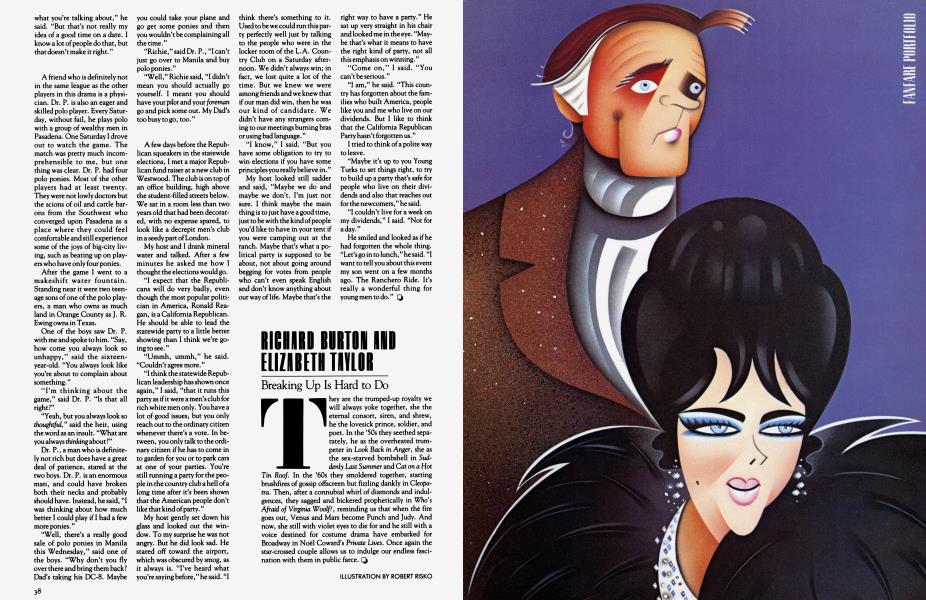
Sign In Not a Subscriber?Join NowThey are the trumped-up royalty we will always yoke together, she the eternal consort, siren, and shrew, he the lovesick prince, soldier, and poet. In the ’50s they seethed separately, he as the overheated trumpeter in Look Back in Anger, she as the sex-starved bombshell in Suddenly Last Summer and Cat on a Hot Tin Roof. In the ’60s they smoldered together, starting brushfires of gossip offscreen but fizzling dankly in Cleopatra. Then, after a connubial whirl of diamonds and indulgences, they sagged and bickered prophetically in Who’s Afraid of Virginia Woolf?, reminding us that when the fire goes out, Venus and Mars become Punch and Judy. And now, she still with violet eyes to die for and he still with a voice destined for costume drama have embarked for Broadway in Noel Coward’s Private Lives. Once again the star-crossed couple allows us to indulge our endless fascination with them in public farce.
FANFARE PORTFOLIO
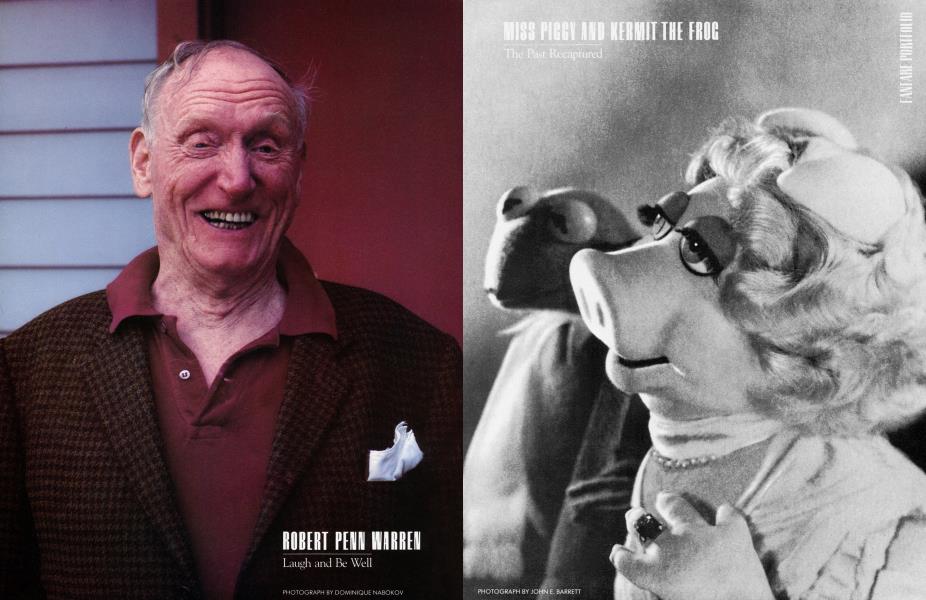
ROBERT PENN WARREN
Laugh and Be Well
MISS PIGGY AND KERMIT THE FROG
The Past Recaptured
FANFARE PORTFOLIO
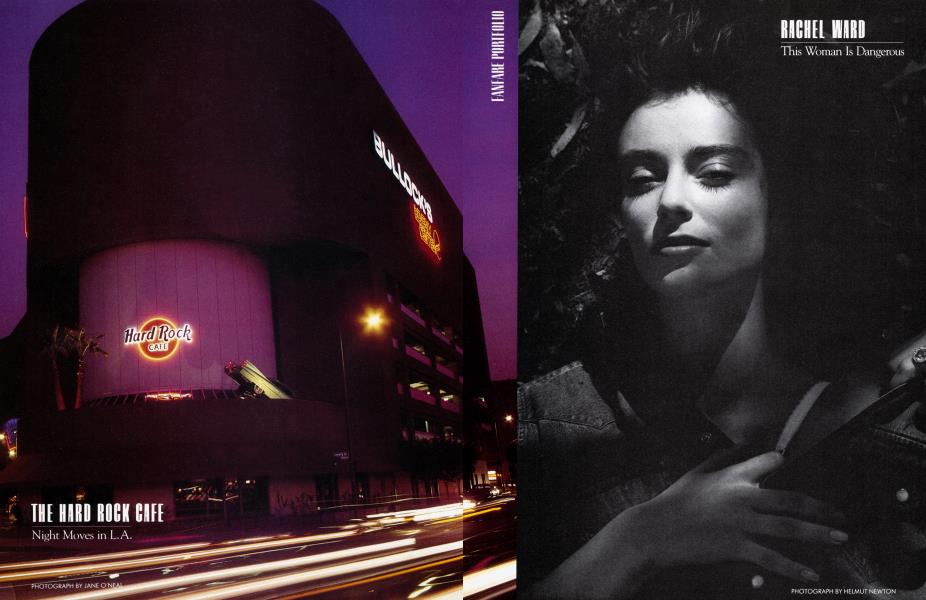
THE HARD ROCK CAFE
Night Moves in L.A.
RACHEL WARD
This Woman Is Dangerous
FANFARE PORTFOLIO
ROBERT PENN WARREN
He once explained: “Historical sense and poetic sense should not, in the end, be contradictory, for if poetry is the little myth we make, history is the big myth we live, and in our living, constantly remake.” He should know. From Kentucky boy to Yale professor, in seventy-eight years and thirty-seven volumes—the newest a narrative poem, Chief Joseph of the Nez Perce, just published—winning almost every imaginable literary prize, writing for “little” magazines and big book clubs, he has made it his business to rescue self (“lonesome weather”) from time (“the mirror into which you stare”), nature (“insufferable intransigence”) from history (the Great God “Twitch”). For Robert Penn Warren, neither self nor history is innocent; the romantics missed the point of original sin, that dragon, that albatross. This Ancient Mariner, dreaming in essays, poems, and novels of such splendid and ambiguous American types as Melville and Dreiser, John Brown and Thomas Jefferson, Huey Long and John James Audubon, has himself become one.
THE HARD ROCK CAFE
A space shuttle? Moby Dick? Neither. It’s another Los Angeles shopping mall/parking lot, one of those “toy garden cities,” as Joan Didion described them, “in which no one lives but everyone consumes.” This one, however, bares its savage dentures in the form of a ribs-eating restaurant. Note its apocalyptic advertisement for itself, a creation of designer Paul Fortune Fearon and owner Peter Morton. The palm tree represents old California, before Spaniards and hot tubs. The ’59 Cadillac, going down with a flourish of fetishistic tail fins, makes a statement about our love-hate relationship with cars. (The statement is borrowed from the Ant Farm, an artists’ collective that buried ten Cadillacs fins-up in the Texas Panhandle in 1974.) L.A.’s city fathers, unamused, hassle the Hard Rock Cafe about that Cadillac.
MISS PIGGY
Newly discovered in the archives of Vanity Fair, a stunning portrait of Kermit and Miss Piggy, taken at the premiere of Flying Down to Rio. Of the magic couple, Vanity Fair critic Karl Gossamer wrote: “He, frog of the world, suave, swashbuckling, verdantly handsome; she, scrumptious, demure, adored, a star in her own right with a good left. It is that rare instance where two stars, their careers at apogee, shine together in splendid syzygy, the one not eclipsing the other, and the twin luminosities resulting from this harmonious conjunction of heavenly bodies producing a dual radiance that strikes the retina of the humble, earthbound observer like the headlights of some celestial Duesenberg hurtling along the cinematic boulevard to a rendezvous with eternity.”
RACHEL WARD
No, she is not Jane Russell. She is, instead, five feet eight inches of killer sex, a twenty-five-year-old British-born Virgo vegetarian who listens to Ry Cooder, reads Evelyn Waugh, and owns four dogs. Magazine covers include British Vogue, Interview, and Cosmopolitan. Men range from David Kennedy (at Xenon) to Joe Namath (a Brut commercial) to Burt Reynolds (Sharky’s Machine) to Steve Martin (Dead Men Don’t Wear Plaid) to Richard Chamberlain and Bryan Brown (The Thom Birds). Chamberlain played Ward’s leading man in the ten-hour ABC-TV mini-series; off camera, the Australian Brown got the part.
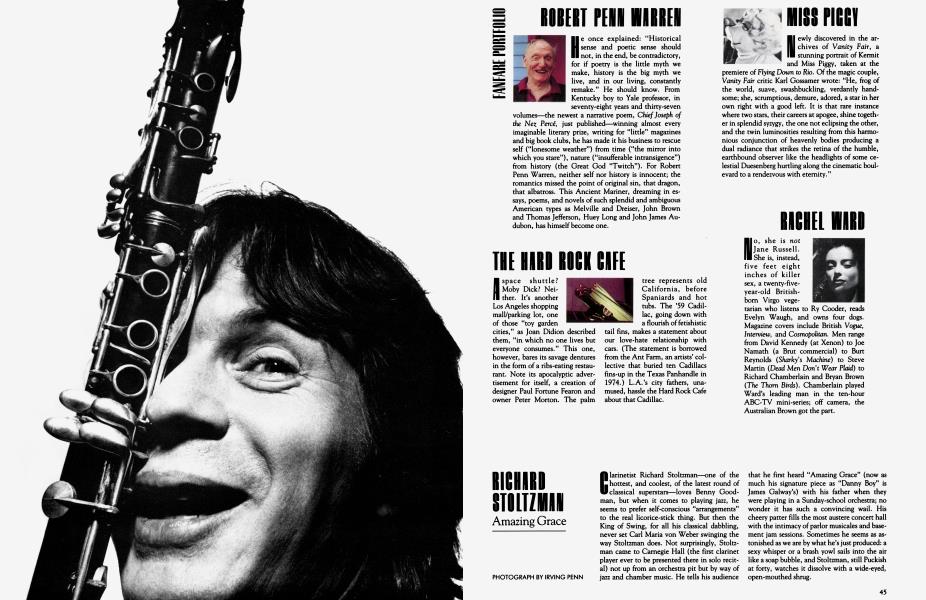
RICHARD STOLTZMAN
Amazing Grace
Clarinetist Richard Stoltzman—one of the hottest, and coolest, of the latest round of classical superstars—loves Benny Goodman, but when it comes to playing jazz, he seems to prefer self-conscious “arrangements” to the real licorice-stick thing. But then the King of Swing, for all his classical dabbling, never set Carl Maria von Weber swinging the way Stoltzman does. Not surprisingly, Stoltzman came to Carnegie Hall (the first clarinet player ever to be presented there in solo recital) not up from an orchestra pit but by way of jazz and chamber music. He tells his audience that he first heard “Amazing Grace” (now as much his signature piece as “Danny Boy” is James Galway’s) with his father when they were playing in a Sunday-school orchestra; no wonder it has such a convincing wail. His cheery patter fills the most austere concert hall with the intimacy of parlor musicales and basement jam sessions. Sometimes he seems as astonished as we are by what he’s just produced: a sexy whisper or a brash yowl sails into the air like a soap bubble, and Stoltzman, still Puckish at forty, watches it dissolve with a wide-eyed, open-mouthed shrug.
Subscribers have complete access to the archive.
Sign In Not a Subscriber?Join Now


