
Sign In to Your Account
Subscribers have complete access to the archive.
Sign In Not a Subscriber?Join NowFANFARE PORTFOLIO
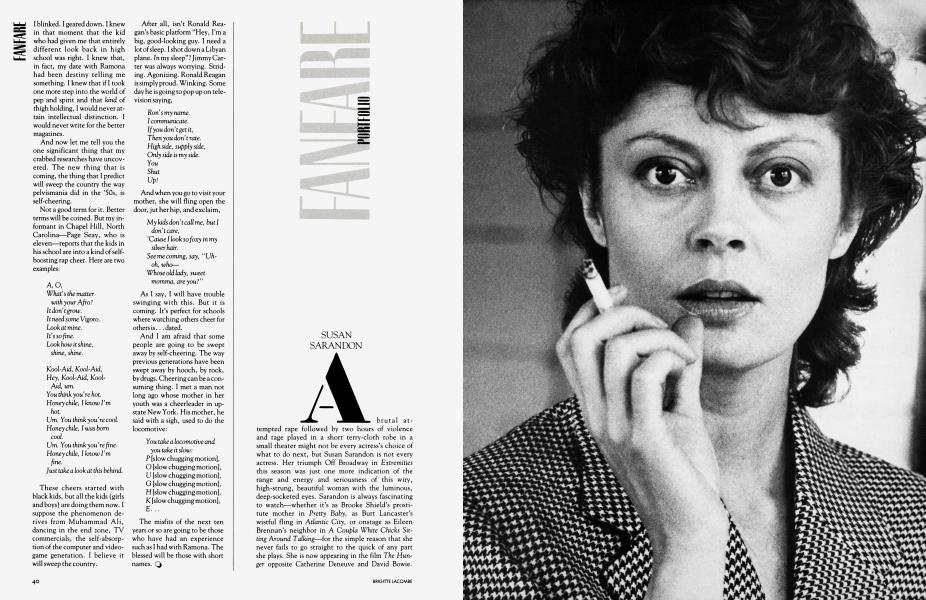
SUSAN SARANDON
Abrutal attempted rape followed by two hours of violence and rage played in a short terry-cloth robe in a small theater might not be every actress’s choice of what to do next, but Susan Sarandon is not every actress. Her triumph Off Broadway in Extremities this season was just one more indication of the range and energy and seriousness of this wiry, high-strung, beautiful woman with the luminous, deep-socketed eyes. Sarandon is always fascinating to watch—whether it’s as Brooke Shield’s prostitute mother in Pretty Baby, as Burt Lancaster’s wistful fling in Atlantic City, or onstage as Eileen Brennan’s neighbor in A Coupla White Chicks Sitting Around Talking—for the simple reason that she never fails to go straight to the quick of any part she plays. She is now appearing in the film The Hunger opposite Catherine Deneuve and David Bowie.
WILLIAM HENRY JACKSON
The Grand Canyon one hundred years ago, as William Henry Jackson posed it and shot it. Perhaps the two men represent conflicting American attitudes toward the land: the lordly owner and the searching guest. Our dying heritage, the history of our survey and sack of the West—these and related matters are taken up by Robert Adams in his polemical and poetic introduction to The American Space, edited by Daniel Wolf, a new book of nineteenth-century landscape photographs including this one.
TONY LO BIANCO
Anyone with an eye for acting who saw Tony Lo Bianco in a stark little gradeB movie called The Honeymoon Killers in 1970 must have realized that here was a potentially wonderful character actor. Good-looking and sensitive, but too intense and ethnic and everyday even then to play romantic comedy, he made you think of such brooding, veristic actors as Anthony Quinn and Lee J. Cobb. This year, as Eddie Carbone, the longshoreman destroyed by a passion for his niece in Arthur Miller’s A View from the Bridge, Lo Bianco has caught up with his potential and joined the ranks of great stage heavies. Almost operatic in its power and daring, his performance is the biggest on Broadway.
TOMMY LEE JONES
Tommy Lee Jones has the look of a roughneck. He’s a tougher James Dean, with a thicker hide and brawnier shoulders. The fact that he went to Harvard doesn’t linger in the mind when you see him playing Doolittle Lynn in Coalminer’s Daughter or Bully Hayes in his upcoming film Savage Islands. If he had come of age as an actor when westerns were popular, he’d probably have acted the Jack Palance roles, not the Gary Cooper leads. It’s hard to decide whether he’s dangerously ugly like Palance, or edifyingly rugged like Clint Eastwood. But when he smiles and softens, as he does here with his new son, Austin, the balance tips toward Eastwood, and you can see evidence of that rare and sexy essence, male tenderness.
VIRGINIA JOHNSON AND LOWELL SMITH
It’s not a romp at the Roxy or a dream of what might happen to a man if he got himself a pair of red silk pajamas. Virginia Johnson and Lowell Smith of the Dance Theater of Harlem are dancing A Streetcar Named Desire—strong meat, even in toe shoes. People who missed Tennessee Williams’s play probably saw the movie. For those who haven’t seen either, the ballet version in the current repertoire, choreographed in 1952 by Valerie Bettis, can be somewhat confusing, but the passion in the last scene between the two protagonists makes even the most somnolent matinee audience sit up and swallow their Milk Duds.
WILLEM DE KOONING
WILLEM de Kooning’s Seated Woman is a figure on a low bench, with a spare pair of limbs resting near it. Here she is, on the lawn of the Grove Isle Club in Miami. The sculpture is an energetic and goofy presence, even goofier when you know that its huge bumps and hollows record the action of fingers in a handful of clay—the sculpture being De Kooning’s mechanical enlargement of his tiny original made in 1969. Though a bit dubious in principle, in this case the inflation of an intimate object justifies itself as a tour de force.
Against crushing evidence that modem sculpture is overmatched by modem architecture, another of the seven casts of Seated Woman can be seen this month at the Seagram Building inNewYork. The Seagram Building has proved that a gracious skyscraper and plaza need not annihilate a well-sited sculpture that is vigorous on its own terms. The most memorable such pieces have been by painters—Jean Dubuffet and Barnett Newman—perhaps because pictorial thinking adapts best to the frame of a glass monolith. The amplification of De Kooning’s amazing touch, invested in a winningly anarchic human image, makes for a fine public disturbance in Seagram’s front yard.
Subscribers have complete access to the archive.
Sign In Not a Subscriber?Join Now


