Sign In to Your Account
Subscribers have complete access to the archive.
Sign In Not a Subscriber?Join NowOne Last Fling
Stephen Schiff
In Fanny and Alexander Ingmar Bergman Throws His Own Farewell Party
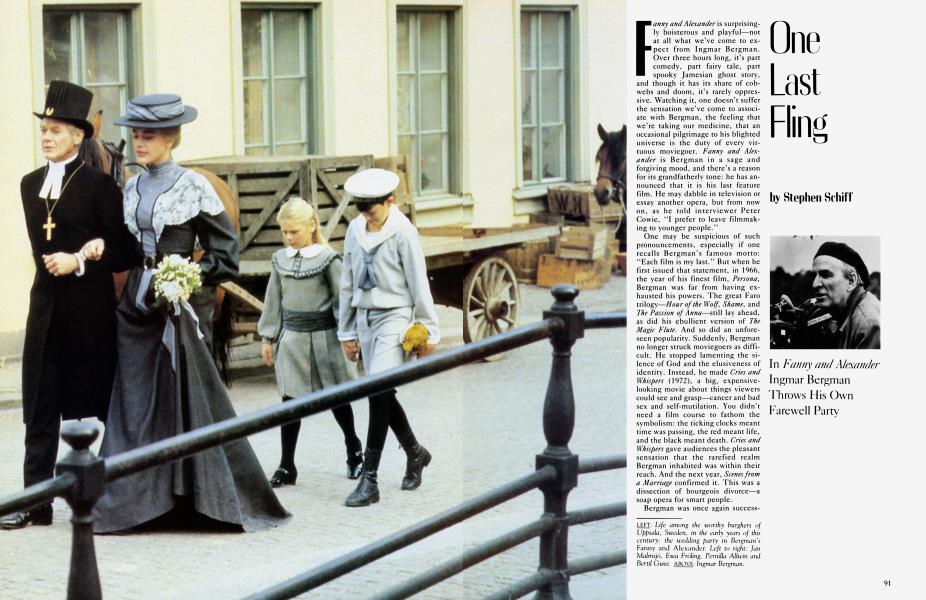
Fanny and Alexander is surprisingly boisterous and playful—not at all what we’ve come to expect from Ingmar Bergman. Over three hours long, it’s part comedy, part fairy tale, part spooky Jamesian ghost story, and though it has its share of cobwebs and doom, it’s rarely oppressive. Watching it, one doesn’t suffer the sensation we’ve come to associate with Bergman, the feeling that we’re taking our medicine, that an occasional pilgrimage to his blighted universe is the duty of every virtuous moviegoer. Fanny and Alexander is Bergman in a sage and forgiving mood, and there’s a reason for its grandfatherly tone: he has announced that it is his last feature film. He may dabble in television or essay another opera, but from now on, as he told interviewer Peter Cowie, “I prefer to leave filmmaking to younger people.”
One may be suspicious of such pronouncements, especially if one recalls Bergman’s famous motto: “Each film is my last.” But when he first issued that statement, in 1966, the year of his finest film, Persona, Bergman was far from having exhausted his powers. The great Faro trilogy—Hour of the Wolf, Shame, and The Passion of Anna—still lay ahead, as did his ebullient version of The Magic Flute. And so did an unforeseen popularity. Suddenly, Bergman no longer struck moviegoers as difficult. He stopped lamenting the silence of God and the elusiveness of identity. Instead, he made Cries and Whispers (1972), a big, expensivelooking movie about things viewers could see and grasp—cancer arid bad sex and self-mutilation. You didn’t need a film course to fathom the symbolism: the ticking clocks meant time was passing, the red meant life, and the black meant death. Cries and Whispers gave audiences the pleasant sensation that the rarefied realm Bergman inhabited was within their reach. And the next year, Scenes from a Marriage confirmed it. This was a dissection of bourgeois divorce—a soap opera for smart people.
Bergman was once again successful. No longer were his finances so precarious that each film was truly in danger of being his last. But he was also in decline. After The Magic Flute, there was the sterility of Face to Face (1976), and then the campy decadence of The Serpent's Egg( 1978), the unconvincing Oedipal warfare of Autumn Sonata (1978), the icy flatness of From the Life of the Marionettes (1980). Bergman often seemed to be slipping into self-parody; as his characters turned wearily toward the camera (or the nearest mirror) and launched into the familiar litany of woes, audiences would smirk and roll their eyes heavenward. When the spirit goes out of a great director, what’s left is usually mannerism— Fellini’s gargoyles, Truffaut’s winsomeness, Altman’s babble. Hounded into German exile by the Swedish tax authorities, Bergman turned everything he touched into glib despair, and even the converts he’d won in the early ’70s began to avoid his films. So when he says that there will be no more features after Fanny and Alexander, one senses that he’s not merely indulging in the old rhetoric. Sixty-five now, and restored to Sweden, he is acknowledging the ebb of his enthusiasm, and maybe even the erosion of his mastery.
Fanny and Alexander even feels like a last film. At once shallow and dauntingly ambitious, it’s a colorful, sprawling entertainment, an epic with the hoary feel of a summingup. It is about the Ekdahls, a large, wealthy family living in the university town of Uppsala, where Bergman was born and raised. The year is 1907, and pale, dark-haired Alexander (played by the bland but pretty Bertil Guve) is ten years old; with his puppet theater and his magic lantern and his fantasies of knickknacks coming to life in the richly upholstered crannies of his grandmother’s mansion, he’s clearly meant to be an autobiographical projection. The movie follows him through a welter of events, from frolicsome parties to harrowing confrontations with evil and the world beyond the grave; it has the sweep and detail of a nineteenth-century novel, and also all the flaws screen adaptations of nineteenth-century novels usually have: sketchiness, loose ends, inexplicable lurches in tone.
But what Bergman is adapting is his own thought. ‘Fanny and Alexander is the sum total of my life as a filmmaker,” he has said, and one can take him at his word. Here are scraps of all his themes and obsessions: as you watch, life diligently reflects art, characters compliantly view persona as performance, magic duly confounds skepticism; blink, and you’ll miss the silence of God. Yet Fanny and Alexander is generous and eager to please. Sven Nykvist’s deep-focus cinematography dotes on the turn-of-the-century trappings, on red and green rooms full of velvet, lace and parquet, on regal women bustling about in sumptuous low-necked gowns. More sparing with close-ups than he has been in years, Bergman captures all the usual tormented faces, but he doesn’t dwell on them; not even in Cries and Whispers did his camera glory so in painterly tableaux, in sensuousness and color, in the satisfying solidity of bodies in space. As the weighty issues trundle by, they don’t feel so lugubrious. Instead, they’re like a procession of guests at an opulent party; they’re his issues, and he seems to be bidding them farewell.
Nearly the first hour of the movie is devoted to Christmas with the Ekdahls, and Bergman hasn’t been in so festive a mood since The Magic Flute. The family, which owns the town’s theater, holds a yuletide feast for the mummers and the staff, and after the merrymaking, Bergman begins to pick out individual characters, individual sorrows. The indefatigable lecher Gustav Adolf (Jarl Kulle) dallies with a pleasingly plump maid, to the bemusement of his tolerant and even plumper wife. Meanwhile, his brother Carl (Borje Ahlstedt), a drunk and a failure, lapses into the movie’s most feverish bout of Bergmanesque soul-searching. “Death taps me on the shoulder,” he groans. “Stretch out your hand and you grope in a void.” It’s a heaping helping, but Bergman seems to know when we’ve had a bellyful, for Carl is immediately remanded to the background—in fact, we rather wonder what ever happened to him. Then there is the third brother, Oscar (Allan Edwall), the theater’s manager and, as everyone admits, its worst actor. He is the father of Alexander and eight-year-old Fanny (Pernilla Allwin), and the husband of their beatifically beautiful mother, Emilie (Ewa Froling), and it isn’t long before he drops out of the umpteenth Christmas dance, looking winded and gray. A few scenes later he’s dead, and here the ghost story begins, for he keeps returning, staring ominously at Fanny and Alexander while single harpsichord notes hang in the empty air.
There’s a disconcerting blatancy to all this. We’ve been shown, all too pointedly, that Oscar used to play the ghost in the theater’s production of Hamlet, and when Emilie gets married again, to the stern, thinlipped bishop (Jan Malmsjo) who presided at the funeral, Bergman has her tell the fiercely unhappy Alexander, “Don’t act Hamlet, my son. I am not Gertrude, and the bishop is not Claudius.” But the rest of the movie is a gloss of Hamlet, and Bergman keeps reminding us of it. So much is spelled out in this movie that there’s nothing to discover; it’s as though the director were kowtowing to those critics who have accused him of being obscure. Perhaps the literary references seem meretricious because the rest of the movie is nothing more or less than Nordic whimsy, delivered with the heavy gusto of a provincial storyteller bouncing a ragamuffin on his knee. When Emilie, Fanny and Alexander move into the bishop’s stark quarters, the movie becomes Hansel and Gretel recast as a ponderous vampire gothic, with the grim bishop subjecting the kids to neo-Nazi interrogations, and his evil mother and sister swooping about in black, cawing imprecations. The plot goes crazy: there are supernatural rescues, outbursts of sorcery and ESP, and a climactic conflagration that recalls Strindberg’s The Pelican. It’s all outlandish and graceless and silly, but the ending shrugs off our astonishment with a reference to A Dream Play, as Alexander’s grandmother reads, “Anything can happen, anything is possible.... On a flimsy ground of reality, the imagination spins out and weaves new patterns.”
This is a beguiling finale for a fairy tale, but a strange one for the cinema’s gloomiest metaphysician. Yet what’s refreshing about Fanny and Alexander is the very avidity Bergman brings to the act of spinning a yarn, the way he captivates us with offhand jokes, with funny characters like the Jewish antique dealer Isak (Erland Josephson), who could have stepped out of Isaac Bashevis Singer, and angelic ones like Emilie, who, as played by the radiant Ewa Froling, is a storybook princess with huge suffering eyes. And like all good fables, Fanny and Alexander has a message, one that lies in the tension between the robust ceremonies and celebrations that bring the Ekdahls together and the anguish they undergo when they are apart. After the revels, the characters repair to their individual chambers, where, unprotected by Dionysian fellow feeling, they ache and agonize; but they are always ready the next morning for a hearty breakfast and a sleigh ride to church. Only in the Elsinore-like castle of the bishop, where festivity is forbidden, are the monsters of the psyche free to scuttle about unleashed. One can’t rid oneself of monsters, Bergman is saying—the bishop will always reappear to haunt Alexander—but one can keep them at bay. In a speech during the movie’s final grand feast, the likable philanderer Gustav Adolf extols the “little world” of pleasure and subterfuge that can insulate us from the terrifying “big world” beyond it, and by the “little world” he means the artificial but redeeming structures the bourgeoisie builds to shore itself up against the howling of evil and the demands of religion: families and parties and outings and, beyond that, the theater, the opera, storytelling itself.
But is this paean to the good life really the conclusion of Bergman’s relentless navigation of alienation and futility? He seems to be telling us that peering into the inner depths is bootless after all, that he has joined the ranks of those who instead distract us from the abyss. Fanny and Alexander is an old man’s movie, the work of a becalmed intellect supping on life’s ephemeral delights—on pretty women and pretty children, on good food and bewitching dreams and the music of Schumann. It’s not, perhaps, the penetrating valediction we might have expected from the movies’ answer to Kierkegaard, but it has its enchantments. And if the alchemy of storytelling can’t overcome the silence of God, it at least seems to have quieted the inner demons of Ingmar Bergman. Q
Subscribers have complete access to the archive.
Sign In Not a Subscriber?Join Now


