
Sign In to Your Account
Subscribers have complete access to the archive.
Sign In Not a Subscriber?Join NowDANCE
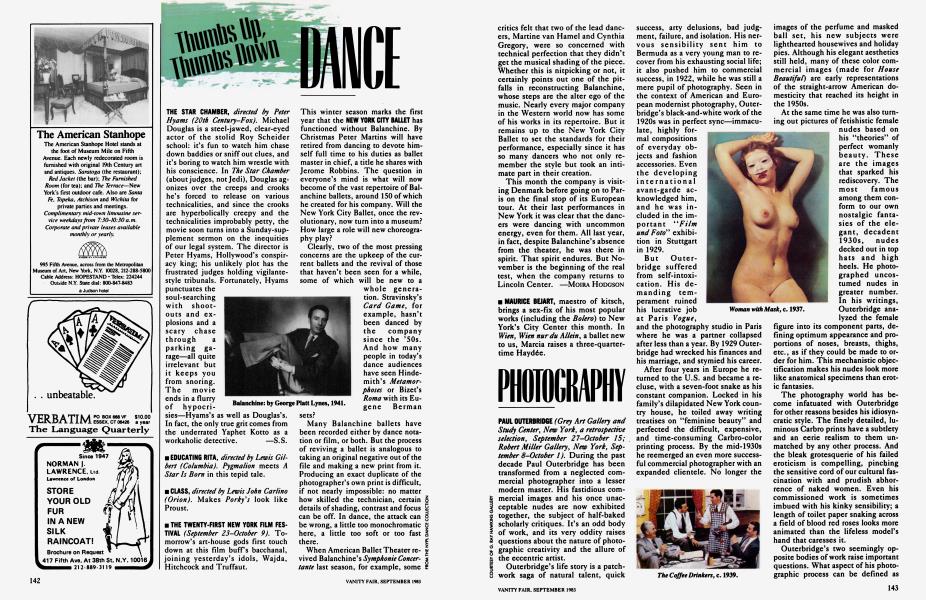
THE STAR CHAMBER, directed by Peter Hyams (20th Century-Fox). Michael Douglas is a steel-jawed, clear-eyed actor of the stolid Roy Scheider school: it’s fun to watch him chase down baddies or sniff out clues, and it’s boring to watch him wrestle with his conscience. In The Star Chamber (about judges, notjedi), Douglas agonizes over the creeps and crooks he’s forced to release on various technicalities, and since the crooks are hyperbolically creepy and the technicalities improbably petty, the movie soon turns into a Sunday-supplement sermon on the inequities of our legal system. The director is Peter Hyams, Hollywood’s conspiracy king; his unlikely plot has the frustrated judges holding vigilantestyle tribunals. Fortunately, Hyams punctuates the soul-searching with shootouts and explosions and a scary chase through a parking garage—all quite irrelevant but it keeps you from snoring. The movie ends in a flurry of hypocrisies—Hyams’s as well as Douglas’s. In fact, the only true grit comes from the underrated Yaphet Kotto as a workaholic detective. —S.S.
S.S
■ EDUCATING RITA, directed by Lewis Gilbert (Columbia). Pygmalion meets A Star Is Born in this tepid tale.
■ CLASS, directed by Lewis John Carlino (Orion). Makes Porky's look like Proust.
■ THE TWENTY-FIRST NEW YORK FILM FESTIVAL (September 23-October 9). Tomorrow’s art-house gods First touch down at this film buff’s bacchanal, joining yesterday’s idols, Wajda, Hitchcock and Truffaut.
This winter season marks the First year that the NEW YORK CITY BALLET has functioned without Balanchine. By Christmas Peter Martins will have retired from dancing to devote himself full time to his duties as ballet master in chief, a title he shares with Jerome Robbins. The question in everyone’s mind is what will now become of the vast repertoire of Balanchine ballets, around 150 of which he created for his company. Will the New York City Ballet, once the revolutionary, now turn into a museum? How large a role will new choreography play?
Clearly, two of the most pressing concerns are the upkeep of the current ballets and the revival of those that haven’t been seen for a while, some of which will be new to a whole generation. Stravinsky’s Card Game, for example, hasn’t been danced by the company since the ’50s. And how many people in today’s dance audiences have seen Hindemith’s Metamorphoses or Bizet’s Roma with its Eugene Berman
Many Balanchine ballets have been recorded either by dance notation or film, or both. But the process of reviving a ballet is analogous to taking an original negative out of the file and making a new print from it. Producing an exact duplicate of the photographer’s own print is difficult, if not nearly impossible: no matter how skilled the technician, certain details of shading, contrast and focus can be off. In dance, the attack can be wrong, a little too monochromatic here, a little too soft or too fast there.
When American Ballet Theater revived Balanchine’s Symphonie Concertante last season, for example, some critics felt that two of the lead dancers, Martine van Hamel and Cynthia Gregory, were so concerned with technical perfection that they didn’t get the musical shading of the piece. Whether this is nitpicking or not, it certainly points out one of the pitfalls in reconstructing Balanchine, whose steps are the alter ego of the music. Nearly every major company in the Western world now has some of his works in its repertoire. But it remains up to the New York City Ballet to set the standards for their performance, especially since it has so many dancers who not only remember the style but took an intimate part in their creation.
This month the company is visiting Denmark before going on to Paris on the final stop of its European tour. At their last performances in New York it was clear that the dancers were dancing with uncommon energy, even for them. All last year, in fact, despite Balanchine’s absence from the theater, he was there in spirit. That spirit endures. But November is the beginning of the real test, when the company returns to Lincoln Center.
MORIA HODGSON
■ MAURICE BEJART, maestro of kitsch, brings a sex-fix of his most popular works (including the Bolero) to New York’s City Center this month. In Wien, Wien nurdu A Hein, a ballet new to us, Marcia raises a three-quartertime Hayd6e.
Subscribers have complete access to the archive.
Sign In Not a Subscriber?Join Now
