Sign In to Your Account
Subscribers have complete access to the archive.
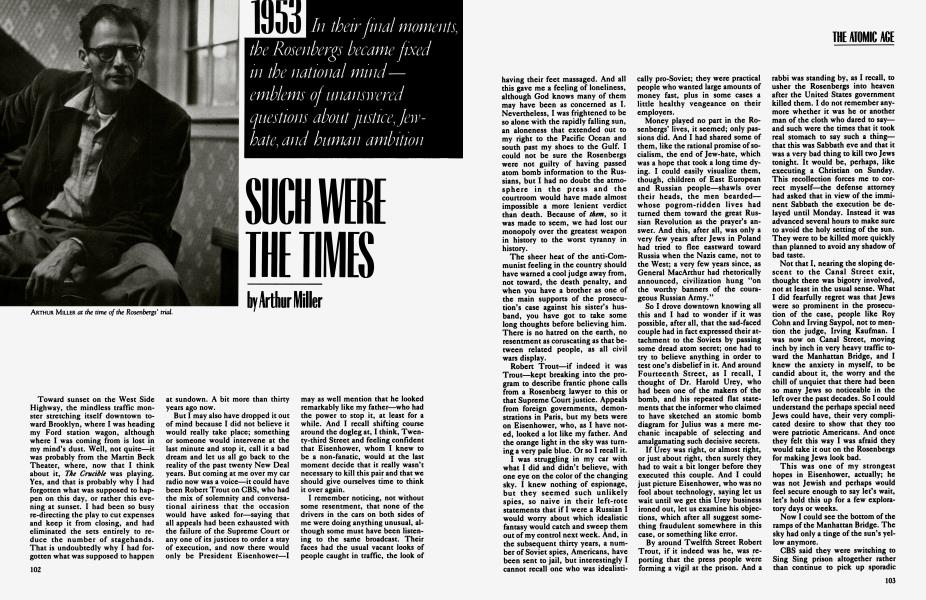
Sign In Not a Subscriber?Join NowSUCH WERE THE TIMES
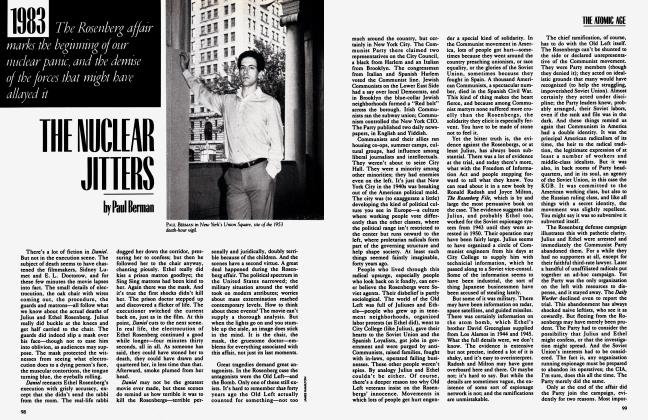
1953 In their final moments, the Rosenbergs became fixed in the national mind— emblems of unanswered question is about justice, Jewhate, and buman ambition
ARTHUR MILLER
Toward sunset on the West Side Highway, the mindless traffic monster stretching itself downtown toward Brooklyn, where I was heading my Ford station wagon, although where I was coming from is lost in my mind’s dust. Well, not quite—it was probably from the Martin Beck Theater, where, now that I think about it, The Crucible was playing. Yes, and that is probably why I had forgotten what was supposed to happen on this day, or rather this evening at sunset. I had been so busy re-directing the play to cut expenses and keep it from closing, and had eliminated the sets entirely to reduce the number of stagehands. That is undoubtedly why I had forgotten what was supposed to happen at sundown. A bit more than thirty years ago now.
But I may also have dropped it out of mind because I did not believe it would really take place; something or someone would intervene at the last minute and stop it, call it a bad dream and let us all go back to the reality of the past twenty New Deal years. But coming at me over my car radio now was a voice—it could have been Robert Trout on CBS, who had the mix of solemnity and conversational airiness that the occasion would have asked for—saying that all appeals had been exhausted with the failure of the Supreme Court or any one of its justices to order a stay of execution, and now there would only be President Eisenhower—I may as well mention that he looked remarkably like my father—who had the power to stop it, at least for a while. And I recall shifting course around the dogleg at, I think, Twenty-third Street and feeling confident that Eisenhower, whom I knew to be a non-fanatic, would at the last moment decide that it really wasn’t necessary to kill this pair and that we should give ourselves time to think it over again.
I remember noticing, not without some resentment, that none of the drivers in the cars on both sides of me were doing anything unusual, although some must have been listening to the same broadcast. Their faces had the usual vacant looks of people caught in traffic, the look of having their feet massaged. And all this gave me a feeling of loneliness, although God knows many of them may have been as concerned as I. Nevertheless, I was frightened to be so alone with the rapidly falling sun, an aloneness that extended out to my right to the Pacific Ocean and south past my shoes to the Gulf. I could not be sure the Rosenbergs were not guilty of having passed atom bomb information to the Russians, but I had no doubt the atmosphere in the press and the courtroom would have made almost impossible a more lenient verdict than death. Because of them, so it was made to seem, we had lost our monopoly over the greatest weapon in history to the worst tyranny in history.
The sheer heat of the anti-Communist feeling in the country should have warned a cool judge away from, not toward, the death penalty, and when you have a brother as one of the main supports of the prosecution’s case against his sister’s husband, you have got to take some long thoughts before believing him. There is no hatred on the earth, no resentment as coruscating as that between related people, as all civil wars display.
Robert Trout—if indeed it was Trout—kept breaking into the program to describe frantic phone calls from a Rosenberg lawyer to this or that Supreme Court justice. Appeals from foreign governments, demonstrations in Paris, but my bets were on Eisenhower, who, as I have noted, looked a lot like my father. And the orange light in the sky was turning a very pale blue. Or so I recall it.
I was struggling in my car with what I did and didn’t believe, with one eye on the color of the changing sky. I knew nothing of espionage, but they seemed such unlikely spies, so naive in their left-rote statements that if I were a Russian I would worry about which idealistic fantasy would catch and sweep them out of my control next week. And, in the subsequent thirty years, a number of Soviet spies, Americans, have been sent to jail, but interestingly I cannot recall one who was idealistically pro-Soviet; they were practical people who wanted large amounts of money fast, plus in some cases a little healthy vengeance on their employers.
Money played no part in the Rosenbergs’ lives, it seemed; only passions did. And I had shared some of them, like the rational promise of socialism, the end of Jew-hate, which was a hope that took a long time dying. I could easily visualize them, though, children of East European and Russian people—shawls over their heads, the men bearded— whose pogrom-ridden lives had turned them toward the great Russian Revolution as the prayer’s answer. And this, after all, was only a very few years after Jews in Poland had tried to flee eastward toward Russia when the Nazis came, not to the West; a very few years since, as General MacArthur had rhetorically announced, civilization hung “on the worthy banners of the courageous Russian Army.’’
So I drove downtown knowing all this and I had to wonder if it was possible, after all, that the sad-faced couple had in fact expressed their attachment to the Soviets by passing some dread atom secret; one had to try to believe anything in order to test one’s disbelief in it. And around Fourteenth Street, as I recall, I thought of Dr. Harold Urey, who had been one of the makers of the bomb, and his repeated flat statements that the informer who claimed to have sketched an atomic bomb diagram for Julius was a mere mechanic incapable of selecting and amalgamating such decisive secrets.
If Urey was right, or almost right, or just about right, then surely they had to wait a bit longer before they executed this couple. And I could just picture Eisenhower, who was no fool about technology, saying let us wait until we get this Urey business ironed out, let us examine his objections, which after all suggest something fraudulent somewhere in this case, or something like error.
By around Twelfth Street Robert Trout, if it indeed was he, was reporting that the press people were forming a vigil at the prison. And a rabbi was standing by, as I recall, to usher the Rosenbergs into heaven after the United States government killed them. I do not remember anymore whether it was he or another man of the cloth who dared to say— and such were the times that it took real stomach to say such a thing— that this was Sabbath eve and that it was a very bad thing to kill two Jews tonight. It would be, perhaps, like executing a Christian on Sunday. This recollection forces me to correct myself—the defense attorney had asked that in view of the imminent Sabbath the execution be delayed until Monday. Instead it was advanced several hours to make sure to avoid the holy setting of the sun. They were to be killed more quickly than planned to avoid any shadow of bad taste.
Not that I, nearing the sloping descent to the Canal Street exit, thought there was bigotry involved, not at least in the usual sense. What I did fearfully regret was that Jews were so prominent in the prosecution of the case, people like Roy Cohn and Irving Saypol, not to mention the judge, Irving Kaufman. I was now on Canal Street, moving inch by inch in very heavy traffic toward the Manhattan Bridge, and I knew the anxiety in myself, to be candid about it, the worry and the chill of unquiet that there had been so many Jews so noticeable in the left over the past decades. So I could understand the perhaps special need Jews could have, their very complicated desire to show that they too were patriotic Americans. And once they felt this way I was afraid they would take it out on the Rosenbergs for making Jews look bad.
This was one of my strongest hopes in Eisenhower, actually; he was not Jewish and perhaps would feel secure enough to say let’s wait, let’s hold this up for a few exploratory days or weeks.
Now I could see the bottom of the ramps of the Manhattan Bridge. The sky had only a tinge of the sun’s yellow anymore.
CBS said they were switching to Sing Sing prison altogether rather than continue to pick up sporadic bulletins. A hushed voice, as though from a sickroom, described the waiting reporters and officials, the telephoning to the Supreme Court. What were people like me to believe? I was left with a powerful impression that one of the Rosenbergs’ chief accusers, Harry Gold, was crazy. Certainly he had altered and added to his story from week to week under FBI suggestion, or so it seemed. Why not clear all this up? Where was Eisenhower? Where was anybody who did not have a career interest in an execution, or an ideological passion to hunt these two down? Where was justice, cool and dispassionate?
We were only eight or so years past the discovery of the mounds of dead in Dachau, Bergen-Belsen, Auschwitz, and other marks of Cain on the forehead of our century. They could not merely be two spies being executed but two Jews. It was not possible to avoid this in the second half of the twentieth century; not even with the best will in the world could the prejudicial stain be totally avoided—no, not even if it were undeserved. Such were the times.
As I have always remembered it, my Ford’s front wheels touched the ramp of the bridge, and rising higher I could see that there was no longer any sunlight in the sky, which was deep blue. It was night. But actually it was a little earlier in the day when the sun was still up that the announcer said that the Rosenbergs had just been executed.
I suppose that the dimming of lights in the prison accounts for the setting of the sun in my memory at this news. But I am sure of one thing—oddly, I wanted to believe they were guilty, although it was beyond me to agree they should have died. I still could not believe the prosecution’s story about a diagram when Harold Urey did not believe it; I could not forget the in-laws’ testimony; but I wanted to believe that there was absolutely conclusive evidence which I had never heard of.
I was alone in the traffic crossing the bridge; the other drivers still seemed to be having their feet massaged. But maybe I did too.
That evening, so I was later told, the audience stood up at The Crucible to observe a minute of silence at the end of the play, which indeed finishes with an execution, and the actors told me there was no applause at this performance.
The years would confuse matters, people thinking I had written the play about the Rosenbergs instead of two and a half years before their names were even in the papers.
And the years would also not let the case rest. According to the new, revised account of the trial by Walter and Miriam Schneir, it appears that General Leslie Groves, who headed the wartime Manhattan Project, had said a year after the executions that the information the Rosenbergs were accused of having given the Russians would have been of only minor value in any attempt to make a bomb. This statement never saw daylight until recently, when the Freedom of Information Act made the revelation possible. Yet the justification for the death sentence was precisely that it was the greatest crime in history. I wish I could say this statement of Groves’s comes as a shocking surprise.
In fact, it was more or less my conjecture as my car rolled into Brooklyn, and I know I was never so alone in Brooklyn in my life. Because I was scared. And now, thirty years later, with Jews trying to flee Russia, that moral shambles, it is simply too terrible to contemplate two people choosing to die rather than speak a word against the Future, which quite probably was how they saw the Soviet Union at the time.
Who knows what they would have thought now, had they not been killed? Had statements like General Groves’s not been suppressed maybe a genuine debate would have thrown light on the case. What was all the hurry? That was what I wondered then and still do.
And it has occurred to me that the greatest crime in history was quite different; but when God discovered the first man-killer among men He did not execute Cain, even for slaying his own brother. But I suppose that is what it takes to be God. Q
Subscribers have complete access to the archive.
Sign In Not a Subscriber?Join Now

