


Sign In to Your Account
Subscribers have complete access to the archive.
Sign In Not a Subscriber?Join NowTELESCOPING YEARS
FLASHBACK
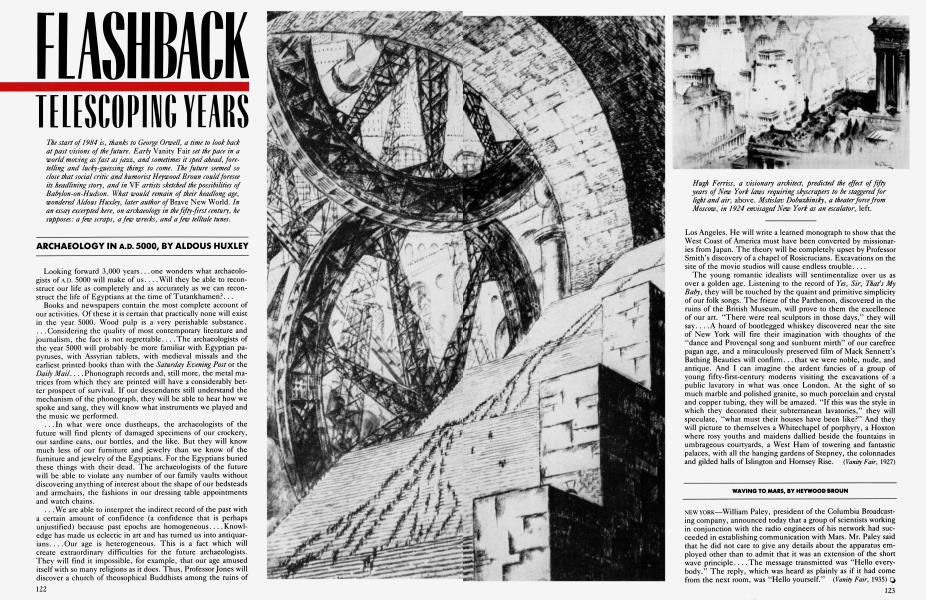
The start of 1984 is, thanks to George Orwell, a time to look back at past visions of the future. Early Vanity Fair set the pace in a world moving as fast as jazz, and sometimes it sped ahead, foretelling and lucky-guessing things to come. The future seemed so close that social critic and humorist Heywood Broun could foresee its headlining story, and in VF artists sketched the possibilities of Babylon-on-Hudson. What would remain of their headlong age, wondered Aldous Huxley, later author of Brave New World. In an essay excerpted here, on archaeology in the fifty-first century, he supposes: a few scraps, a few wrecks, and a few telltale tunes.
ARCHAEOLOGY IN A.D. 5000, BY ALDOUS HUXLEY
Looking forward 3,000 years.. .one wonders what archaeologists of A.D. 5000 will make of us... .Will they be able to reconstruct our life as completely and as accurately as we can reconstruct the life of Egyptians at the time of Tutankhamen?. ..
Books and newspapers contain the most complete account of our activities. Of these it is certain that practically none will exist in the year 5000. Wood pulp is a very perishable substance.
. . .Considering the quality of most contemporary literature and journalism, the fact is not regrettable... .The archaeologists of the year 5000 will probably be more familiar with Egyptian papyruses, with Assyrian tablets, with medieval missals and the earliest printed books than with the Saturday Evening Post or the Daily Mail.. . .Phonograph records and, still more, the metal matrices from which they are printed will have a considerably better prospect of survival. If our descendants still understand the mechanism of the phonograph, they will be able to hear how we spoke and sang, they will know what instruments we played and the music we performed.
... In what were once dustheaps, the archaeologists of the future will find plenty of damaged specimens of our crockery, our sardine cans, our bottles, and the like. But they will know much less of our furniture and jewelry than we know of the furniture and jewelry of the Egyptians. For the Egyptians buried these things with their dead. The archaeologists of the future will be able to violate any number of our family vaults without discovering anything of interest about the shape of our bedsteads and armchairs, the fashions in our dressing table appointments and watch chains.
.. .We are able to interpret the indirect record of the past with a certain amount of confidence (a confidence that is perhaps unjustified) because past epochs are homogeneous.... Knowledge has made us eclectic in art and has turned us into antiquarians.... Our age is heterogeneous. This is a fact which will create extraordinary difficulties for the future archaeologists. They will find it impossible, for example, that our age amused itself with so many religions as it does. Thus, Professor Jones will discover a church of theosophical Buddhists among the ruins of Los Angeles. He will write a learned monograph to show that the West Coast of America must have been converted by missionaries from Japan. The theory will be completely upset by Professor Smith's discovery of a chapel of Rosicrucians. Excavations on the site of the movie studios will cause endless trouble....
The young romantic idealists will sentimentalize over us as over a golden age. Listening to the record of Yes, Sir, That's My Baby, they will be touched by the quaint and primitive simplicity of our folk songs. The frieze of the Parthenon, discovered in the ruins of the British Museum, will prove to them the excellence of our art. "There were real sculptors in those days," they will say....A hoard of bootlegged whiskey discovered near the site of New York will fire their imagination with thoughts of the "dance and Provengal song and sunburnt mirth" of our carefree pagan age, and a miraculously preserved film of Mack Sennett's Bathing Beauties will confirm.. .that we were noble, nude, and antique. And I can imagine the ardent fancies of a group of young fifty-first-century moderns visiting the excavations of a public lavatory in what was once London. At the sight of so much marble and polished granite, so much porcelain and crystal and copper tubing, they will be amazed. "If this was the style in which they decorated their subterranean lavatories," they will speculate, "what must their houses have been like?" And they will picture to themselves a Whitechapel of porphyry, a Hoxton where rosy youths and maidens dallied beside the fountains in umbrageous courtyards, a West Ham of towering and fantastic palaces, with all the hanging gardens of Stepney, the colonnades and gilded halls of Islington and Hornsey Rise. (Vanity Fair, 1927)
WAVING TO MARS, BY HEYWOOD BROUN
NEW YORK—William Paley, president of the Columbia Broadcasting company, announced today that a group of scientists working in conjunction with the radio engineers of his network had succeeded in establishing communication with Mars. Mr. Paley said that he did not care to give any details about the apparatus employed other than to admit that it was an extension of the short wave principle. .. .The message transmitted was "Hello everybody." The reply, which was heard as plainly as if it had come from the next room, was "Hello yourself." (Vanity Fair, 1935)
Subscribers have complete access to the archive.
Sign In Not a Subscriber?Join Now
