Sign In to Your Account
Subscribers have complete access to the archive.
Sign In Not a Subscriber?Join NowBooks
WICKED WITCH OF THE WEST
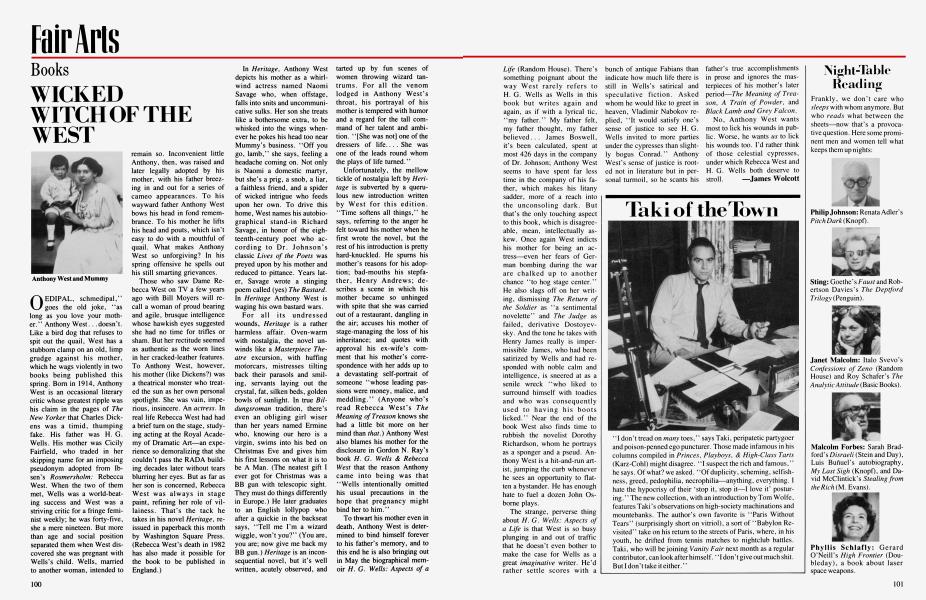
OEDIPAL, schmedipal,” goes the old joke, “as long as you love your mother.” Anthony West. . .doesn’t. Like a bird dog that refuses to spit out the quail, West has a stubborn clamp on an old, limp grudge against his mother, which he wags violently in two books being published this spring. Bom in 1914, Anthony West is an occasional literary critic whose greatest ripple was his claim in the pages of The New Yorker that Charles Dickens was a timid, thumping fake. His father was H. G. Wells. His mother was Cicily Fairfield, who traded in her skipping name for an imposing pseudonym adopted from Ibsen’s Rosmersholm: Rebecca West. When the two of them met, Wells was a world-beating success and West was a striving critic for a fringe feminist weekly; he was forty-five, she a mere nineteen. But more than age and social position separated them when West discovered she was pregnant with Wells’s child. Wells, married to another woman, intended to remain so. Inconvenient little Anthony, then, was raised and later legally adopted by his mother, with his father breezing in and out for a series of cameo appearances. To his wayward father Anthony West bows his head in fond remembrance. To his mother he lifts his head and pouts, which isn’t easy to do with a mouthful of quail. What makes Anthony West so unforgiving? In his spring offensive he spells out his still smarting grievances.
Those who saw Dame Rebecca West on TV a few years ago with Bill Moyers will recall a woman of proud bearing and agile, brusque intelligence whose hawkish eyes suggested she had no time for trifles or sham. But her rectitude seemed as authentic as the worn lines in her cracked-leather features. To Anthony West, however, his mother (like Dickens?) was a theatrical monster who treated the sun as her own personal spotlight. She was vain, imperious, insincere. An actress. In real life Rebecca West had had a brief turn on the stage, studying acting at the Royal Academy of Dramatic Art—an experience so demoralizing that she couldn’t pass the RADA building decades later without tears blurring her eyes. But as far as her son is concerned, Rebecca West was always in stage paint, refining her role of villainess. That’s the tack he takes in his novel Heritage, reissued in paperback this month by Washington Square Press. (Rebecca West’s death in 1982 has also made it possible for the book to be published in England.)
In Heritage, Anthony West depicts his mother as a whirlwind actress named Naomi Savage who, when offstage, falls into snits and uncommunicative sulks. Her son she treats like a bothersome extra, to be whisked into the wings whenever he pokes his head too near Mummy’s business. “Off you go, lamb,” she says, feeling a headache coming on. Not only is Naomi a domestic martyr, but she’s a prig, a snob, a liar, a faithless friend, and a spider of wicked intrigue who feeds upon her own. To drive this home, West names his autobiographical stand-in Richard Savage, in honor of the eighteenth-century poet who according to Dr. Johnson’s classic Lives of the Poets was preyed upon by his mother and reduced to pittance. Years later, Savage wrote a stinging poem called (yes) The Bastard. In Heritage Anthony West is waging his own bastard wars.
For all its undressed wounds, Heritage is a rather harmless affair. Oven-warm with nostalgia, the novel unwinds like a Masterpiece Theatre excursion, with huffing motorcars, mistresses tilting back their parasols and smiling, servants laying out the crystal, fat, silken beds, golden bowls of sunlight. In true Bildungsroman tradition, there’s even an obliging girl wiser than her years named Ermine who, knowing our hero is a virgin, swims into his bed on Christmas Eve and gives him his first lessons on what it is to be A Man. (The neatest gift I ever got for Christmas was a BB gun with telescopic sight. They must do things differently in Europe.) He later graduates to an English lollypop who after a quickie in the backseat says, “Tell me I’m a wizard wiggle, won’t you?” (You are, you are; now give me back my BB gun.) Heritage is an inconsequential novel, but it’s well written, acutely observed, and tarted up by fun scenes of women throwing wizard tantrums. For all the venom lodged in Anthony West’s throat, his portrayal of his mother is tempered with humor and a regard for the tall command of her talent and ambition. “(She was not] one of the dressers of life.. . . She was one of the leads round whom the plays of life turned.”
Unfortunately, the mellow tickle of nostalgia left by Heritage is subverted by a querulous new introduction written by West for this edition. “Time softens all things,” he says, referring to the anger he felt toward his mother when he first wrote the novel, but the rest of his introduction is pretty hard-knuckled. He spurns his mother’s reasons for his adoption; bad-mouths his stepfather, Henry Andrews; describes a scene in which his mother became so unhinged with spite that she was carried out of a restaurant, dangling in the air; accuses his mother of stage-managing the loss of his inheritance; and quotes with approval his ex-wife’s comment that his mother’s correspondence with her adds up to a devastating self-portrait of someone “whose leading passions were money, malice, and meddling.” (Anyone who’s read Rebecca West’s The Meaning of Treason knows she had a little bit more on her mind than that.) Anthony West also blames his mother for the disclosure in Gordon N. Ray’s book H. G. Wells & Rebecca West that the reason Anthony came into being was that “Wells intentionally omitted his usual precautions in the hope that pregnancy might bind her to him.”
To thwart his mother even in death, Anthony West is determined to bind himself forever to his father’s memory, and to this end he is also bringing out in May the biographical memoir H. G. Wells: Aspects of a Life (Random House). There’s something poignant about the way West rarely refers to H. G. Wells as Wells in this book but writes again and again, as if with a lyrical tic, “my father.” My father felt, my father thought, my father believed. . . James Boswell, it’s been calculated, spent at most 426 days in the company of Dr. Johnson; Anthony West seems to have spent far less time in the company of his father, which makes his litany sadder, more of a reach into the unconsoling dark. But that’s the only touching aspect to this book, which is disagreeable, mean, intellectually askew. Once again West indicts his mother for being an actress—even her fears of German bombing during the war are chalked up to another chance “to hog stage center.” He also slags off on her writing, dismissing The Return of the Soldier as “a sentimental novelette” and The Judge as failed, derivative Dostoyevsky. And the tone he takes with Henry James really is impermissible James, who had been satirized by Wells and had responded with noble calm and intelligence, is sneered at as a senile wreck “who liked to surround himself with toadies and who was consequently used to having his boots licked.” Near the end of the book West also finds time to rubbish the novelist Dorothy Richardson, whom he portrays as a sponger and a pseud. Anthony West is a hit-and-run artist, jumping the curb whenever he sees an opportunity to flatten a bystander. He has enough hate to fuel a dozen John Osborne plays.
The strange, perverse thing about H. G. Wells: Aspects of a Life is that West is so busy plunging in and out of traffic that he doesn’t even bother to make the case for Wells as a great imaginative writer. He’d rather settle scores with a bunch of antique Fabians than indicate how much life there is still in Wells’s satirical and speculative fiction. Asked whom he would like to greet in heaven, Vladimir Nabokov replied, “It would satisfy one’s sense of justice to see H. G. Wells invited to more parties under the cypresses than slightly bogus Conrad.” Anthony West’s sense of justice is rooted not in literature but in personal turmoil, so he scants his father’s true accomplishments in prose and ignores the masterpieces of his mother’s later period—The Meaning of Treason, A Train of Powder, and Black Lamb and Grey Falcon.
No, Anthony West wants most to lick his wounds in public. Worse, he wants us to lick his wounds too. I’d rather think of those celestial cypresses, under which Rebecca West and H. G. Wells both deserve to stroll.
—James Wolcott
Subscribers have complete access to the archive.
Sign In Not a Subscriber?Join Now
