
Sign In to Your Account
Subscribers have complete access to the archive.
Sign In Not a Subscriber?Join NowPhotography
STEINERT IN SAN FRANCISCO
JUDITH MARA GUTMAN
JUDITH MARA GUTMAN focuses on one of the great innovators of modern photography
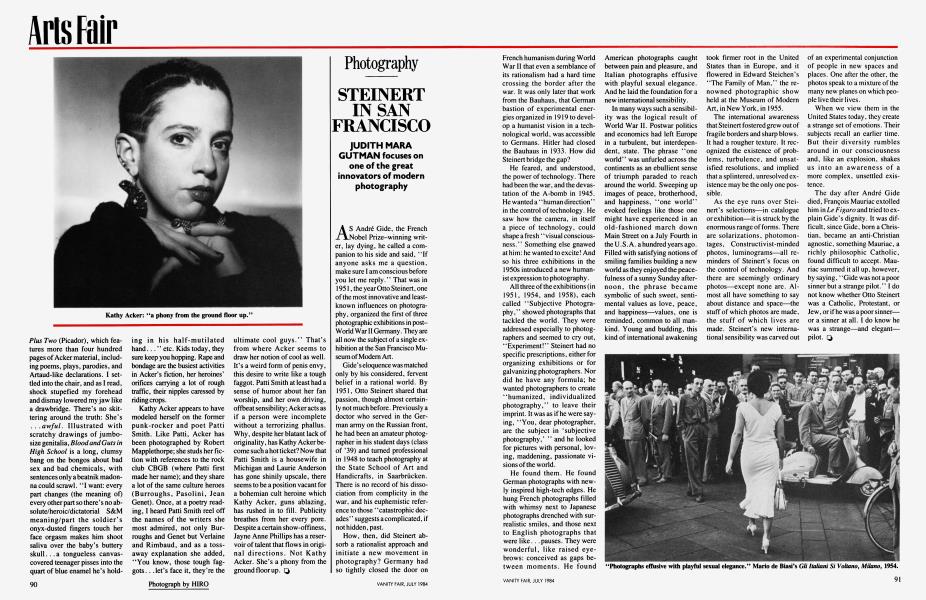
AS Andre Gide, the French Prize-winning writer, lay dying, he called a companion to his side and said, "If anyone asks me a question, make sure I am conscious before you let me reply." That was in 1951, the year Otto Steinert, one of the most innovative and leastknown influences on photography, organized the first of three photographic exhibitions in postWorld War II Germany. They are all now the subject of a single exhibition at the San Francisco Museum of Modem Art.
Gide's eloquence was matched only by his considered, fervent belief in a rational world. By 1951, Otto Steinert shared that passion, though almost certainly not much before. Previously a doctor who served in the German army on the Russian front, he had been an amateur photographer in his student days (class of '39) and turned professional in 1948 to teach photography at the State School of Art and Handicrafts, in Saarbriicken. There is no record of his dissociation from complicity in the war, and his euphemistic reference to those ' 'catastrophic decades" suggests a complicated, if not hidden, past.
How, then, did Steinert absorb a rationalist approach and initiate a new movement in photography? Germany had so tightly closed the door on French humanism during World War II that even a semblance of its rationalism had a hard time crossing the border after the war. It was only later that work from the Bauhaus, that German bastion of experimental energies organized in 1919 to develop a humanist vision in a technological world, was accessible to Germans. Hitler had closed the Bauhaus in 1933. How did Steinert bridge the gap?
He feared, and understood, the power of technology. There had been the war, and the devastation of the A-bomb in 1945. He wanted a' 4 human direction' ' in the control of technology. He saw how the camera, in itself a piece of technology, could shape afresh "visual consciousness." Something else gnawed at him: he wanted to excite! And so his three exhibitions in the 1950s introduced a new humanist expression to photography.
All three of the exhibitions (in 1951, 1954, and 1958), each called "Subjective Photography," showed photographs that tackled the world. They were addressed especially to photographers and seemed to cry out, "Experiment!" Steinert had no specific prescriptions, either for organizing exhibitions or for galvanizing photographers. Nor did he have any formula; he wanted photographers to create "humanized, individualized photography," to leave their imprint. It was as if he were saying, "You, dear photographer, are the subject in 'subjective photography,' " and he looked for pictures with personal, loving, maddening, passionate visions of the world.
He found them. He found German photographs with newly inspired high-tech edges. He hung French photographs filled with whimsy next to Japanese photographs drenched with surrealistic smiles, and those next to English photographs that were like.. .pauses. They were wonderful, like raised eyebrows: conceived as gaps between moments. He found American photographs caught between pain and pleasure, and Italian photographs effusive with playful sexual elegance. And he laid the foundation for a new international sensibility.
In many ways such a sensibility was the logical result of World War II. Postwar politics and economics had left Europe in a turbulent, but interdependent, state. The phrase "one world" was unfurled across the continents as an ebullient sense of triumph paraded to reach around the world. Sweeping up images of peace, brotherhood, and happiness, "one world" evoked feelings like those one might have experienced in an old-fashioned march down Main Street on a July Fourth in theU.S.A. a hundred years ago. Filled with satisfying notions of smiling families building a new world as they enjoyed the peacefulness of a sunny Sunday afternoon, the phrase became symbolic of such sweet, sentimental values as love, peace, and happiness—values, one is reminded, common to all mankind. Young and budding, this kind of international awakening took firmer root in the United States than in Europe, and it flowered in Edward Steichen's "The Family of Man," the renowned photographic show held at the Museum of Modern Art, in New York, in 1955.
The international awareness that Steinert fostered grew out of fragile borders and sharp blows. It had a rougher texture. It recognized the existence of problems, turbulence, and unsatisfied resolutions, and implied that a splintered, unresolved existence may be the only one possible.
As the eye runs over Steinert's selections—in catalogue or exhibition—it is struck by the enormous range of forms. There are solarizations, photomontages, Constructivist-minded photos, luminograms—all reminders of Steinert's focus on the control of technology. And there are seemingly ordinary photos—except none are. Almost all have something to say about distance and space—the stuff of which photos are made, the stuff of which lives are made. Steinert's new international sensibility was carved out of an experimental conjunction of people in new spaces and places. One after the other, the photos speak to a mixture of the many new planes on which people live their lives.
When we view them in the United States today, they create a strange set of emotions. Their subjects recall an earlier time. But their diversity rumbles around in our consciousness and, like an explosion, shakes us into an awareness of a more complex, unsettled existence.
The day after Andre Gide died, Francois Mauriac extolled him in Le Figaro and tried to explain Gide's dignity. It was difficult, since Gide, born a Christian, became an anti-Christian agnostic, something Mauriac, a richly philosophic Catholic, found difficult to accept. Mauriac summed it all up, however, by saying,4 'Gide was not a poor sinner but a strange pilot." I do not know whether Otto Steinert was a Catholic, Protestant, or Jew, or if he was a poor sinner— or a sinner at all. I do know he was a strange—and elegant— pilot.
Subscribers have complete access to the archive.
Sign In Not a Subscriber?Join Now
