Sign In to Your Account
Subscribers have complete access to the archive.
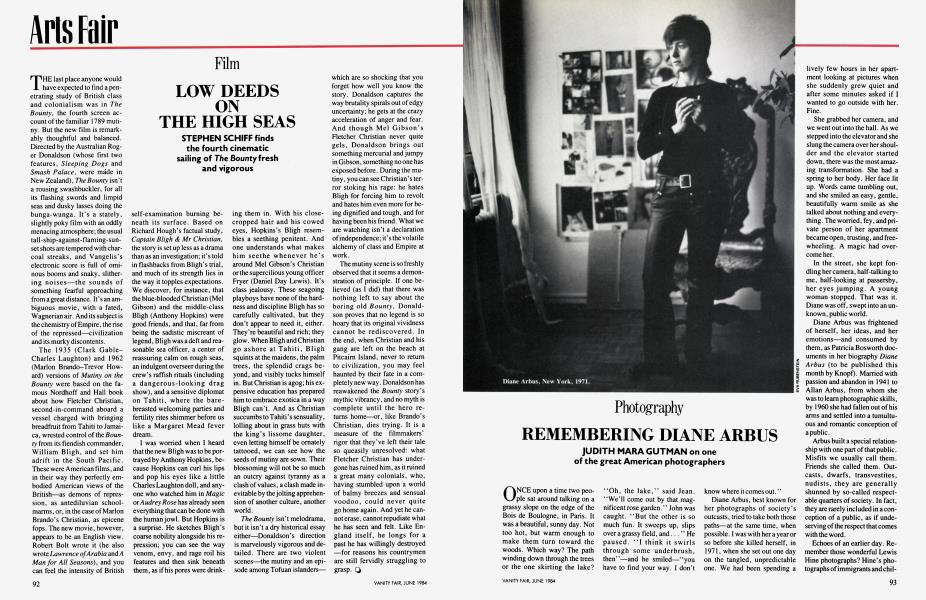
Sign In Not a Subscriber?Join NowREMEMBERING DIANE ARBUS
JUDITH MARA GUTMAN on one of the great American photographers
Photography
ONCE upon a time two people sat around talking on a grassy slope on the edge of the Bois de Boulogne, in Paris. It was a beautiful, sunny day. Not too hot, but warm enough to make them turn toward the woods. Which way? The path winding down through the trees or the one skirting the lake?
“Oh, the lake,” said Jean. “We’ll come out by that magnificent rose garden. ” John was caught. “But the other is so much fun. It sweeps up, slips over a grassy field, and...” He paused. “I think it swirls through some underbrush, then”—and he smiled—“you have to find your way. I don’t know where it comes out. ’ ’
Diane Arbus, best known for her photographs of society’s outcasts, tried to take both those paths—at the same time, when possible. I was with her a year or so before she killed herself, in 1971, when she set out one day on the tangled, unpredictable one. We had been spending a lively few hours in her apartment looking at pictures when she suddenly grew quiet and after some minutes asked if I wanted to go outside with her. Fine.
She grabbed her camera, and we went out into the hall. As we stepped into the elevator and she slung the camera over her shoulder and the elevator started down, there was the most amazing transformation. She had a spring to her body. Her face lit up. Words came tumbling out, and she smiled an easy, gentle, beautifully warm smile as she talked about nothing and everything. The worried, fey, and private person of her apartment became open, trusting, and freewheeling. A magic had overcome her.
In the street, she kept fondling her camera, half-talking to me, half-looking at passersby, her eyes jumping. A young woman stopped. That was it. Diane was off, swept into an unknown, public world.
Diane Arbus was frightened of herself, her ideas, and her emotions—and consumed by them, as Patricia Bosworth documents in her biography Diane Arbus (to be published this month by Knopf). Married with passion and abandon in 1941 to Allan Arbus, from whom she was to learn photographic skills, by 1960 she had fallen out of his arms and settled into a tumultuous and romantic conception of a public.
Arbus built a special relationship with one part of that public. Misfits we usually call them. Friends she called them. Outcasts, dwarfs, transvestites, nudists, they are generally shunned by so-called respectable quarters of society. In fact, they are rarely included in a conception of a public, as if undeserving of the respect that comes with the word.
Echoes of an earlier day. Remember those wonderful Lewis Hine photographs? Hine’s photographs of immigrants and children in and out of factories were taken around 1910, before he went on to photograph mental patients, among others. Audiences are captivated by these photographs today.
Then, these pictures were shocking. Respectable people found the subjects repugnant, even repulsive. They shuddered at the dirty, unkempt surroundings in which these untouchables lived, and those who weren’t reformers wanted nothing more than to keep those people out on the fringe, to keep them from “infecting” decent people.
Some of these fringe people, however,, moved into conventional society. Diane Arbus’s grandparents were among them. Her maternal grandfather was a bookie who became a fur trader in the winter, when the racetrack was closed. (Bosworth’s book, produced without the cooperation of Arbus’s husband, two daughters, or final confidant, is chock-full of information of this sort.) With Diane’s mother and father, her grandparents went on to open Russeks, one of New York’s classy specialty shops, selling furs to the likes of the Astors and Rockefellers, who hugged the established center of society. They also settled into this world with such flourish that Diane, who was bom in 1923, was brought up surrounded by servants, nannies, chauffeurs, and French and English antiques. In effect, Diane lived on an island.
Diane probably never linked her going out to the fringe with her grandfather’s life on the fringe. She constructed what she called her “family album” in the 1960s, but if she made a connection, it seems to have been on a less than conscious level—as if she were just playing around with a bunch of pictures. In the same spirit, she seems not to have connected herself with Hine’s portraiture. We know she considered Hine one of the great photographers. She didn’t seem to realize that she in her society paralleled Hine’s movement in his. She probably never realized that her move out to the fringe not only built on Hine’s but expanded its place and role in the historical and aesthetic development of photography. Innocently , it seems, she stumbled through inexplicable torrents of history as mounting personal despair swarmed about her.
Arbus carried on a chilling, exuberant, frenetic, self-doubting dialogue with herself. She moved into the unconscious, played with the conscious, groveled in despair, and touched stars of brightness. Trying, especially in her early life, to take the picturesque, ordered path— she loved the idea of being passionately dependent on her husband—she also loved ferreting out the tangled, unpredictable routes.
I don’t remember seeing many mirrors in her apartment. She didn’t need them. She carried a duality of persona within herself and siphoned it through the camera. Her portraits— commercial as well as “artistic”—are suffused with it. Is The Human Pin Cushion, a portrait of a circus performer with pins stuck through his neck and cheek, repulsive? Or does it finally melt the viewer’s gaze into a compassionate bond? Susan Sontag in On Photography says Arbus’s triumph was in shaping a new style out of frontality, solemnity, and frankness. A first step. Arbus’s great triumph lay in her capacity to wed that frankness to individuals not usually treated as humans.
Arbus drew on tiny fragments of a person’s life, delicate filaments. And she constructed fictions from them. And that’s what her pictures are—wonderful fictions. She created characters. as in a novel. And it is these characters who reveal a truth far beyond the truth of a more ordinary portrait.
Subscribers have complete access to the archive.
Sign In Not a Subscriber?Join Now
