

Sign In to Your Account
Subscribers have complete access to the archive.
Sign In Not a Subscriber?Join NowExpelled!
Being thrown out of a good school was a great help to their careers
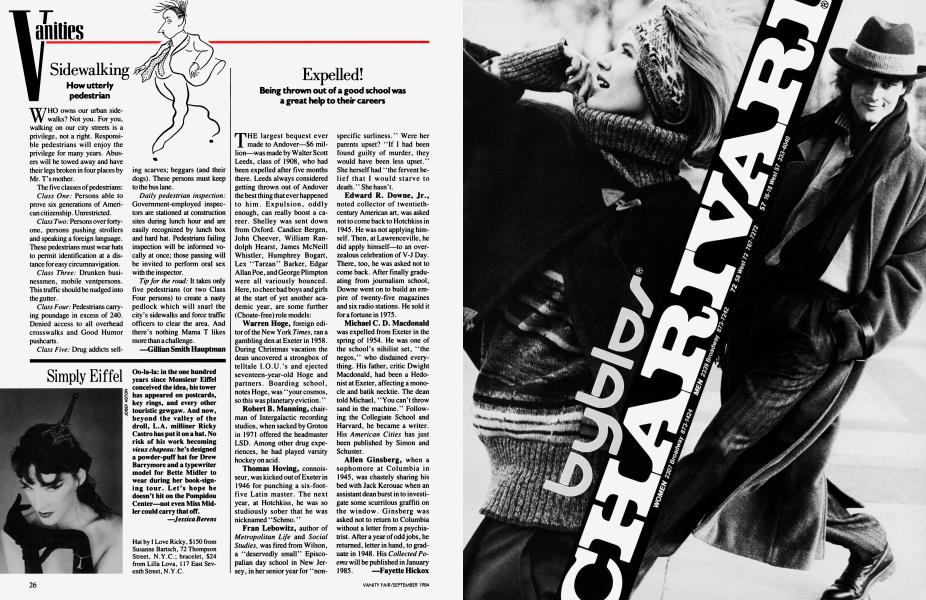
THE largest bequest ever made to Andover—$6 million—was made by Walter Scott Leeds, class of 1908, who had been expelled after five months there. Leeds always considered getting thrown out of Andover the best thing that ever happened to him. Expulsion, oddly enough, can really boost a career. Shelley was sent down from Oxford. Candice Bergen, John Cheever, William Randolph Hearst, James McNeill Whistler, Humphrey Bogart, Lex “Tarzan” Barker, Edgar Allan Poe, and George Plimpton were all variously bounced. Here, to cheer bad boys and girls at the start of yet another academic year, are some further (Choate-free) role models:
Warren Hoge, foreign editor of the New York Times, ran a gambling den at Exeter in 1958. During Christmas vacation the dean uncovered a strongbox of telltale I.O.U.’s and ejected seventeen-year-old Hoge and partners. Boarding school, notes Hoge, was “your cosmos, so this was planetary eviction. ’ ’
Robert B. Manning, chairman of Intergalactic recording studios, when sacked by Groton in 1971 offered the headmaster LSD. Among other drug experiences, he had played varsity hockey on acid.
Thomas Hoving, connoisseur, was kicked out of Exeter in 1946 for punching a six-footfive Latin master. The next year, at Hotchkiss, he was so studiously sober that he was nicknamed “Schmo. ’ ’
Fran Lebowitz, author of Metropolitan Life and Social Studies, was fired from Wilson, a “deservedly small” Episcopalian day school in New Jersey, in her senior year for “nonspecific surliness.” Were her parents upset? “If I had been found guilty of murder, they would have been less upset.” She herself had “the fervent belief that I would starve to death.’’She hasn’t.
Edward R. Downe, Jr., noted collector of twentiethcentury American art, was asked not to come back to Hotchkiss in 1945. He was not applying himself. Then, at Lawrenceville, he did apply himself—to an overzealous celebration of V-J Day. There, too, he was asked not to come back. After finally graduating from journalism school, Downe went on to build an empire of twenty-five magazines and six radio stations. He sold it for a fortune in 1975.
Michael C. D. Macdonald was expelled from Exeter in the spring of 1954. He was one of the school’s nihilist set, “the negos,” who disdained everything. His father, critic Dwight Macdonald, had been a Hedonist at Exeter, affecting a monocle and batik necktie. The dean told Michael, “You can’t throw sand in the machine.” Following the Collegiate School and Harvard, he became a writer. His American Cities has just been published by Simon and Schuster.
Allen Ginsberg, when a sophomore at Columbia in 1945, was chastely sharing his bed with Jack Kerouac when an assistant dean burst in to investigate some scurrilous graffiti on the window. Ginsberg was asked not to return to Columbia without a letter from a psychiatrist. After a year of odd jobs, he returned, letter in hand, to graduate in 1948. His Collected Poems will be published in January 1985.
Fayette Hickox
Subscribers have complete access to the archive.
Sign In Not a Subscriber?Join Now