Sign In to Your Account
Subscribers have complete access to the archive.
Sign In Not a Subscriber?Join NowLooking for Cool in L.A
Less than Zero's BRET EASTON ELLIS chronicles his quest for the ultimate "happening" place in L.A. with Brat Packer JUDD NELSON and photographer BRADFORD BRANSON
It was the first weeks of August in L.A. Killer bees were found in the San Joaquin Valley. The city was awaiting the anniversary of the Manson slayings. One of my sister's friends was shot to death as he walked out of a club called Hot Trax in the San Fernando Valley. Rock Hudson admitted his battle with AIDS. Madonna and Sean Penn were set to wed on the sixteenth. The No. 1 song was "Shout," by Tears for Fears. I met Judd Nelson on a hot clear day at Carney's on Sunset Boulevard. Judd had two cheeseburgers with mustard and onions, fries, and an orange juice. I had a chiliburger, fries, and a Diet Coke. And while we talked about what
we were going to be doing in the next couple of weeks, we were occasionally interrupted by girls asking for Judd's autograph, an alarming number of them holding frozen chocolate-covered bananas. I had been away for so long I had no idea what was "cool" to do in L.A., and Judd had been working pretty much nonstop for the past year or so, so we decided to go on a ' 'quest for cool, " a search for the ' 'happening" places in the city. We thought we'd dress the part, try to adopt the proper attire (we decided on black pants, black jacket, black shoes, thin black tie, white shirt, white socks) and search these places out, find where it was cool to buy clothes, to eat, to hang out, to drink, to dance. Places we had heard about or vaguely remembered. Sitting there on the yellow train on Sunset, we were half joking, half serious, and it seemed like a good idea, fun, harmless, maybe a little dumb. And while we ordered more fries, we talked some more about this quest. And we talked about it for a little while at the Crown bookstore on Wilshire in Santa Monica and at the Centerfold newsstand on Fairfax, and finally got an idea of where to go, of what to do, to begin our search for cool. Judd drove.
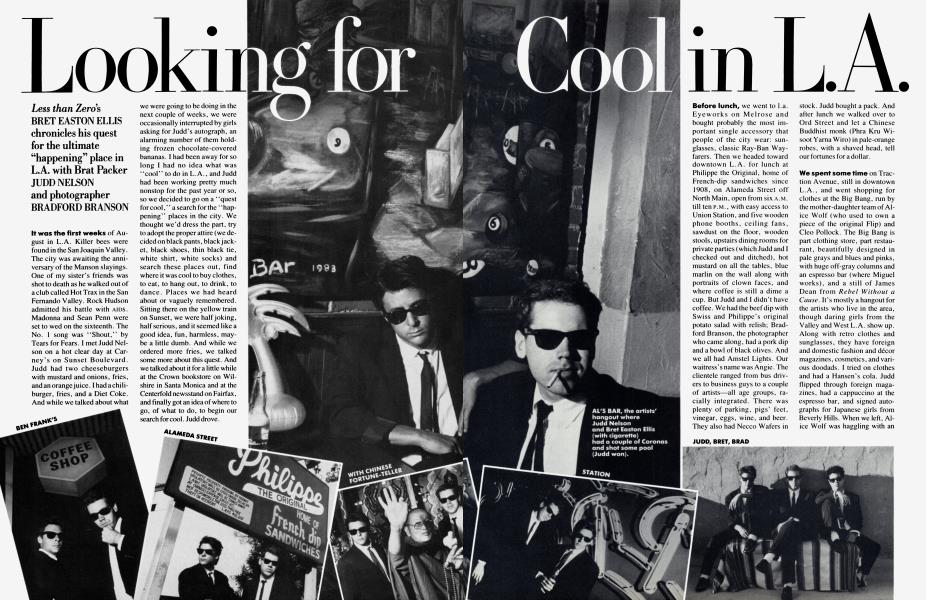
ALAMEDA STREET
WITH CHINESE FORTUNE-TELLER
Before lunch, we went to l.a. Eyeworks on Melrose and bought probably the most important single accessory that people of the city wear: sunglasses, classic Ray-Ban Wayfarers. Then we headed toward downtown L.A. for lunch at Philippe the Original, home of French-dip sandwiches since 1908, on Alameda Street off North Main, open from six A.M. till ten P.M. , with easy access to Union Station, and five wooden phone booths, ceiling fans, sawdust on the floor, wooden stools, upstairs dining rooms for private parties (which Judd and I checked out and ditched), hot mustard on all the tables, blue marlin on the wall along with portraits of clown faces, and where coffee is still a dime a cup. But Judd and I didn't have coffee. We had the beef dip with Swiss and Philippe's original potato salad with relish; Bradford Branson, the photographer who came along, had a pork dip and a bowl of black olives. And we all had Amstel Lights. Our waitress's name was Angie. The clientele ranged from bus drivers to business guys to a couple of artists—all age groups, racially integrated. There was plenty of parking, pigs' feet, vinegar, eggs, wine, and beer. They also had Necco Wafers in stock. Judd bought a pack. And after lunch we walked over to Ord Street and let a Chinese Buddhist monk (Phra Kru Wisoot Yarna Wiro) in pale-orange robes, with a shaved head, tell our fortunes for a dollar.
We spent some time on Traction Avenue, still in downtown L.A., and went shopping for clothes at the Big Bang, run by the mother-daughter team of Alice Wolf (who used to own a piece of the original Flip) and Cleo Pollock. The Big Bang is part clothing store, part restaurant, beautifully designed in pale grays and blues and pinks, with huge off-gray columns and an espresso bar (where Miguel works), and a still of James Dean from Rebel Without a Cause. It's mostly a hangout for the artists who live in the area, though daring girls from the Valley and West L.A. show up. Along with retro clothes and sunglasses, they have foreign and domestic fashion and decor magazines, cosmetics, and various doodads. I tried on clothes and had a Hansen's cola. Judd flipped through foreign magazines, had a cappuccino at the espresso bar, and signed autographs for Japanese girls from Beverly Hills. When we left, Alice Wolf was haggling with an Oriental sweatshirt salesman.
We were still wearing black, and so we tried to keep in the shade on our short walk over to the Museum of Neon Art, past the young bearded artist in the baseball cap painting the crosswalk in fluorescent-pink-andgreen lettering a few feet from the huge neon-strung Mona Lisa over the museum entrance. It was hot in the MONA, and dark, and we saw the owner, Lily Lakich, who designed the neon sign above the Big Bang, making more neon art in the back of the museum. At first Judd and I were too nervous to touch some of the audience-participation neon-art machines, but then we got used to the idea. We didn't stay long, because the heat from the neon was getting us hotter. Out in the air-conditioned reception area, the girl behind the desk asked us how it was. Judd and I looked at each other, then back at her.
" It was cool, " we said.
Then we walked back outside, stood in the shade and loosened our ties, waited for Bradford, wondering where he was.
"It was cool, wasn't it?" I askedJudd.
"I think so," he said, looking up at the humming neon face. "Yeah. It was cool."
Al's Bar, on the same block, on Hewitt Street, is an artists' hangout with a beat-up piano in the comer, sublime graffiti in the men's room, and a great jukebox: Bryan Ferry, the Cramps, A1 Green, Dion, X, Los Lobos, Talking Heads (Judd's favorite group: on his answering machine nobody talks—there's just David Byme singing "Stay Up Late"), the Shirelles, Springsteen. We had a couple of Coronas, shot some pool (Judd won), took some photos that came out too light in the vintage 1940 photo booth, listened to Johnny Mathis sing "Chances Are," and we talked about other bars in the city, agreeing that the Coronet on La Cienega can be cool sometimes but is usually filled with too many guys fromU.C.L.A. getting rowdy.
Al's Bar was also the first place that we heard about a certain special club. A very private club. A very mysterious club. And above all. . .
Avery cool club.
We heard this from a local artist (gesso on the tom jeans, handsome, T-shirt, expensive-looking boots, swigging Bud), and we listened attentively as this guy we were now shooting pool with told us about it. He wasn't sure where it was going to be this week. It could be any night. Anyplace. It could be as far away as Glendale, or maybe it would be on Sunset, or in West L. A., or maybe even in the Valley, or maybe in Venice, but wherever it was, whenever it was, it was the most. .. and now he paused, before he shot that eight ball into the right corner pocket. . . cool. . . club in all of Los Angeles.
"What is this place called?" we asked.
He looked us over, hitched up his jeans, and called out to a fellow artist at the bar, "Hey, Gerard, the fucking Blues Brothers wanna know about the Bud. ' '
Gerard looked over at us, laughed, and turned back to his drink.
"The Bud?" Judd mouthed to me.
I shrugged, looked back at the
guy-
"What'sitcalled?" Iasked.
He put the pool cue back on the rack and said, "It's called..." He looked at his fingernails. "It's called...the BudClub. .
"The Bud Club," Judd said while we were sitting in the bar at the Hilton Hotel on Wilshire in downtown L.A., waiting for the traffic on the freeways to let up. "Ever hear of the Bud Club?" he asked Bradford, his eyes on the tall, pretty waitress from Texas who was watching the large-screen TV; a Delta plane had crashed in Fort Worth, killing most on board.
"The Bud Club?'' Brad asked. "Is that with one d or two?"
"Don't know," Judd said, looking over at me.
"I think it's one," I said, though I wasn't sure. "I haven't heard of it either."
"I think we should find it," Judd said.
Brad and I agreed, then fell silent when we caught sight of the burning L-1011 lying just off the runway. The waitress from Texas quietly took another order, and Judd made a phone call. I asked Bradford about the downtown scene, since I was surprised to find how trendy it had become. The only person I'd had any contact with who lived downtown was Peter Ivers of the New Wave Theater, who was murdered in his loft around two years ago. Bradford talked about how depressing the downtown scene actually was.
Judd came back from the phone, and we paid the check. Then we went down to the garage, where the young Chicano valet asked Judd for his autograph, and we got into his Jeep and talked about how we could find this special club, this unknown, this ultimately cool club called the Bud Club.
Driving down Sunset, Judd, Bradford, and I in Judd's Jeep, we saw a blinding streak move quick, then slow, across the twilit sky. Traffic stopped on Sunset. Judd pulled his Jeep into the Chevron station on the corner of Laurel. The streak seemed to burst and go faster. A guy on a motorcycle turned into the gas station and took off his helmet. He had a head of long stringy hair, greasy, and stoned red eyes staring off above the billboards (RETURN OF THE LIVING DEAD THEY'RE BACK FROM THE GRAVE AND READY TO PARTY).
"What in the hell is it?" Judd asked, stepping out of the Jeep.
The guy on the motorcycle with the UB40 T-shirt on said, "Put your heads between your knees. It's all over, dudes."
Judd stared at him, then back at the sky.
Another car pulled into the gas station, and a youngish middle-aged businessman in a threepiece suit, balding, mustache, got out of his car, looking worried, taking his tie off. "What the fuck is that?" he asked.
"We don't know," Judd said.
"It's a missile. It's a fucking missile," the businessman said, answering his own question.
Judd and I bumped into Crispin Glover, who like us was too shy to dance in the middle of the floor.
We stood there, looking up at the sky, at the lingering white streak, which glowed brighter, then started to fade (and which was actually two navigationalsatellite booster rockets from Vandenberg Air Force Base). The businessman got back in his car and pulled out into the traffic. The guy on the motorcycle put his helmet back on and left.
We were hungry. We didn't want sushi, though if we had we could have gone to Katsu on Hillhurst, and we didn't want Mexican, though if we had we would have headed out to El Cholo or El Coyote. We wanted Cajun food, so we went over to Pico, to the Ritz Cafe for a Cajun black steak, and sat in one of the roomy booths. While we were cooling our mouths from the fire-hot black steak, Bradford's assistant, Jeff ("I like it here— this place has a real New York feel to it"), arrived and told us that the Dirt Box was the club to go to tonight, really the only club to go to on a Friday night. So we paid the check, went out to the parking lot, and while Judd was waiting for his Jeep, he was asked if he was Judd Hirsch.
"Judd Hirsch? No," Judd said.
"Oh. Thought you were," the guy said, laughing. "Look like him."
''Well..." Judd said. "Maybe it's the sunglasses."
The Jeep pulled up and we got in, headed downtown, toward the Dirt Box.
"Oh my God," Judd said. "Judd Hirsch? Do I look like Judd Hirsch?"
I was still laughing, and said, "No."
"How depressing," he said.
We were quiet for a little while. I almost reached for the radio, then realized there wasn't one in the Jeep—too easy to steal. Just the cars passing on Sunset were the only noise. We came to a light. Then Judd suddenly screamed, "Judd Hirsch?!? Fucking Judd Hirsch?!?"
A lot of people Judd and I met.
in L. A. last summer told us that the only Continued from page 93
Continued on page 118
good clubs were the illegal after-hours clubs. The only decent legal clubs we heard talked about were Z-Deluxe (at the Imperial Gardens on Sunset, on Thursday nights), the Glam Slam Club (same place, on Wednesdays), and—if you like Bruce Springsteen—the Boss Club (same location, on Tuesday nights). The other good clubs were either predominantly gay, like Rage and Revolver (which used to be the Blue Parrot) and Studio One, or clubs like Powertools that used to be after-hours but then became legit.
So we went to the Dirt Box, one of the "floating clubs"—essentially illegal because of serving alcohol past two o'clock—which tonight was in a rather nondescript dance hall on Hope Street. You have to buy "death skulls" (two bucks apiece) in the lobby, and you simply hand one of these tiny plastic skulls to a bartender, who'll get you a beer or a glass of wine. It seemed like a good place to go if you're shy and prefer to dance alone, like Judd did, in a comer without being noticed. Judd and I bumped into Crispin Glover, who like us was too shy to do any dancing in the middle of the floor.
"What sort of people come here?" we asked a drunken girl, sitting in the too brightly lit lobby, pretty, obviously under-age, pale skin, violet-black hair.
"Who are you guys? The Blues Brothers?" she asked us.
"No. We're looking for the Bud Club," we told her.
"What kind of people come here?" she asked herself. "I don't know. Losers, mostly."
Judd and I looked at each other. "Losers?"
"Yeah, losers," the girl said.
"But we heard this was the coolest club on Friday nights," we said.
"Yeah? Well, it's O.K.," she said. "Did you see the missile tonight?"
"What are losers?" we asked.
"I don't know." She shrugged. "Sixteen-year-olds?' '
We stayed around until about four o'clock and kept drinking. Asked a lot of people if they had heard of the Bud Club, and then if anybody knew where this place was going to be next week. Nobody did.
If you go to the clubs downtown, it
helps to know the area, so when you leave, drunk and tired, you can find the freeway. Judd and I couldn't. We followed some people we met at the Dirt Box for a while, but they made a sudden turn, so we stopped following them and just took Wilshire home.
There are a number of places to go to in L.A. if you just want a snack, like the Food Bank in Westwood, Primi in West L.A., or Spago on Sunset for pizza. Or Chin Chin on Sunset Boulevard for dim sum, where it's best to take out and eat in the spacious parking lot, which we did, on the trunk of somebody's Mercedes, while Judd did his Tina Turner Aunty Entity impersonation from the new Mad Max movie ("Why, he ain't nothin' but a raggedy man!") for passersby. It was dusk, and even though Judd was occasionally asked for an autograph, we still had a great view, dim sum chicken dumplings, ribs, Tsingtao beer, and spring rolls. It was also where we found out from an L.A. Herald Examiner we picked up in the parking lot about the plane crash in Japan that killed 520 people.
I went to the opening of Lunch, a new club on Highland, right off Melrose, on a Thursday night when Judd was home reading and not in the mood to go out. A couple of the members of Frankie Goes to Hollywood were there, along with Andre Cymone and Anthony "Swan" Kiedis, the lead singer of the Red Hot Chili Peppers, and Gene Anthony Ray, who was dancing on the staircase. Matt Dike, the D.J. from Powertools, was there too, and I asked him if he had heard of a place called the Bud Club. He said he had but didn't know exactly where it was. And there was a drunken British girl who told me that Lunch was "such a New York place." What was weird was how unlike New York Lunch was, with its open ceiling, palm trees, bonfire, BMWs parked out front. This girl asked me where I went to school, and I told her Vermont.
"Vermont? Is Vermont in England?" she asked.
"Is Vermont in England?"
"Yeah." Her grapefruit juice and vodka was slowly spilling out of her glass, but she didn't notice.
"No. Vermont's a state," I told her.
"It is? Oh my," she said.
On a Saturday night we ate at Chianti Cucina on Melrose. Then we headed for Station on Sunset, another "floating club," which Bradford told us was run by a couple of guys who work at the Hard Rock. If you stay late enough you can have breakfast at the Denny's coffee shop right across the street. (Other good breakfast places are Duke's at the Tropicana Motel, a haven for the music crowd; Ben Frank's on Sunset, which is one of the last high-class coffee shops; and Gorky's, a Russian cafeteria downtown on Eighth Street.)
We parked, walked past the prostitutes on Sunset and into the dark, highceilinged club—really just a big room, maybe a warehouse. The D.J. played the Smiths and John Lydon and Afrika Bambaataa; naked mannequins were hanging by string from the ceiling; Lowenbrau and wine were served behind a small bar, with two punked-out bartenders on duty. There were slides on a wall-size screen in the comer; one was of Judd surprised by a flash, one of a black girl in a bikini (actually a guy, Judd told me).
You look around and see the same people you saw at Lunch and at the Dirt Box, and the same girl in the sailor cap you'll see at Powertools, and then you finally see the old neon Flipper's sign in the comer, leaning against a wall, a reminder of the transience of the L.A. club scene. Where Flipper's used to be is now the big Esprit store, on the corner of Santa Monica and La Cienega.
Judd was dancing alone in a comer, and I danced alone in another comer, every so often passing each other, holding beers, in the dark. We asked a couple of girls if they knew where the Bud Club was. Some told us Malibu. Others told us downtown. But none of them knew for sure.
Already drunk, tired from dancing, the whole idea of "cool" fading from our minds, we headed toward Powertools, described by almost everyone we ran into during those weeks as the "hottest," "the most happening" club in all of Los Angeles. Powertools was started by Matt Dike and our photographer, Bradford Branson, last November at Washington and Crenshaw, with an exhibition of model/artist Fritz Koke's work. Andy Warhol, Annie Lennox, Andy Summers, Malcolm McLaren, Lauren Hutton all showed up. It moved from there to an old ballroom on Ninth Street called Club Bravado, then to the rooftop of the Embassy Hotel. For the two weeks I went (open on Saturday nights), it was at the Park Plaza Hotel, where the Nairobi Room used to be. Once past the doormen ("Should we let the Blues Brothers in?"), who were thorough, Judd and I went through a hall dominated by a flashing strobe light, and then into another dark, highceilinged dance hall, complete with gogo dancers and the shadows of cockroaches encased in glass boxes projected onto the ceiling. ("I guess it's to encourage people to dance," someone said.) Outside was a spacious patio with tables and chairs, and three films going on at once on the concrete wall: the trailer from The Missouri Breaks; animal/nature documentaries (a really weird one about animals that looked like woodchucks but turned out to be lemmings flinging themselves off a cliff into the sea); antimarijuana propaganda films from the late sixties, early seventies; car accidents played back in slow motion; a coyote being tortured by an electric cattle prod. Powertools has the best D.J. in L.A., Matt Dike—though Lee Selwyn at Club Soho, on the third floor of the Pabst brewery in downtown L.A. on Friday nights, is probably runner-up. When I asked John Shanks, lead singer of the band Victims of Chance (which used to be Line One), what sort of people come to Powertools, he told me, "Artists, musicians, actors, people who follow Matt wherever he goes. . . And people come here because the girls are hot." Kevin Dolan, drummer of the Abecedarians, agreed. Though the girls I talked to were concerned mainly about the anniversary of the Manson killings and the upcoming wedding of Madonna and Sean Penn, they did seem to be among the most stylish-looking we ran into. "Why do you come here?" I asked them. Same answer. "The guys are really hot." The guys I talked to acted preoccupied with either the promotional budget for Weird Science or the Delta air crash in Fort Worth ("Who was the dickweed flying that fucker?").
As it got later, there was talk of other clubs, since Powertools, now legitimate, stopped serving alcohol at two. La Dolce Vita was mentioned, as was the Aerial on La Brea and a place called the Attack, though some said it wasn't around anymore.
But it was at Powertools that Judd and I seemed to lose our enthusiasm for the search for cool. The car-accident films, the roaches still hopping tirelessly in their glass cages, the nonstop music, the trailer for The Missouri Breaks being run over and over, uneased us, wore us out. We were beginning to see the possibility of never finding the Bud Club, that maybe, like our quest, the whole thing was a joke. And so Judd and I left Powertools sometime around 3:30, exhausted, shaken, the quest for cool finally exacting its price.
The freeways were mostly empty. There was a light mist, and occasional taillights disappearing into it. If there's a dominant color that time of night it's purple, or maybe pink, because of the harsh glow from the fluorescent streetlights. Driving along the Santa Monica Freeway, back toward West L.A., in the middle of the night, no radio blaring, just the sound of wind and engine and the quiet hum of the heater—the night is cool to you, you've been in the club for so long—you can see the boulevards of the city after all the clubs have let out for the night. The few cars are solitary and move fast, and disappear into the weird mist that gathers in patches along the roads and freeways. The only places where people are gathering at this hour are all-night coffee shops, from Canter's on Fairfax to Pennyfeathers on La Cienega to Ben Frank's on Sunset. The late middle of the night is the quietest, softest time in the city. It's when the city seems most vulnerable, and except for the intense pinks and oranges and purples at sunset the most lonely and haunting.
It was the first weeks of August in L.A. The Delta plane crash in Fort Worth was due to something called "wind shear." The baseball strike lasted forty-eight hours. The Night Stalker claimed maybe his thirtieth victim in California. It was the anniversary of the Watts Riots, of the bombings of Hiroshima and Nagasaki. We never found the Bud Club. We followed a car with a license plate that read DOUCARE down the wrong off ramp, and we didn't know where we were going, what we were doing. Our feet were sore. We took our shoes off. We danced a lot that summer. □
Subscribers have complete access to the archive.
Sign In Not a Subscriber?Join Now


