Sign In to Your Account
Subscribers have complete access to the archive.
Sign In Not a Subscriber?Join NowDIZZYLAND
Disney is suddenly the hottest studio in Tinseltown, buzzing with new projects and dizzy with old money. STEPHEN SCHIFF looks behind all the excitement being caused by the new three Mouseketeers, Eisner, Wells, and Katzenberg
For years, Disney has been the little studio that couldn't, the last repository of the schmaltzy and the uncool. Trumpets and banners would periodically announce a New, Improved, Suddenly With-It Disney—only to be followed, in a theater near you, by thudders like Something Wicked This Way Comes, The Watcher in the Woods, and TRON. Insiders came to think of Disney as "the land that time
forgot," the dream factory that had snored through the seventies and eighties, had lost touch with the youth market it had practically invented. But all this has changed. "In a town of action and power junkies, where people are always looking for the hottest floating crap game, Disney is where it happens to be right now," says one industry insider. "They're cutting more deals than anybody else."
Lots more. Since the new management team of Michael Eisner (chairman and C.E.O.), Frank Wells (president), and Jeffrey Katzenberg (chairman of the motion-picture-and-TV division) took over last fall—after a wrenching corporate shakeup—nearly a hundred feature-film projects have been put into development, with seventy-five more being prepared for The Disney Sunday Movie, which may start airing on ABC as early as February. Disney watchers accustomed to the company's snoozy, out-of-it atmosphere have been surprised by the new team's salutary hipness. "Every other studio in town felt like show business," says Lowell Ganz, who co-wrote Splash for Disney and maintains an office there. "But here it was like being in some gigantic lawn-mower company—like writing for Sears. Now there's constant construction, and offices are getting bigger and furniture is coming and going. There's a highenergy feeling." George Lucas is creating rides for the theme parks, and Francis Coppola is directing a Michael Jackson short (in 3-D, yet) to be shown at Disneyland and Epcot Center. The architect Michael Graves is discussing building designs for the Disney lot. Spago's Wolfgang Puck has been consulted on how to improve the notorious Disney commissary, where little old grannies—refugees from some platonic high-school cafeteria— still serve Goofy Burgers at Stone Age prices. There's even a new outdoor disco at Disneyland called Videopolis, where kids can boogie to giant-screen rock videos, occasionally accompanied by Fantasyland's own squeaky-clean version of the Solid Gold dancers. And though the music at Videopolis is by Prince, Madonna, and Tears for Fears, spiky hairdos and black leather (and, incidentally, blacks and Hispanics) are as rare as they were on the old American Bandstand—or The Mickey Mouse Club. Uncle Walt would have loved it.
Early on, Eisner announced that Disney "must go Hollywood." Now it has. Bette Midler and Nick Nolte have just finished a Disney picture directed by Paul Mazursky; Madonna has been asked to do a new comedy by the makers of Airplane!; and a spangly array of Hollywood's best and brightest—and youngest—producers and screenwriters have lined up to slave exclusively for Eisner and Katzenberg. Why? "Because together they're unbeatable," says Craig Zadan, who coproduced the hit Footloose for them when they were pashas at Paramount. "Eisner has incredible instincts about movies—he smells successful things. And then you have Katzenberg—they call him the Golden Retriever. He canvasses the town, and he stays on everybody. I'm amazed at him. Katzenberg started calling me a few months ago—'When are you going to bring your projects here? When?' He sends me notes. He checks in. It's like he noodges you, but it's also a form of seduction."
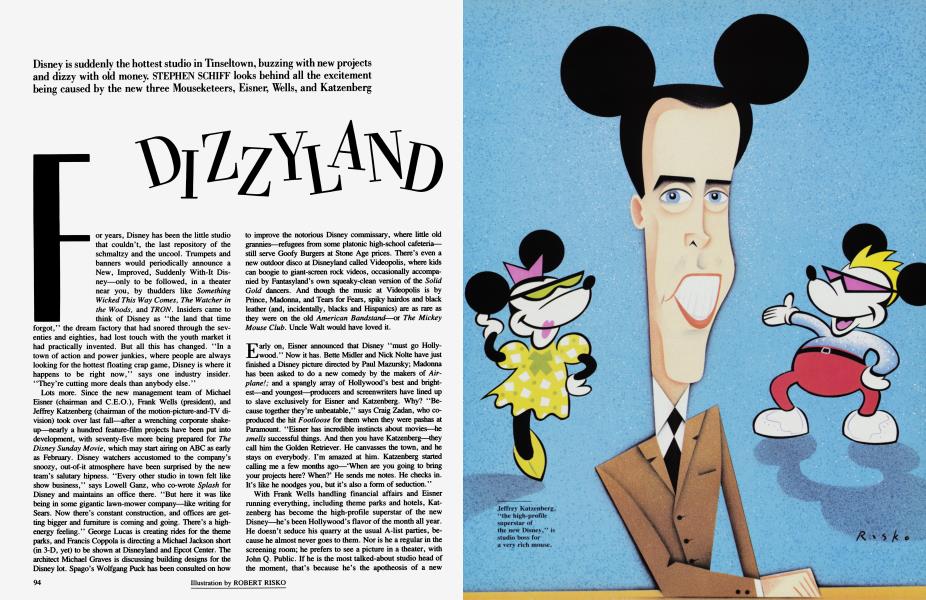
With Frank Wells handling financial affairs and Eisner running everything, including theme parks and hotels, Katzenberg has become the high-profile superstar of the new Disney—he's been Hollywood's flavor of the month all year. He doesn't seduce his quarry at the usual A-list parties, because he almost never goes to them. Nor is he a regular in the screening room; he prefers to see a picture in a theater, with John Q. Public. If he is the most talked-about studio head of the moment, that's because he's the apotheosis of a new breed. In the grand old days, the studios were run by colorful tyrants—garment-district types who often did not understand either movies or modem managerial technique, but had a knack for the care and feeding of their own power. Gradually these moguls—the Mayers and Goldwyns and Cohns—and the studios they ran were bought out by giant conglomerates, and lawyers and managers became the new kingpins, men who knew how to run a business but didn't necessarily understand what making movies (and tending moviemakers) was all about. And now there is Katzenberg—one of the very few studio heads to have mastered both. An N.Y.U. dropout who in his teens had worked on John Lindsay's campaigns, Katzenberg learned show biz at the knee of Paramount's chairman, Barry Diller (now the head of Twentieth Century Fox), whom he went to work for in 1975, at the age of twenty-four. From the moment he arrived at his first studio, he yearned to run one. "Jeffrey's very goal-oriented," a friend remarks. "He always wanted to be a studio head, and now he's thirty-four and he's a studio head. The whole town respects that kind of guy."
That's partly because the whole town has never seen anything like him. Katzenberg is remarkably stable for a studio boss; he was with Paramount for ten years—two or three lifetimes by current movieland standards—and he has said that he plans to stay with Disney for the next thirty. Short, wiry, and ambitious enough to have earned the appellation "a little Sammy Glick" from his former boss, Gulf -IWestern chairman Martin Davis (G + W owns Paramount), Katzenberg is famous for a workaday drill that has the rest of Hollywood playing catch-up. It's not just that he's in the office seven days a week, arriving at 6:15 in the morning (when he makes his calls to Europe) and departing around 8 P.M. It's not just that his production executives keep leaving Saturday-night parties early because Katzenberg expects them at seven o'clock meetings Sunday morning. What boggles a town known for daiquirisoaked poolside deals is how little escapes Katzenberg—how little falls through the cracks in his system. "You would think that he spreads himself too thin, but he doesn't," says a wellplaced production executive. "He gives you the impression that he's everywhere, and he remembers everywhere he's been. His aggressiveness has upped the ante in this town. While Jeff was at Paramount, he not only knew whom Eddie Murphy was talking to, he knew what Murphy was wearing every day." When Katzenberg is not in a meeting, his two secretaries are firing phone calls at him, one after another; he makes about 150 a day. And his Monday-morning regime—during which he rings up lawyers, agents, and producers and asks them what scripts or galleys they've read over the weekend—is legend; a spot on the Monday list has become an insider's badge of honor. "He's married to this wonderful lady named Marilyn," says an executive at Paramount, "and they had twins a couple of years ago, a boy and a girl, and the joke went around about how expediently he got that out of the way, got his family launched. If he could have, he would probably have had the Lamaze classes in his office on the lot."
What does all this furious activity have to do with making terrific movies? Quite possibly nothing. Hollywood has resigned itself to the truth of William Goldman's famous maxim, that as far as the science of manufacturing hits goes, "nobody knows anything." And as for making good films—well, in today's Tinseltown, that's scarcely even an issue: art went out the window with Dish Night. What Jeffrey Katzenberg is trying to do is build a movie studio—or rather turn a groggy little organization that used to cough up four or five films a year into a modem company that makes fifteen or sixteen. And not just Herbie the Love Bug pictures. He has said that at Disney he would make any of the films he made at Paramount except Friday the 13th and Joy of Sex—and Paramount during the reign of Diller, Eisner, and Katzenberg was the most successful studio of its era. But Disney isn't shaped the way Paramount was. Turning it into an active studio has required a complete—and sometimes wrenching—structural overhaul. And in order to get his factory up to speed, Katzenberg has built a stable of contract writers and producers who work exclusively for Disney in a manner reminiscent of the studio days of the thirties and forties—a manner that the rest of the industry has considered unfeasible for four decades.
Continued on page 120
Continued from page 96
Katzenberg can afford to take risks other studios are unwilling to take, not only because Disney is enormously wealthy but because its motion-pictureand-television division hasn't been a major contributor to that wealth for years: film and TV earnings currently amount to less than 10 percent of Disney's $1.6 billion annual revenues. The theme parks are the corporation's cash cow, and a movie failure or two isn't going to change that. (Disney stock has soared from around forty-eight dollars a
share before the company's shake-up to somewhere in the high eighties at this writing.) So Katzenberg can offer unusual inducements. Daniel Petrie Jr., who wrote the hit Beverly Hills Cop, was persuaded to sign a three-year exclusive contract partly because Katzenberg sweetened the deal with promises that Petrie would get to produce and, eventually, direct. "Most studios see people only in certain categories," says Petrie. "Writers are just writers. Actors that you see in a certain role can only play that kind of role. The guys at Disney tend to do the opposite. They want to mix and match the creative elements. Instead of waiting passively for talented people to come to them, they go out and get the people they want. And they enjoy giving young directors and young writers their first shot." Disney has signed up the twenty-three-year-old director Phil Joanou on the basis of a thirty-minute student film he made at U.S.C. "I don't think it's an accident that Phil is here," says Petrie. "I mean, at other studios it would be 'Wait and see and let the story editor meet with him.' And here everybody wants to talk to him. We all talk—it really feels like a movie studio in the old days. I like the idea that if I am working on something, I can just walk down the hall and discuss it with other writers. And maybe in the end three other writers will be writing my screenplay idea, and I'll wind up producing it."
It all sounds just ducky, of course, but not every heart in Hollywood is pounding assent. Why, ask some naysayers, would a really talented writer or producer want to go exclusive with anyone—why be locked in unless you're not much in demand and don't expect to be? Besides, exclusive contracts don't necessarily produce the best films. "What happens when one of your exclusive people brings you five projects and you don't like any of them?" asks a production executive at a rival studio. "Chances are that when he comes in with project number six you're not even going to look at it, you're just going to say yes. And that's no way to make pictures." One of Hollywood's hottest young producers adds, "If you're exclusive with them, you can become a prisoner. Because these guys like to be the boss. They want to tell you what to do; they want to change your movie. And they don't leave you alone."
Then there's the little matter of taste. What Eisner and Katzenberg like are "high concept" pictures— movies that are easy to market because you can sum up their appeal in a sentence or two. One of Katzenberg's favorite projects was Trading Places: white business exec and black bum trade places. Or Beverly Hills Cop: streetwise detective joins forces with hilariously polite Beverly Hills police. Or even Witness: tough cop among the Amish. Not coincidentally, all these movies are about heroes who aren't where they belong—Katzenberg seems to love "fish out of water" stories. Daniel Petrie can sum up his projects, without irony, in pure highconceptese. The first script he wrote was ' 'Treasure Island in Outer Space" (that one never got made). And the Disney project Petrie's working on now? "The Last Detail Meets 48 HRS."
There are other rules. "They don't want English stuff or period stuff," says the writer-producer Jennifer Miller, who created the TV show Paper Dolls and now has a Disney deal. "It's in my contract that what I do has to be for a PG rating." Although there have always been exceptions, the guidelines Eisner and Katzenberg drew at Paramount are notorious. Nothing rural. No dust. No snow. No quaint New England villages. No saddles. ''At many studios people are encouraged to bring in projects that are sort of their own," says a prominent screenwriter. ''The executives have separate bailiwicks, and since there's diversity among the executives, there's diversity among the movies. But the Disney team wants a fairly uniform product. They like to generate their own ideas, and even if you bring them an idea that wasn't originally, say, a fish-out-ofwater story, they will try to fashion it into a fish-out-of-water story." The screenwriter's agent once read him a list of projects—mostly comedies— that the gang now at Disney wanted someone to write, ''and I nearly cried. They wanted four sailors on shore leave. Or four Wacs on shore leave. My favorite is this one: A man has lost
everything in life except his dog. And his dog gets ill and has to go to the vet, and the vet says, 'The dog is going to die unless I perform a certain procedure within twenty-four hours.' The procedure will cost seventy-five dollars, and the guy hasn't got seventy-five dollars. So the project is about how the guy tries to raise seventy-five dollars in one day. The name of the project is, so help me, 'Save My Dog.' And if you want to write it, call up Disney."
Whether or not ''Save My Dog" is ever made, a great many Disney films soon will be—and that's not to mention the new Golden Girls sitcom on NBC, the two new Saturday-morning animation shows (on CBS and NBC), the $300 million studio-plus-themepark Disney is planning for Florida, and the EuroDisneyland projected for France or Spain. Jonathan Taplin, who produced Disney's My Science Project, has heard Michael Eisner fantasize about a hotel in the shape of Mickey Mouse, ''with people staying in the arms and legs." Analysts figure that Disney's new major stockholders, the Bass brothers of Fort Worth, will give the Eisner-Wells-Katzenberg team a
grace period of three years. But moviegoers may prove less patient. And for good reason.
The Disney of the seventies was haunted by the ghost of Uncle Walt; no decision could be made there without someone's asking, ''What would the old man have done?" And the response was always far more timorous than Walt himself might ever have dreamed. Entrapped by the patterns of the past, the people at the old Disney lost their grip on the future. Now, in the industry's eyes, Disney owns the future—and with great expectations come great responsibilities. Hollywood admires the new Disney energy and the willingness of Eisner and Katzenberg to give untested voices a hearing, but it also hopes there's room in their plans for the kind of experimentation that creates not just popular movies but great ones—the kind of experimentation other studios may no longer be able to afford. The excitement you hear amid the crowing over Eisner and Katzenberg often masks a certain desperation: if not at Disney, then where? After all, as one Disney vice president puts it, "Mickey is a very rich mouse."
Subscribers have complete access to the archive.
Sign In Not a Subscriber?Join Now


