Sign In to Your Account
Subscribers have complete access to the archive.
Sign In Not a Subscriber?Join NowEDITOR'S LETTER
FAME GAME
The December issue of Vanity Fair aims to bring Christmas to its knees. We've stuffed the stocking with spectacle and color and literary richesse.
As a result, the season of goodwill kept a wide berth of this office. It's been a month of fencing with the egos of superstars and wrestling their press agents to the ground. Fame, Dashiell Hammett said, is just a paint job. We needed his sense of perspective around the V.F. office as we sought to define what constituted a nomination for this year's Hall of Fame, our own highly idiosyncratic procession to Mount Parnassus photographed by Annie Leibovitz (page 72). Close your eyes on '85 and the year swims before you as one long mixed METAPHOR-AIDS and Mexico, yes, but also Ronald Merrick's khaki shorts for fourteen Jewel in the Crown weeks and the fierce falsetto of Dr. Ruth Westheimer. Those who made it into the final cut represent our view of life as a comedy of counterpoint. We praise, for instance, Tip O'Neill for his courage and Don Johnson for his hairless chest.
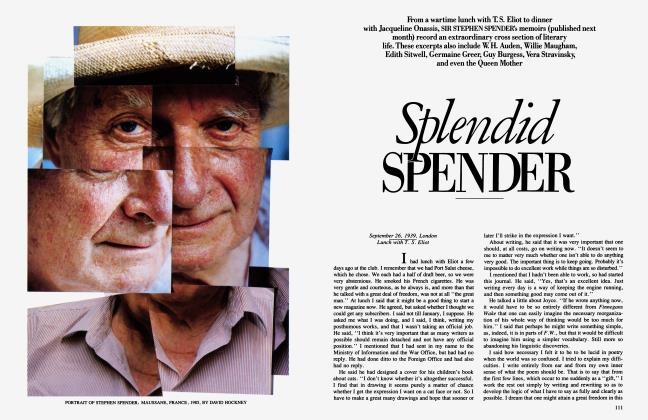
Fame has flickered round Sir Stephen Spender all his life, but he has never quite seized the limelight. Now he is publishing his memoirs, and I predict he will bloom at last. Poet, liberal, critic, and intellectual catalyst, he's always had a high literary reputation, but its luster was eclipsed by his two closest friends—Auden and Isherwood. For fifty years he has been uniquely placed to observe the artistic and political scene of Transatlantica. Happily for us, as you'll see from our excerpt on page 110, he knows how to gossip. His journals are a compulsive weaving of ideas and self-communion with malicious human detail and a poet's grasp of atmosphere. After an evening with Edith Sitwell he comments, "Whenever there was silence it was appalling, as though boredom and sterility might seep like the fog outside through a chink in a door or a window." Reading the journals is like dining with Spender when he's in particularly good form. In life, as you might expect from his writing, he's a vague, self-deprecating figure who constantly undercuts his professorial dignity by saying something quietly hilarious. Last time I saw him he was relishing a recent incident in a bookshop in the Midwest. The man at the till looked at his American Express card and said, "Stephen Spender? I know you. Aren't you a near-celebrity?" "It halfmade my day," Sir Stephen told me. It was the quintessential Spender joke.
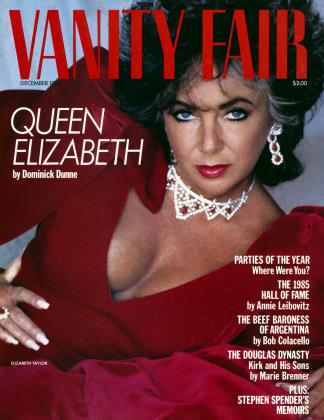
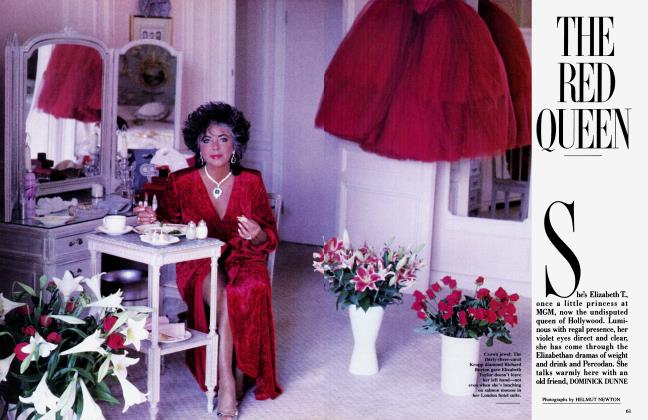
Near-celebrity has never been Elizabeth Taylor's problem. As she tells Dominick Dunne in his cover story on page 60, "I can't remember when I wasn't famous." Photographing her on vacation in London required a major mobilization of troops to transform her from the routinely ravishing to the simply out-of-this-world. The gowns and the hairdresser came from Paris; the photographer, Helmut Newton, came from Monaco; the writer, Dominick Dunne, came from New York; and the customs officer came on strong. He pounced on our Paris editor, Nicole Wisniak, when she sashayed blithely past the NOTHING TO DECLARE sign at Heathrow Airport bearing a sackful of Saint Laurent dresses for Miss Taylor's delectation. It was twelve hours before London editor Sarah Giles managed to raise the necessary scratch to soothe Her Majesty's customs, only to find Miss Taylor preferred the British gown by Emanuel anyway. ("She eez a crazy dwarf" was Mile. Wisniak's verdict on this snub to French couture.)
The last time Helmut and Dominick worked together was on the Claus von Bulow cover story for the August issue, when Claus slithered into his controversial black leathers. It's gratifying this writer and photographer could team up again to feature Elizabeth Taylor in an issue where most of the talents who've helped to shape Vanity Fair in 1985—Marie Brenner, James Wolcott, Bob Colacello, Annie Leibovitz, Harry Benson, Bill King—have each done a turn for the Christmas finale. We've tried this year to create a place where the brightest could do their best—sometimes with surprising commotion.
This was the year when little Vanity Fair kept getting its picture in the papers. A near-celebrity at last. Flashbulbs popped not just over the von Bulow revelations but when the Reagans kissed for Harry Benson's camera in our June issue and again in October when our cover story on the Princess of Wales pushed Hurricane Gloria off the front page of the British tabloids and reverberated back across the Atlantic.
It was also a year when you gave us a wonderful vote of confidence with new subscriptions galore.
Merry Christmas: I hope we all continue to get on famously in 1986.
Editor in chief
Subscribers have complete access to the archive.
Sign In Not a Subscriber?Join Now