

Sign In to Your Account
Subscribers have complete access to the archive.
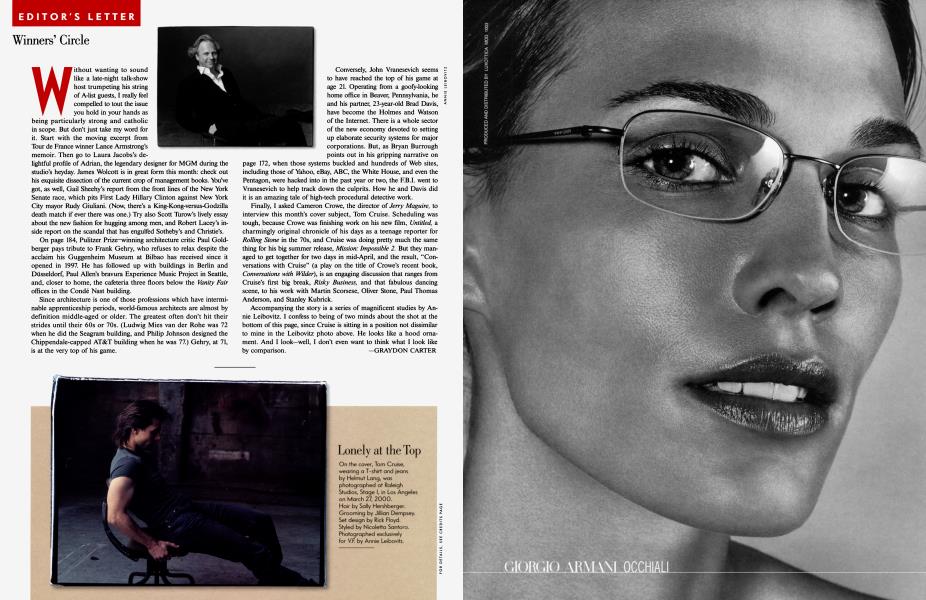
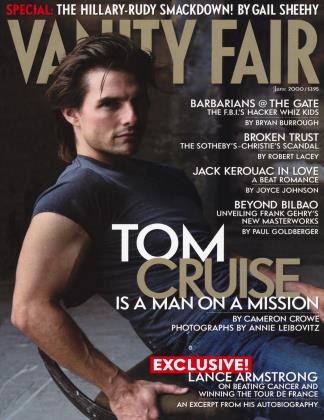
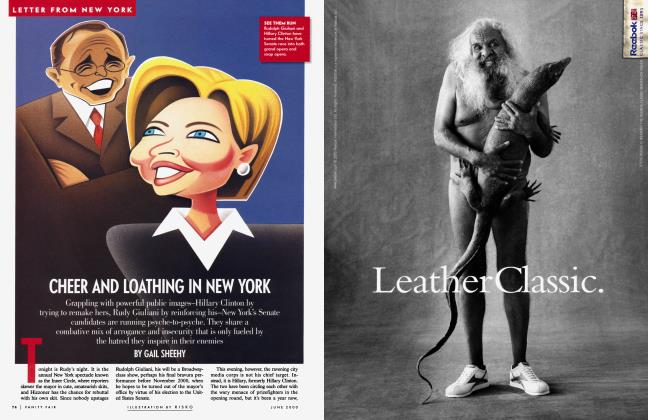
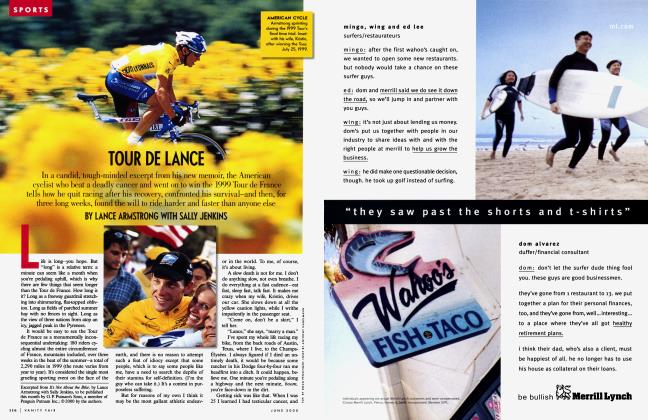
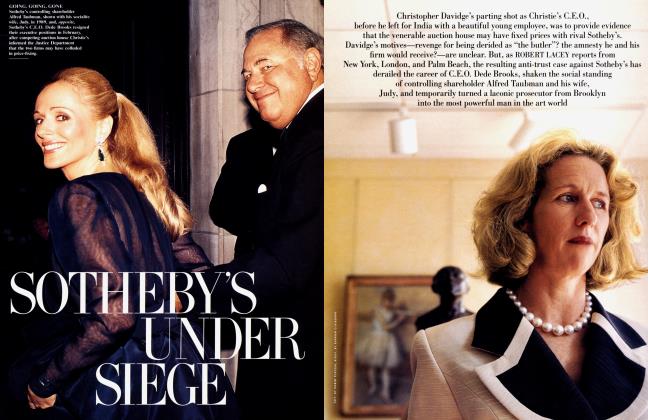
Sign In Not a Subscriber?Join NowWithout wanting to sound like a late-night talk-show host trumpeting his string of A-list guests, I really feel compelled to tout the issue you hold in your hands as being particularly strong and catholic in scope. But don’t just take my word for it. Start with the moving excerpt from Tour de France winner Lance Armstrong’s memoir. Then go to Laura Jacobs’s delightful profile of Adrian, the legendary designer for MGM during the studio’s heyday. James Wolcott is in great form this month: check out his exquisite dissection of the current crop of management books. u’ve got, as well, Gail Sheehy’s report from the front lines of the New York Senate race, which pits First Lady Hillary Clinton against New York City mayor Rudy Giuliani. (Now, there’s a King-Kong-versus-Godzilla death match if ever there was one.) Try also Scott Turow’s lively essay about the new fashion for hugging among men, and Robert Lacey’s inside report on the scandal that has engulfed Sotheby’s and Christie’s.
On page 184, Pulitzer Prize-winning architecture critic Paul Goldberger pays tribute to Frank Gehry, who refuses to relax despite the acclaim his Guggenheim Museum at Bilbao has received since it opened in 1997. He has followed up with buildings in Berlin and Diisseldorf, Paul Allen’s bravura Experience Music Project in Seattle, and, closer to home, the cafeteria three floors below the Vanity Fair offices in the Conde Nast building.
Since architecture is one of those professions which have interminable apprenticeship periods, world-famous architects are almost by definition middle-aged or older. The greatest often don’t hit their strides until their 60s or 70s. (Ludwig Mies van der Rohe was 72 when he did the Seagram building, and Philip Johnson designed the Chippendale-capped AT&T building when he was 77.) Gehry, at 71, is at the very top of his game.
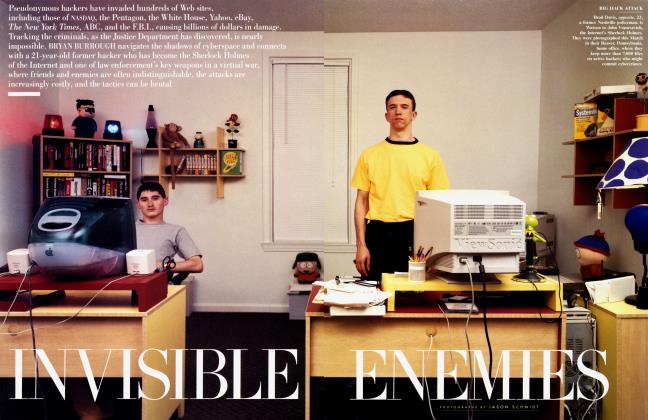
Conversely, John Vranesevich seems to have reached the top of his game at age 21. Operating from a goofy-looking home office in Beaver, Pennsylvania, he and his partner, 23-year-old Brad Davis, have become the Holmes and Watson of the Internet. There is a whole sector of the new economy devoted to setting up elaborate security systems for major corporations. But, as Bryan Burrough points out in his gripping narrative on page 172, when those systems buckled and hundreds of Web sites, including those of Yahoo, eBay, ABC, the White House, and even the Pentagon, were hacked into in the past year or two, the F.B.I. went to Vranesevich to help track down the culprits. How he and Davis did it is an amazing tale of high-tech procedural detective work.
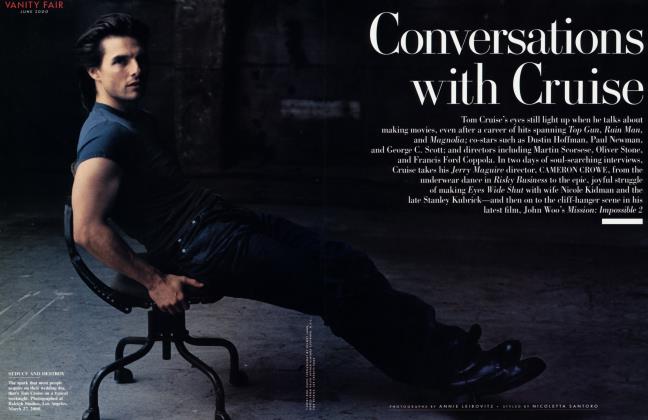
Finally, I asked Cameron Crowe, the director of Jerry Maguire, to interview this month’s cover subject, Tom Cruise. Scheduling was tough, because Crowe was finishing work on his new film, Untitled, a charmingly original chronicle of his days as a teenage reporter for Rolling Stone in the 70s, and Cruise was doing pretty much the same thing for his big summer release, Mission: Impossible 2. But they managed to get together for two days in mid-April, and the result, “Conversations with Cruise” (a play on the title of Crowe’s recent book, Conversations with Wilder), is an engaging discussion that ranges from Cruise’s first big break, Risky Business, and that fabulous dancing scene, to his work with Martin Scorsese, Oliver Stone, Paul Thomas Anderson, and Stanley Kubrick.
Accompanying the story is a series of magnificent studies by Annie Leibovitz. I confess to being of two minds about the shot at the bottom of this page, since Cruise is sitting in a position not dissimilar to mine in the Leibovitz photo above. He looks like a hood ornament. And I look—well, I don’t even want to think what I look like by comparison.

Subscribers have complete access to the archive.
Sign In Not a Subscriber?Join Now