


Sign In to Your Account
Subscribers have complete access to the archive.
Sign In Not a Subscriber?Join NowLloyd Webber's Requiem
MUSIC
Michael Walsh
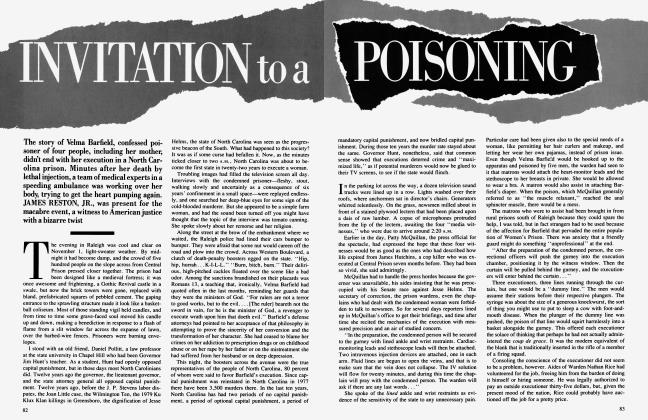
Jesus Christ Superstar was suggested by the dean of St. Paul's Cathedral, Evita was Tim Rice's idea, Cats first scrabbled forth as a book of poems by T. S. Eliot, and Starlight Express chugged into London's Apollo Victoria Theatre last spring as the Little Engine That Could come to life. But Requiem Mass, Andrew Lloyd Webber's latest project, has a more somber origin. "I've been terribly concerned about the slaughter in Cambodia ever since I read an article in the New York Times about a young boy forced to kill his sister to save her from torture by the Khmer Rouge," explains the composer. "But when the I.R. A. bomb went off in Harrods, I decided to write the piece the minute Starlight was finished."
Completed in November, Requiem was recorded in London just before Christmas, and will have its world premiere on February 24 at Saint Thomas Church in Manhattan, with Lorin Maazel conducting and a cast that will include superstar tenor Placido Domingo. Thanks to the persistence of "Memory," there are many who think of Lloyd Webber as a mere purveyor of slick Europopsicles. But he has also written a body of unpublished English church music—angular, dissonant pieces that are musically more akin to the desperate atonality of parts of Evita than to the cozy music-hall verities of Cats. "It's not really a change of direction," says Lloyd Webber. "But if you only know me from Starlight Express, this will change your mind."
Requiem uses the same text as Verdi's great setting. The soprano part (sung by Lloyd Webber's wife, Sarah) and that of the boy alto are prominent, reflecting the piece's original inspiration. "It's all very subliminal, of course," says the composer, "but there is a suggestion of a brother and a sister there." Lloyd Webber's penchant for thematic transformation, familiar to anyone who saw Evita—remember how "Oh What a Circus" turned into "Don't Cry for Me Argentina"?—here gets free rein. The spare, quasi-modal opening Requiem melody reappears in various guises throughout the work, permeating it with an intense devotionalism that is dissipated only briefly in the high-spirited, soaring Hosanna, which has more than a whiff of the West End about it. More than a hint of difficulty too: originally the tenor had to negotiate a murderous series of high Bflats and even a B-natural. "I will have to talk to him about this," said Domingo, and apparently he did, for the part now lies more comfortably.
If Requiem is not as much a departure for Lloyd Webber as it at first seems, it does mark his formal coming out in America as a "serious" musician. There may be additional such works in the future—his next musical, Aspects of Love, based on David Garnett's Bloomsbury novel, is likely to be more chamber opera than lavish Broadway spectacle. Whatever happens, Requiem, from a composer whose eclecticism is often mistaken for opportunism, serves notice that there is more to Andrew Lloyd Webber than the Jellicle Ball.
Subscribers have complete access to the archive.
Sign In Not a Subscriber?Join Now