

Sign In to Your Account
Subscribers have complete access to the archive.
Sign In Not a Subscriber?Join NowLove in the Afternoon
ALISON LURIE dallies in the afterglow of Botticelli's Venus and Mars
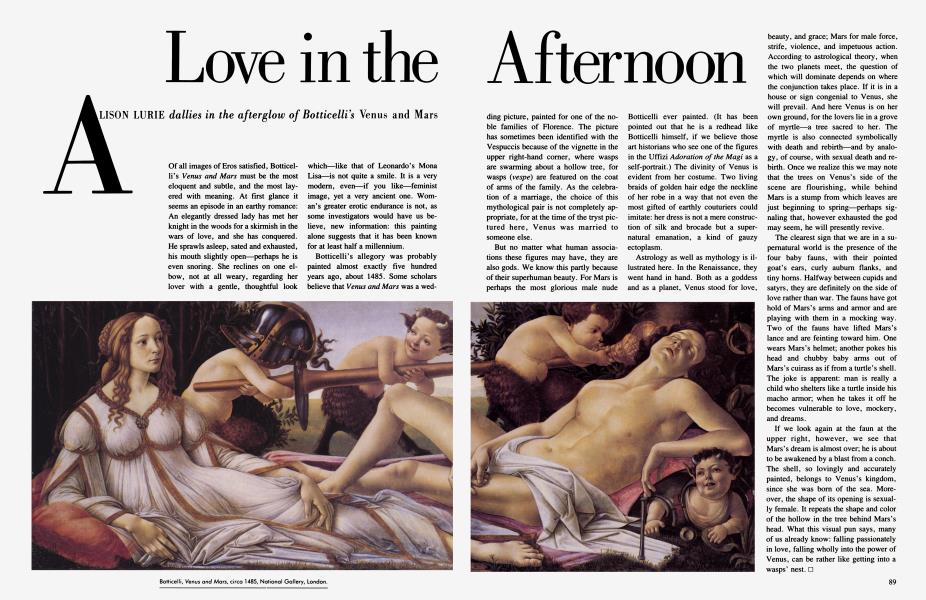
Of all images of Eros satisfied, Botticelli's Venus and Mars must be the most eloquent and subtle, and the most layered with meaning. At first glance it seems an episode in an earthy romance: An elegantly dressed lady has met her knight in the woods for a skirmish in the wars of love, and she has conquered. He sprawls asleep, sated and exhausted, his mouth slightly open—perhaps he is even snoring. She reclines on one elbow, not at all weary, regarding her lover with a gentle, thoughtful look
which—like that of Leonardo's Mona Lisa—is not quite a smile. It is a very modem, even—if you like—feminist image, yet a very ancient one. Woman's greater erotic endurance is not, as some investigators would have us believe, new information: this painting alone suggests that it has been known for at least half a millennium.
Botticelli's allegory was probably painted almost exactly five hundred years ago, about 1485. Some scholars believe that Venus and Mars was a wedding picture, painted for one of the noble families of Florence. The picture has sometimes been identified with the Vespuccis because of the vignette in the upper right-hand comer, where wasps are swarming about a hollow tree, for wasps ivespe) are featured on the coat of arms of the family. As the celebration of a marriage, the choice of this mythological pair is not completely appropriate, for at the time of the tryst pictured here, Venus was married to someone else.
But no matter what human associations these figures may have, they are also gods. We know this partly because of their superhuman beauty. For Mars is perhaps the most glorious male nude
Botticelli ever painted. (It has been pointed out that he is a redhead like Botticelli himself, if we believe those art historians who see one of the figures in the Uffizi Adoration of the Magi as a self-portrait.) The divinity of Venus is evident from her costume. Two living braids of golden hair edge the neckline of her robe in a way that not even the most gifted of earthly couturiers could imitate: her dress is not a mere construction of silk and brocade but a supernatural emanation, a kind of gauzy ectoplasm.
Astrology as well as mythology is illustrated here. In the Renaissance, they went hand in hand. Both as a goddess and as a planet, Venus stood for love,
beauty, and grace; Mars for male force, strife, violence, and impetuous action. According to astrological theory, when the two planets meet, the question of which will dominate depends on where the conjunction takes place. If it is in a house or sign congenial to Venus, she will prevail. And here Venus is on her own ground, for the lovers lie in a grove of myrtle—a tree sacred to her. The myrtle is also connected symbolically with death and rebirth—and by analogy, of course, with sexual death and rebirth. Once we realize this we may note that the trees on Venus's side of the scene are flourishing, while behind Mars is a stump from which leaves are just beginning to spring—perhaps signaling that, however exhausted the god may seem, he will presently revive.
The clearest sign that we are in a supernatural world is the presence of the four baby fauns, with their pointed goat's ears, curly auburn flanks, and tiny horns. Halfway between cupids and satyrs, they are definitely on the side of love rather than war. The fauns have got hold of Mars's arms and armor and are playing with them in a mocking way. Two of the fauns have lifted Mars's lance and are feinting toward him. One wears Mars's helmet; another pokes his head and chubby baby arms out of Mars's cuirass as if from a turtle's shell. The joke is apparent: man is really a child who shelters like a turtle inside his macho armor; when he takes it off he becomes vulnerable to love, mockery, and dreams.
If we look again at the faun at the upper right, however, we see that Mars's dream is almost over; he is about to be awakened by a blast from a conch. The shell, so lovingly and accurately painted, belongs to Venus's kingdom, since she was bom of the sea. Moreover, the shape of its opening is sexually female. It repeats the shape and color of the hollow in the tree behind Mars's head. What this visual pun says, many of us already know: falling passionately in love, falling wholly into the power of Venus, can be rather like getting into a wasps' nest.
Subscribers have complete access to the archive.
Sign In Not a Subscriber?Join Now
