
Sign In to Your Account
Subscribers have complete access to the archive.
Sign In Not a Subscriber?Join NowTHE GOOD BAD MASTER
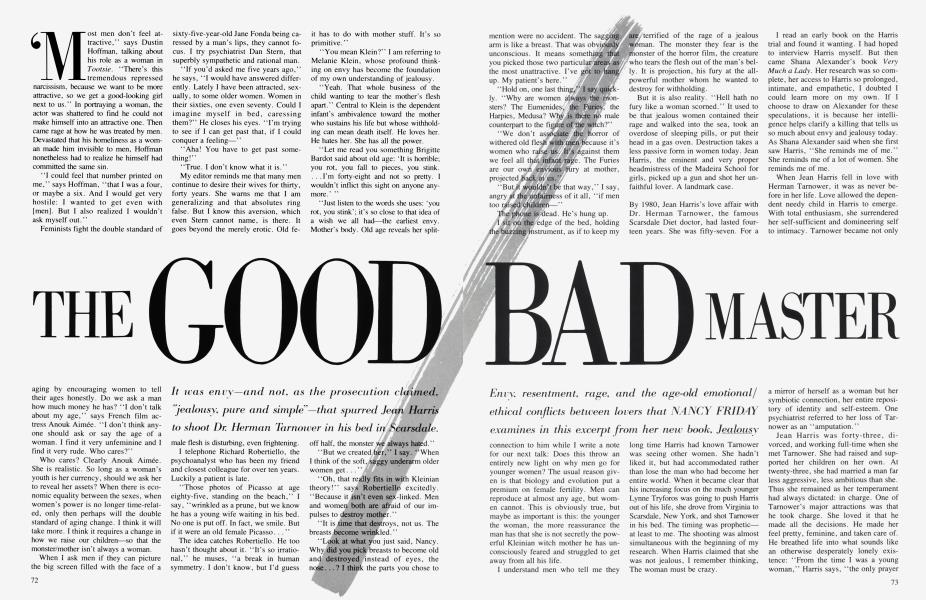
It was envy—and not, as the prosecution claimed, "jealousy, pure and simple"—that spurred Jean Harris to shoot Dr. Herman Tarnower in his bed in Scarsdale. Envy resentment, rage, and the age-old emotional/ethical conflicts between lovers that NANCY FRIDAY examines in this excerpt from her new book, Jealousy male flesh is disturbing, even frightening. off half, the monster we always hated."
ost men don't feel attractive," says Dustin Hoffman, talking about his role as a woman in Tootsie. "There's this tremendous repressed narcissism, because we want to be more attractive, so we get a good-looking girl next to us." In portraying a woman, the actor was shattered to find he could not make himself into an attractive one. Then came rage at how he was treated by men. Devastated that his homeliness as a woman made him invisible to men, Hoffman nonetheless had to realize he himself had committed the same sin.
"I could feel that number printed on me," says Hoffman, "that I was a four, or maybe a six. And I would get very hostile: I wanted to get even with [men]. But I also realized I wouldn't ask myself out."
Feminists fight the double standard of aging by encouraging women to tell their ages honestly. Do we ask a man how much money he has? "I don't talk about my age," says French film actress Anouk Aimee. "I don't think anyone should ask or say the age of a woman. I find it very unfeminine and I find it very rude. Who cares?"
Who cares? Clearly Anouk Aimee. She is realistic. So long as a woman's youth is her currency, should we ask her to reveal her assets? When there is economic equality between the sexes, when women's power is no longer time-related, only then perhaps will the double standard of aging change. I think it will take more. I think it requires a change in how we raise our children—so that the monster/mother isn't always a woman.
When I ask men if they can picture the big screen filled with the face of a sixty-five-year-old Jane Fonda being caressed by a man's lips, they cannot focus. I try psychiatrist Dan Stem, that superbly sympathetic and rational man.
"If you'd asked me five years ago," he says, "I would have answered differently. Lately I have been attracted, sexually, to some older women. Women in their sixties, one even seventy. Could I imagine myself in bed, caressing them?" He closes his eyes. "I'm trying to see if I can get past that, if I could conquer a feeling—"
"Aha! You have to get past something!"
"True. I don't know what it is."
My editor reminds me that many men continue to desire their wives for thirty, forty years. She warns me that I am generalizing and that absolutes ring false. But I know this aversion, which even Stem cannot name, is there. It goes beyond the merely erotic. Old fe-
I telephone Richard Robertiello, the psychoanalyst who has been my friend and closest colleague for over ten years. Luckily a patient is late.
"Those photos of Picasso at age eighty-five, standing on the beach," I say, "wrinkled as a prune, but we know he has a young wife waiting in his bed. No one is put off. In fact, we smile. But if it were an old female Picasso.
The idea catches Robertiello. He too hasn't thought about it. "It's so irrational," he muses, "a break in human symmetry. I don't know, but I'd guess it has to do with mother stuff. It's so primitive."
"You mean Klein?" I am referring to Melanie Klein, whose profound thinking on envy has become the foundation of my own understanding of jealousy.
"Yeah. That whole business of the child wanting to tear the mother's flesh apart." Central to Klein is the dependent infant's ambivalence toward the mother who sustains his life but whose withholding can mean death itself. He loves her. He hates her. She has all the power.
"Let me read you something Brigitte Bardot said about old age: 'It is horrible; you rot, you fall to pieces, you stink.
. . .I'm forty-eight and not so pretty. I wouldn't inflict this sight on anyone anymore.' "
"Just listen to the words she uses: 'you rot, you stink'; it's so close to that idea of a wish we all had—the earliest envy. Mother's body. Old age reveals her split-
"But we created her," I say. "When I think of the soft, saggy underarm older women get.
"Oh, that really fits in with Kleinian theory!" says Robertiello excitedly. "Because it isn't even sex-linked. Men and women both are afraid of our impulses to destroy mother."
"It is time that destroys, not us. The breasts become wrinkled."
"Look at what you just said, Nancy. Why did you pick breasts to become old and destroyed instead of eyes, the nose. . . ? I think the parts you chose to mention were no accident. The sag arm is like a breast. That was ohm unconscious. It means something you picked those two particular areas as the most unattractive. I've got to hang up. My patient's here."
"Hold on, one last thing," I say quickly. "Why are women always the monsters? The Eumenides, the Furies, the Harpies, Medusa? Why is there no male counterpart to the figure of the witch?"
"We don't associate the horror of withered old flesh with men because it's women who raise us. It's against them we feel all that infant ia£e. The Furies are our own envious fury at mother, projected back at us."
"But it wouldn't be that way," I say, angry at the unfairness of it all, "if men too raised children—"
The phone is dead. He's hung up.
I sit on the edge of the bed, holding the buzzing instrument, as if to keep my connection to him while I write a note for our next talk: Does this throw an entirely new light on why men go for younger women? The usual reason given is that biology and evolution put a premium on female fertility. Men can reproduce at almost any age, but women cannot. This is obviously true, but maybe as important is this: the younger the woman, the more reassurance the man has that she is not secretly the powerful Kleinian witch mother he has unconsciously feared and struggled to get away from all his life.
NANCY FRIDAY
I understand men who tell me they terrified of the rage of a jealous man. The monster they fear is the onster of the horror film, the creature who tears the flesh out of the man's belly. It is projection, his fury at the allpowerful mother whom he wanted to destroy for withholding.
But it is also reality. "Hell hath no fury like a woman scorned." It used to be that jealous women contained their rage and walked into the sea, took an overdose of sleeping pills, or put their head in a gas oven. Destruction takes a less passive form in women today. Jean Harris, the eminent and very proper headmistress of the Madeira School for girls, picked up a gun and shot her unfaithful lover. A landmark case.
By 1980, Jean Harris's love affair with Dr. Herman Tarnower, the famous Scarsdale Diet doctor, had lasted fourteen years. She was fifty-seven. For a long time Harris had known Tarnower was seeing other women. She hadn't liked it, but had accommodated rather than lose the man who had become her entire world. When it became clear that his increasing focus on the much younger Lynne Tryforos was going to push Harris out of his life, she drove from Virginia to Scarsdale, New York, and shot Tarnower in his bed. The timing was prophetic— at least to me. The shooting was almost simultaneous with the beginning of my research. When Harris claimed that she was not jealous, I remember thinking, The woman must be crazy.
I read an early book on the Harris trial and found it wanting. I had hoped to interview Harris myself. But then came Shana Alexander's book Very Much a Lady. Her research was so complete, her access to Harris so prolonged, intimate, and empathetic, I doubted I could learn more on my own. If I choose to draw on Alexander for these speculations, it is because her intelligence helps clarify a killing that tells us so much about envy and jealousy today. As Shana Alexander said when she first saw Harris, "She reminds me of me." She reminds me of a lot of women. She reminds me of me.
When Jean Harris fell in love with Herman Tarnower, it was as never before in her life. Love allowed the dependent needy child in Harris to emerge. With total enthusiasm, she surrendered her self-sufficient and domineering self to intimacy. Tarnower became not only a mirror of herself as a woman but her symbiotic connection, her entire repository of identity and self-esteem. One psychiatrist referred to her loss of Tarnower as an "amputation."
Jean Harris was forty-three, divorced, and working full-time when she met Tarnower. She had raised and supported her children on her own. At twenty-three, she had married a man far less aggressive, less ambitious than she. Thus she remained as her temperament had always dictated: in charge. One of Tarnower's major attractions was that he took charge. She loved it that he made all the decisions. He made her feel pretty, feminine, and taken care of. He breathed life into what sounds like an otherwise desperately lonely existence: "From the time I was a young woman," Harris says, "the only prayer I ever prayed was, Just give me the strength to get through this day, one day at a time."
Jean Harris had lived by the Nice Girl Rules all her life. When she became Tamower's lover, she broke those rules, continuing the affair even when she knew there would be no marriage, even when she knew there were other women. By her own mles, she was a tainted woman. But she had reason to stay. She had lived by the white-glove script and got nothing back. Tamower accepted her as an equal and as a woman.
Like so many women today, Jean Harris was caught between her mother's submissive generation and a world in which she was a chief executive, acting ''like a man." Tarno wer healed the split. Ideally, falling in love is a mutual affair, "taking care of" one another. In the beginning, that is how it was. Then Tamower withdrew.
But not totally. He kept her dangling, always waiting, never sure of when she could see him again. He became the parent, allowing her to see him when she was a good girl, literally banishing her from his presence when she didn't behave. It was a replay of the Kleinian life-and-death situation, where one person has all the power either to give or to withhold himself. Harris constantly lived in terror of being abandoned.
As protection against her destructive rage, Harris marshaled Klein's classic defenses against envy: she idealized Tamower into a god and devalued herself. When she allowed herself to remain Tamower's lover with no promise of marriage, she surrendered conscience to him. It was the beginning of her deterioration. She transferred the burden of her own demands on herself—that she be a person of the highest moral integrity—onto him. He became her ego ideal, her narcissistic extension. He had to be above everyone, high enough to meet the standard of her cruel superego, which demanded superhuman perfection. Now that she was so low, he had to be perfect enough for the two of them.
Remaining Tamower's lover meant, to a woman of Jean Harris's ethical background, a total compromise of her integrity. Integrity was a word Harris used often during the trial. She repeatedly demeaned her rival as low and said Tryforos's usurpation of her place was an attack on her integrity. These were taken to be snobbish remarks. They hurt her defense. It was unfortunate. The correct interpretation of what Harris meant by integrity was self-esteem. Being replaced in Tamower's heart by a woman whom she could not respect lowered Tamower and thus diminished Harris's own self-esteem.
Harris had a symbiotic contract with Tamower which was only in her head; having abandoned to him the part of herself on which she placed greatest value—her integrity as a moral person, a quality she'd drummed into the female student bodies of every school she'd headed—he must be ideal. If he was less, then she was less. She hated The Complete Scarsdale Medical Diet. If he was the kind of person who wrote pop best-sellers, then she too, by extension, was cheap and commercial. If he was not Bayard, the perfect knight, sans peur et sans reproche, she was just a whore.
To preserve the man she loved, to preserve herself, Harris split off the bad doctor who wrote faddish diet books and who slept with inferior people like Tryforos, his nurse. What remained was the other half, the idealized god who meant life itself. As if in a textbook example of the results of splitting, all was revealed in a famous letter. When it was read at the trial, Harris's closest friends could not believe she had written it. The letter accused her rival of being a slut and a whore, and sounded as if it had been written by a whore. All the vile and ugly parts of Tamower, which Harris could not afford to see in him, she smeared on herself and her rival. The Kleinian monster inside, which she had refused to project onto him, erupted in that letter.
Continued on page 102
Continued from page 74
Using almost Kleinian imagery herself, Shana Alexander writes: "The Letter was the work of a lady driven mad by her own demons. Buried resentments pour forth from its pages like the tiny devils with pitchforks that gush from the mouth of victims of demonic possession in medieval paintings."
One of the rules Harris imposed on her defense lawyers was that not one bad word be said about Tarnower. She wanted the trial to vindicate not her but her romance, her lover. If she were to be acquitted by proving he was a rotten bastard who deserved what he got, if he were morally flawed, the sacrifice of her integrity to him would be a dirty joke. She crippled her own defense.
The prosecution called the case "jealousy, pure and simple. Discarded mistress, having lost her man to a younger woman.. Harris repeatedly denied that she was jealous. She wanted to be honest; believed in honesty and justice so totally that she never doubted vindication if she told the truth. When a woman as intelligent as Harris maintains with such consistency that she is not jealous, we ought to listen carefully.
Certainly she was in a jealous situation. It was clear Tamower was leaving her for good, abandoning her for a younger woman. But she didn't kill the other woman. Various forms of envy were flying around within the triangle. She certainly envied the other woman's youth and beauty. We know that Harris devalued her own looks to an almost pathological degree. At her trial she was still attractive enough to be nicknamed Miss Pretty by one of the guards, but her self-image was such that she had decided against plastic surgery five years earlier for fear that it would make her look "even uglier [than I already am]."
A constant thorn to Harris was that Lynne Tryforos represented a way of being a woman that Harris could never imitate. Harris hated it that Tryforos defined femininity by acting like a servant to Tamower. "I wish I had been bom a doormat, or a man," says Harris. Being a doormat meant to Harris all the passive, self-sacrificing behavior that traditional women performed to cajole men. She half-bought this definition of womanliness but could not find it in herself to act that way. To be fair, Tamower never asked her to. But in the end he rejected her in favor of a woman who did act like his servant.
"I was a person and no one ever knew." What did Harris mean by that? her attorney asked. Weeping, Harris replied, "I think it had something to do with being a woman who had worked for a long time, and had done the things a man does to support a family, but still [was] a woman. I always felt that. . .in Westchester I was a woman in a pretty dress.. . [going] to a dinner party with Dr. Tamower.. .in Washington I was a woman in a pretty dress and the headmistress. But I wasn't sure who I was. .. and it didn't seem to matter. ... I was a person sitting in an empty chair. ' '
Harris's ultimate rage wasn't directed at Tryforos; if it hadn't been Tryforos in the doctor's bed, it would have been another woman. I think this is why she said she wasn't jealous. Something in her knew that her real emotion—though she didn't name it—was directed at Tarnower. It was a combination of resentment and rage. It was envy. Jealousy involves a triangle, the fear of loss to a rival. Envy is a two-party transaction, beginning in the earliest, most primitive relationship, between mother and child, where one person is totally dependent on the other. That was Harris and Tarnower. He could have saved her life, but chose not to.
One line of Harris's defense was that she intended to kill herself when she brought the gun to Tamower's house. She was in a frenzy of drug deprivation. For days she had been out of the pills Tamower had been prescribing for her for years. She was also exhausted, depressed by the worst professional crises of her life; she wanted to talk to him one last time.
I believe she did intend to kill herself. Or part of her did. When she got to his bedroom, was the doctor concerned for her, compassionate? Tamower greeted her arrival with irritation. Once more he turned away from her. She killed the person her unconscious meant to kill.
"I agree with that," says Robertiello. "But, Nancy, be careful that you don't make this sound like a pathological surrendering of herself. Tamower didn't ask her to surrender herself. She did it very happily. Maybe she did lose part of her identity. But on the whole her love affair with Tamower was a joyful experience. Even after he died, she said that he was the most important thing that ever happened to her." Robertiello loved Shana Alexander's book.
"I don't think Tamower comes out as such a villain," he continues, "except in the cruel, insensitive way he handled leaving Jean. In a lot of ways I identify with him. What I like about him is what she liked about him. He needed a lot of narcissistic reflection and acclaim. He was a social climber and needed women around. But whatever his needs, he was the kind of guy who found a way to get them gratified."
"So he was selfish."
"Selfish isn't a dirty word. You don't impose a moralistic system on a person in terms of evaluating him. If you take the morals out of it, he wasn't such a bad guy. She never thought he was a bad guy."
"Friends of mine in Scarsdale liked him."
"You and I would probably like him in terms of having a presence, being direct, for real, not being a wimp or an unconscious, sneaky manipulator. His manipulations were up front."
"He really did represent and give her a part of herself that had been wiped out."
"But not just in a sexual, male/female way," says Robertiello. "He didn't have all that inhibiting AngloSaxon bullshit that she was brought up on and which crippled her. She never accused him of misusing her. He never put her down or diminished her personhood, or her 'masculine' parts. He didn't destroy them in terms of using her as a cunt. He shared a lot of very important intellectual and spiritual experiences with her. He didn't just respond to the baby in her, he responded to all of her—to the baby, to the woman, to the man, if you will. A total response. At a certain point, somebody else came along who interested him more. That's life."
"Everything you read about Tarno wer depicts him as a bastard," I say. "Both books were written by women. It's interesting that you like him."
"He was a good father to Harris for a long time. He really was the good daddy she needed but never had."
"Harris's mother represented all the subservient stuff that she hated."
"She must have needed her father very badly as a girl, both as a source of love and as a model of action and getting things done. But he rejected her viciously. He didn't just deny her closeness, which would have allowed her to introject him as a model. He also withheld from her any acknowledgment of her womanliness. "
"That is a special gift a father can give his daughter better than anyone."
"If you are a little girl with a lot of 'masculine' sex-role characteristics, so powerful they refuse to be tamped down into a conventional picture of what a woman is, then more than ever you need a good father. One who says, 'You're a beautiful young woman, and I'm really tickled with you.' Harris got that from Tamower. He responded to her as a beautiful woman but also as a very capable person."
"So many young girls today grow up in single-parent families without daddies. Who's going to give them confirmation they can be aggressive and competitive and still be desirable women?"
"I don't think for a moment Harris doubted she was a woman." says Robertiello. "But she didn't think she was feminine, maternal, nurturing, womanly. Performing like a man for so much of her life set up tremendous envies for Harris."
"The envy of the new woman for the traditional woman," I say.
"And the other way around too," he says. "The traditional ones are envious of the independent ones. It increases all these problems between women."
"Oh, The War Between the Women," I say. "That's the title of something I've brought to read you."
"Read."
"This is from a study by sociologist Kristin Luker. Her point is that women activists on either side of the abortion issue are fighting a vicious war over far more than abortion itself. 'Their feelings on abortion,' Luker said, 'are embedded in a larger world view, so for them to question their beliefs about abortion would be to challenge an interrelated set of values about the roles of motherhood, the sexes, of morality, of religion and of human rights.' And listen to this: Luker goes on to say, 'The pro-life people spent as much as forty hours a week on the issue,' but she couldn't find a pro-choice activist 'who put in more than five hours.'
"That's because," says Robertiello, "for the pro-life women, their whole identity is in question. It's a consuming passion."
"Here's Luker's profile of each camp, according to the New York Times: 'The typical anti-abortion activist is a forty-four-year-old [woman] who was married at age seventeen and has three or more children. Her father graduated from high school only, although there is a better than even chance that she went to college. . . .She does not work outside the home. . . .Her husband is a small-businessman or lower-income white-collar employee, and the family income is less than $30,000 a year. She attends church at least once a week, and is most likely a Catholic.
" "Her counterpart on the pro-choice side is also married and forty-four. She was married at twenty-two or older and has one or two children. Her father is a college graduate, and she is likely to be one too. She is employed and is married to a professional man. Their combined income is $50,000 or more. She rarely attends church.'
"The pro-life woman," says Robertiello, "really feels the new woman denigrates everything her life stands for. All her repression and sacrifice."
"On the other side, women who work outside the home feel that prochoice is integral to their whole lives. The battle isn't being fought overtly in terms of envy—you don't hear that word—but it's certainly there."
"Don't forget," says Robertiello, "the pro-choice women have a lot of envy too. They must envy the traditional woman, who is taken care of, who doesn't have to fight to preserve her position, who doesn't have to compete in a man's world."
"She may have chosen to give up the traditional role, but she hasn't got the sureness of womanliness, had she stayed home like her mother.
"On the other hand, the pro-lifers envy the working woman being the heroine of the day, getting all the attention in the media."
"So the abortion issue is like who shot the archduke at Sarajevo. It's a much bigger war. What women have at stake is. Who is the real woman?"
"This is very much what we were talking about with Harris," says Robertiello. "Tarnower solved the conflict for her by applauding both her professionalism and her womanliness."
"But then he stopped loving her."
"It was unlikely she'd ever replace him. First of all, there aren't a lot of guys around like that. Second, she didn't have the wherewithal to get another one."
"I was interviewing a woman recently who veers between older men and much younger ones," I say. "She is thirty-six and has a good job. Right now she's with a man much younger than she. She refuses to let him see any of his women friends. Her previous affairs have been with men twenty and thirty years older. She had never been jealous, because in her eyes she had the power. She was the pretty young thing. What makes her jealous today is that her new lover is the pretty young thing."
"Sounds like the daddy figures affirm the little girl in her," says Robertiello, "and the young guys affirm those strong 'masculine' qualities which made her so successful in business. This woman can't find both in one person. Tarnower was rare in that he gave Harris both. That's why losing him was such a stunning blow."
"You really did identify with Tarnower," I say.
"The book did a lot for me personally," Robertiello muses. "Enhanced my own feeling about myself. In some ways Tarnower is like a carbon of me. I've also taken my women all over the world on trips. I've reinforced their feelings about themselves as women. But I also respected their so-called masculine ambitions. Almost all the women I've been with have grown professionally. They've gone to graduate school, increased their practice, developed in their profession. I gave them the stuff they didn't get from their fathers. Even when I broke up with a woman, I never felt like a bastard who had victimized her. I did feel affirmed by that book."
"Affirmed? Tarnower got killed!"
"I almost got killed several times."
"That's because you promise women you'll be there forever, and they foolishly believe it. They could risk stepping outside the dependent role and becoming successful on their own. But then, like Tarnower, you abandon them."
"I've never understood the enraged reactions from women when I left them. Like, how can you be so furious with me after all I've done for you?"
A perplexing moment. Am I to understand Robertiello really didn't know why women were so furious when he left them? He has described himself as so terrified of their anger, he literally cowered in a corner. "I've always been more afraid of women than of men," he has told me many times.
He knows his pattern. First he figures out exactly what the woman needs, then offers himself as the perfect answer to her prayers, all the while promising never to leave. In the end, because he does not get anything back out of the one-way relationship, he takes his departure. "Richard," I say, "you're an analyst. Aren't you being deliberately and self-protectively naive?"
"I really didn't feel losing me was all that big a deal."
I look at him, taken aback. He isn't joking. Nor is this false humility. He is a mixture of self-inflation and self-devaluation—like most of us.
"1 met a lover I had not seen for ten years." He is still talking. "She said that after I left her she'd been depressed for a year. I was astonished. Hell, I didn't even know she'd cared, so to speak. I knew she loved me, but 1 didn't think I was that important. Tamower made me realize how rare it is for a man to be able to respond to both the ambitious, 'masculine' side of a woman and to the feminine too. The book explains it. I gave them everything they'd ever wanted and then pulled it away."
"That's why you like the book," I say. "You found a brother in Tarnower."
"Even if Harris killed him, she didn't want to denigrate him. She said Tamower was emotionally the most important person in her life. That said she knew Tarnower had given her a lot, and confirmed that I had given my women a lot too. I had never realized how important I had been to these women. Now that 1 do, I can understand why they always wanted to destroy me when I left."
"You broke your promise, Richard."
"When I make the promise that I never will leave, I'm not conning them. I have total belief that I never will leave."
"That's why you're terrified of a woman enraged," I say. "You think these women are going to kill you."
"They want to."
"They haven't yet."
"Not literally, but figuratively. The things some of them have done have been vicious, incredible."
"What makes them so threatening is that you endow them with so much power."
"I project my own rage onto them. They become the giant killer mother of the nursery. What makes me so envious is that I know I cannot make it without a woman."
"You have two support systems. The first is this office—your patients who see you as God. The second is your woman, who adores you. If you get home and Susan is merely talking to her sister on the phone—"
"Not merely. Especially if she's talking to her sister."
"You're jealous."
He laughs nervously.
"Which you call sibling rivalry. You'd better watch out. Harris is the tip of the wedge. Women are buying guns."
"You mean literally?"

Subscribers have complete access to the archive.
Sign In Not a Subscriber?Join Now


