




Sign In to Your Account
Subscribers have complete access to the archive.
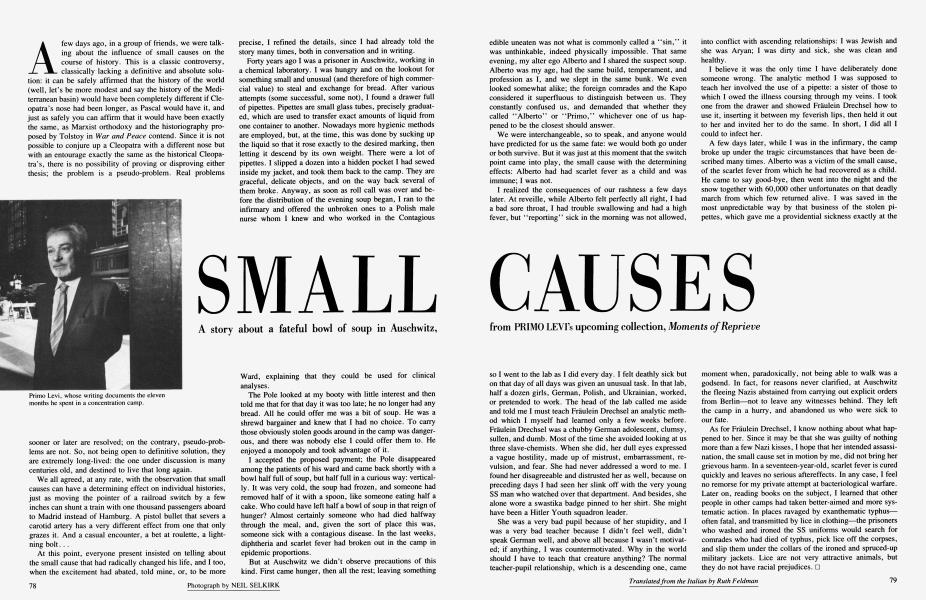
Sign In Not a Subscriber?Join NowSMALL CAUSES
A story about a fateful bowl of soup in Auschwitz, from PRIMO LEVI's upcoming collection, Moments of Reprieve
Afew days ago, in a group of friends, we were talking about the influence of small causes on the course of history. This is a classic controversy, classically lacking a definitive and absolute solution: it can be safely affirmed that the history of the world (well, let's be more modest and say the history of the Mediterranean basin) would have been completely different if Cleopatra's nose had been longer, as Pascal would have it, and just as safely you can affirm that it would have been exactly the same, as Marxist orthodoxy and the historiography proposed by Tolstoy in War and Peace contend. Since it is not possible to conjure up a Cleopatra with a different nose but with an entourage exactly the same as the historical Cleopatra's, there is no possibility of proving or disproving either thesis; the problem is a pseudo-problem. Real problems sooner or later are resolved; on the contrary, pseudo-problems are not. So, not being open to definitive solution, they are extremely long-lived: the one under discussion is many centuries old, and destined to live that long again.
We all agreed, at any rate, with the observation that small causes can have a determining effect on individual histories, just as moving the pointer of a railroad switch by a few inches can shunt a train with one thousand passengers aboard to Madrid instead of Hamburg. A pistol bullet that severs a carotid artery has a very different effect from one that only grazes it. And a casual encounter, a bet at roulette, a lightning bolt. . .
At this point, everyone present insisted on telling about the small cause that had radically changed his life, and I too, when the excitement had abated, told mine, or, to be more precise, I refined the details, since I had already told the story many times, both in conversation and in writing.
Forty years ago I was a prisoner in Auschwitz, working in a chemical laboratory. I was hungry and on the lookout for something small and unusual (and therefore of high commercial value) to steal and exchange for bread. After various attempts (some successful, some not), I found a drawer full of pipettes. Pipettes are small glass tubes, precisely graduated, which are used to transfer exact amounts of liquid from one container to another. Nowadays more hygienic methods are employed, but, at the time, this was done by sucking up the liquid so that it rose exactly to the desired marking, then letting it descend by its own weight. There were a lot of pipettes. I slipped a dozen into a hidden pocket I had sewed inside my jacket, and took them back to the camp. They are graceful, delicate objects, and on the way back several of them broke. Anyway, as soon as roll call was over and before the distribution of the evening soup began, I ran to the infirmary and offered the unbroken ones to a Polish male nurse whom I knew and who worked in the Contagious Ward, explaining that they could be used for clinical analyses.
The Pole looked at my booty with little interest and then told me that for that day it was too late; he no longer had any bread. All he could offer me was a bit of soup. He was a shrewd bargainer and knew that I had no choice. To carry those obviously stolen goods around in the camp was dangerous, and there was nobody else I could offer them to. He enjoyed a monopoly and took advantage of it.
I accepted the proposed payment; the Pole disappeared among the patients of his ward and came back shortly with a bowl half full of soup, but half full in a curious way: vertically. It was very cold, the soup had frozen, and someone had removed half of it with a spoon, like someone eating half a cake. Who could have left half a bowl of soup in that reign of hunger? Almost certainly someone who had died halfway through the meal, and, given the sort of place this was, someone sick with a contagious disease. In the last weeks, diphtheria and scarlet fever had broken out in the camp in epidemic proportions.
But at Auschwitz we didn't observe precautions of this kind. First came hunger, then all the rest; leaving something edible uneaten was not what is commonly called a "sin," it was unthinkable, indeed physically impossible. That same evening, my alter ego Alberto and I shared the suspect soup. Alberto was my age, had the same build, temperament, and profession as I, and we slept in the same bunk. We even looked somewhat alike; the foreign comrades and the Kapo considered it superfluous to distinguish between us. They constantly confused us, and demanded that whether they called "Alberto" or "Primo," whichever one of us happened to be the closest should answer.
We were interchangeable, so to speak, and anyone would have predicted for us the same fate: we would both go under or both survive. But it was just at this moment that the switch point came into play, the small cause with the determining effects: Alberto had had scarlet fever as a child and was immune; I was not.
I realized the consequences of our rashness a few days later. At reveille, while Alberto felt perfectly all right, I had a bad sore throat, I had trouble swallowing and had a high fever, but "reporting" sick in the morning was not allowed, so I went to the lab as I did every day. I felt deathly sick but on that day of all days was given an unusual task. In that lab, half a dozen girls, German, Polish, and Ukrainian, worked, or pretended to work. The head of the lab called me aside and told me I must teach Fraulein Drechsel an analytic method which I myself had learned only a few weeks before. Fraulein Drechsel was a chubby German adolescent, clumsy, sullen, and dumb. Most of the time she avoided looking at us three slave-chemists. When she did, her dull eyes expressed a vague hostility, made up of mistrust, embarrassment, revulsion, and fear. She had never addressed a word to me. I found her disagreeable and distrusted her as well, because on preceding days I had seen her slink off with the very young SS man who watched over that department. And besides, she alone wore a swastika badge pinned to her shirt. She might have been a Hitler Youth squadron leader.
She was a very bad pupil because of her stupidity, and I was a very bad teacher because I didn't feel well, didn't speak German well, and above all because I wasn't motivated; if anything, I was countermotivated. Why in the world should I have to teach that creature anything? The normal teacher-pupil relationship, which is a descending one, came into conflict with ascending relationships: I was Jewish and she was Aryan; I was dirty and sick, she was clean and healthy.
I believe it was the only time I have deliberately done someone wrong. The analytic method I was supposed to teach her involved the use of a pipette: a sister of those to which I owed the illness coursing through my veins. I took one from the drawer and showed Fraulein Drechsel how to use it, inserting it between my feverish lips, then held it out to her and invited her to do the same. In short, I did all I could to infect her.
A few days later, while I was in the infirmary, the camp broke up under the tragic circumstances that have been described many times. Alberto was a victim of the small cause, of the scarlet fever from which he had recovered as a child. He came to say good-bye, then went into the night and the snow together with 60,000 other unfortunates on that deadly march from which few returned alive. I was saved in the most unpredictable way by that business of the stolen pipettes, which gave me a providential sickness exactly at the moment when, paradoxically, not being able to walk was a godsend. In fact, for reasons never clarified, at Auschwitz the fleeing Nazis abstained from carrying out explicit orders from Berlin—not to leave any witnesses behind. They left the camp in a hurry, and abandoned us who were sick to our fate.
As for Fraulein Drechsel, I know nothing about what happened to her. Since it may be that she was guilty of nothing more than a few Nazi kisses, I hope that her intended assassination, the small cause set in motion by me, did not bring her grievous harm. In a seventeen-year-old, scarlet fever is cured quickly and leaves no serious aftereffects. In any case, I feel no remorse for my private attempt at bacteriological warfare. Later on, reading books on the subject, I learned that other people in other camps had taken better-aimed and more systematic action. In places ravaged by exanthematic typhus— often fatal, and transmitted by lice in clothing—the prisoners who washed and ironed the SS uniforms would search for comrades who had died of typhus, pick lice off the corpses, and slip them under the collars of the ironed and spruced-up military jackets. Lice are not very attractive animals, but they do not have racial prejudices.
Ruth Feldman
Subscribers have complete access to the archive.
Sign In Not a Subscriber?Join Now
