
Sign In to Your Account
Subscribers have complete access to the archive.
Sign In Not a Subscriber?Join NowOut to Lunch with Bernardo Bertolucci
The Italian movie director brings his own pasta to Beijing. By ALLEN KURZWEIL
ALLEN KURZWEIL
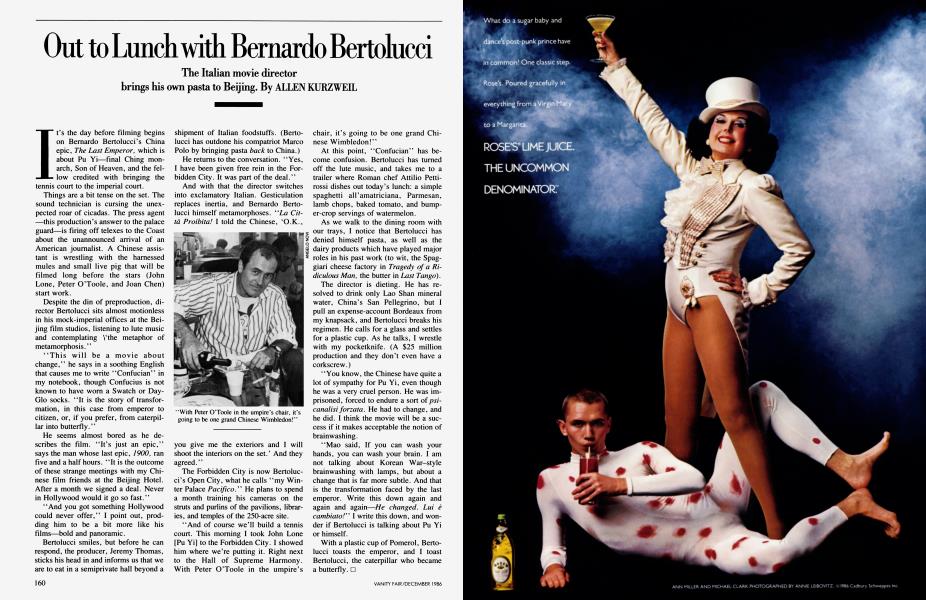
It's the day before filming begins on Bernardo Bertolucci's China epic, The Last Emperor, which is about Pu Yi—final Ching monarch, Son of Heaven, and the fellow credited with bringing the tennis court to the imperial court.
Things are a bit tense on the set. The sound technician is cursing the unexpected roar of cicadas. The press agent —this production's answer to the palace guard—is firing off telexes to the Coast about the unannounced arrival of an American journalist. A Chinese assistant is wrestling with the harnessed mules and small live pig that will be filmed long before the stars (John Lone, Peter O'Toole, and Joan Chen) start work.
Despite the din of preproduction, director Bertolucci sits almost motionless in his mock-imperial offices at the Beijing film studios, listening to lute music and contemplating Vthe metaphor of metamorphosis."
"This will be a movie about change," he says in a soothing English that causes me to write "Confucian" in my notebook, though Confucius is not known to have worn a Swatch or DayGlo socks. "It is the story of transformation, in this case from emperor to citizen, or, if you prefer, from caterpillar into butterfly."
He seems almost bored as he describes the film. "It's just an epic," says the man whose last epic, 1900, ran five and a half hours. "It is the outcome of these strange meetings with my Chinese film friends at the Beijing Hotel. After a month we signed a deal. Never in Hollywood would it go so fast."
"And you got something Hollywood could never offer," I point out, prodding him to be a bit more like his films—bold and panoramic.
Bertolucci smiles, but before he can respond, the producer, Jeremy Thomas, sticks his head in and informs us that we are to eat in a semiprivate hall beyond a shipment of Italian foodstuffs. (Bertolucci has outdone his compatriot Marco Polo by bringing pasta back to China.)
He returns to the conversation. "Yes, I have been given free rein in the Forbidden City. It was part of the deal."
And with that the director switches into exclamatory Italian. Gesticulation replaces inertia, and Bernardo Bertolucci himself metamorphoses. "La Citta Proibita! I told the Chinese, 'O.K.,
you give me the exteriors and I will shoot the interiors on the set.' And they agreed."
The Forbidden City is now Bertolucci's Open City, what he calls "my Winter Palace Pacifico." He plans to spend a month training his cameras on the struts and purlins of the pavilions, libraries, and temples of the 250-acre site.
"And of course we'll build a tennis court. This morning I took John Lone [Pu Yi] to the Forbidden City. I showed him where we're putting it. Right next to the Hall of Supreme Harmony. With Peter O'Toole in the umpire's chair, it's going to be one grand Chinese Wimbledon!"
At this point, "Confucian" has become confusion. Bertolucci has turned off the lute music, and takes me to a trailer where Roman chef Attilio Pettirossi dishes out today's lunch: a simple spaghetti all'amatriciana, Parmesan, lamb chops, baked tomato, and bumper-crop servings of watermelon.
As we walk to the dining room with our trays, I notice that Bertolucci has denied himself pasta, as well as the dairy products which have played major roles in his past work (to wit, the Spaggiari cheese factory in Tragedy of a Ridiculous Man, the butter in Last Tango).
The director is dieting. He has resolved to drink only Lao Shan mineral water, China's San Pellegrino, but I pull an expense-account Bordeaux from my knapsack, and Bertolucci breaks his regimen. He calls for a glass and settles for a plastic cup. As he talks, I wrestle with my pocketknife. (A $25 million production and they don't even have a corkscrew.)
"You know, the Chinese have quite a lot of sympathy for Pu Yi, even though he was a very cruel person. He was imprisoned, forced to endure a sort of psicanalisi forzata. He had to change, and he did. I think the movie will be a success if it makes acceptable the notion of brainwashing.
"Mao said, If you can wash your hands, you can wash your brain. I am not talking about Korean War-style brainwashing with lamps, but about a change that is far more subtle. And that is the transformation faced by the last emperor. Write this down again and again and again—He changed. Lui e cambiato!" I write this down, and wonder if Bertolucci is talking about Pu Yi or himself.
With a plastic cup of Pomerol, Bertolucci toasts the emperor, and I toast Bertolucci, the caterpillar who became a butterfly.
Subscribers have complete access to the archive.
Sign In Not a Subscriber?Join Now