Sign In to Your Account
Subscribers have complete access to the archive.
Sign In Not a Subscriber?Join NowRooting for the Rambo-ettes
Hollywood's new woman
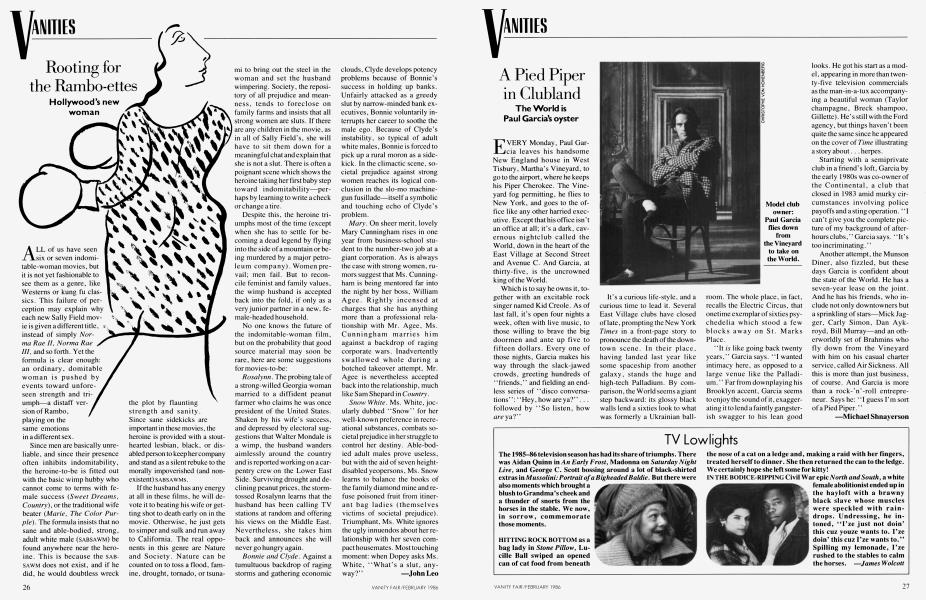
ALL of us have seen six or seven indomitable-woman movies, but it is not yet fashionable to see them as a genre, like Westerns or kung fu classics. This failure of perception may explain why each new Sally Field movie is given a different title, i instead of simply Norma Rae II, Norma Rae III, and so forth. Yet the formula is clear enough: an ordinary, domitable woman is pushed by events toward unforeseen strength and triumph—a distaff version of Rambo, playing on the same emotions in a different sex.
Since men are basically unreliable, and since their presence often inhibits indomitability, the heroine-to-be is fitted out with the basic wimp hubby who cannot come to terms with female success (Sweet Dreams, Country), or the traditional wife beater (Marie, The Color Purple). The formula insists that no sane and able-bodied, strong, adult white male (SABSAWM) be found anywhere near the heroine. This is because the SABSAWM does not exist, and if he did, he would doubtless wreck the plot by flaunting strength and sanity. Since sane sidekicks are important in these movies, the heroine is provided with a stouthearted lesbian, black, or disabled person to keep her company and stand as a silent rebuke to the morally impoverished (and nonexistent) SABSAWMS.
If the husband has any energy at all in these films, he will devote it to beating his wife or getting shot to death early on in the movie. Otherwise, he just gets to simper and sulk and run away to California. The real opponents in this genre are Nature and Society. Nature can be counted on to toss a flood, famine, drought, tornado, or tsunami to bring out the steel in the woman and set the husband wimpering. Society, the repository of all prejudice and meanness, tends to foreclose on family farms and insists that all strong women are sluts. If there are any children in the movie, as in all of Sally Field's, she will have to sit them down for a meaningful chat and explain that she is not a slut. There is often a poignant scene which shows the heroine taking her first baby step toward indomitability—perhaps by learning to write a check or change a tire.
Despite this, the heroine triumphs most of the time (except when she has to settle for becoming a dead legend by flying into the side of a mountain or being murdered by a major petroleum company). Women prevail; men fail. But to reconcile feminist and family values, the wimp husband is accepted back into the fold, if only as a very junior partner in a new, female-headed household.
No one knows the future of the indomitable-woman film, but on the probability that good source material may soon be rare, here are some suggestions for movies-to-be:
Rosalynn. The probing tale of a strong-willed Georgia woman married to a diffident peanut farmer who claims he was once president of the United States. Shaken by his wife's success, and depressed by electoral suggestions that Walter Mondale is a wimp, the husband wanders aimlessly around the country and is reported working on a carpentry crew on the Lower East Side. Surviving drought and declining peanut prices, the stormtossed Rosalynn learns that the husband has been calling TV stations at random and offering his views on the Middle East. Nevertheless, she takes him back and announces she will never go hungry again.
Bonnie and Clyde. Against a tumultuous backdrop of raging storms and gathering economic clouds, Clyde develops potency problems because of Bonnie's success in holding up banks. Unfairly attacked as a greedy slut by narrow-minded bank executives, Bonnie voluntarily interrupts her career to soothe the male ego. Because of Clyde's instability, so typical of adult white males, Bonnie is forced to pick up a rural moron as a sidekick. In the climactic scene, societal prejudice against strong women reaches its logical conclusion in the slo-mo machinegun fusillade—itself a symbolic and touching echo of Clyde's problem.
Mary. On sheer merit, lovely Mary Cunningham rises in one year from business-school student to the number-two job at a giant corporation. As is always the case with strong women, rumors suggest that Ms. Cunningham is being mentored far into the night by her boss, William Agee. Rightly incensed at charges that she has anything more than a professional relationship with Mr. Agee, Ms. Cunningham marries him against a backdrop of raging corporate wars. Inadvertently swallowed whole during a botched takeover attempt, Mr. Agee is nevertheless accepted back into the relationship, much like Sam Shepard in Country.
Snow White. Ms. White, jocularly dubbed "Snow" for her well-known preference in recreational substances, combats societal prejudice in her struggle to control her destiny. Able-bodied adult males prove useless, but with the aid of seven heightdisabled yeopersons, Ms. Snow learns to balance the books of the family diamond mine and refuse poisoned fruit from itinerant bag ladies (themselves victims of societal prejudice). Triumphant, Ms. White ignores the ugly innuendos about her relationship with her seven compact housemates. Most touching moment: when Dopey asks Ms. White, "What's a slut, anyway?"
John Leo
Subscribers have complete access to the archive.
Sign In Not a Subscriber?Join Now