



Sign In to Your Account
Subscribers have complete access to the archive.
Sign In Not a Subscriber?Join NowThe Mind's Eye
LEON WIESELTIER
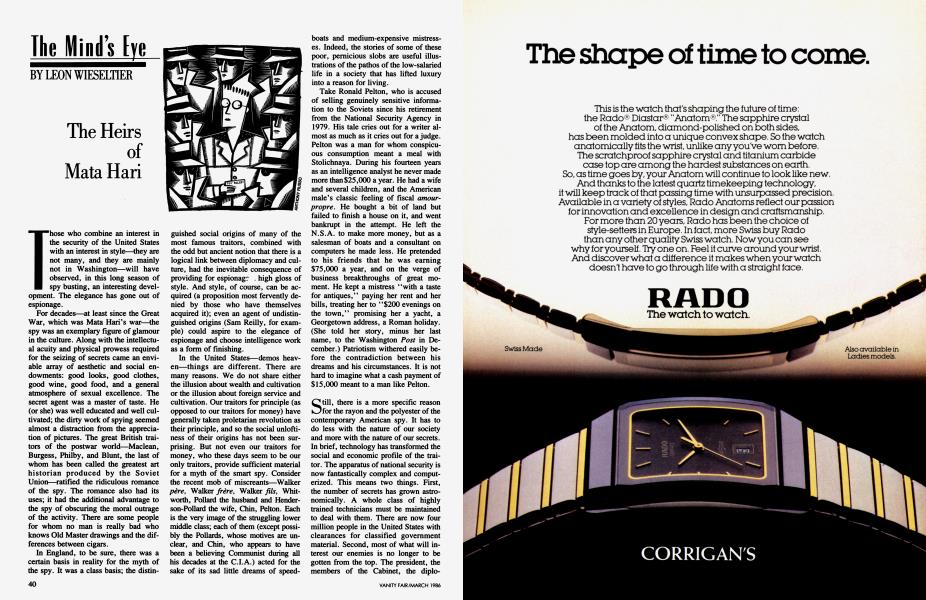
The Heirs of Mata Hari
Those who combine an interest in the security of the United States with an interest in style—they are not many, and they are mainly not in Washington—will have observed, in this long season of spy busting, an interesting development. The elegance has gone out of espionage.
For decades—at least since the Great War, which was Mata Hari's war—the spy was an exemplary figure of glamour in the culture. Along with the intellectual acuity and physical prowess required for the seizing of secrets came an enviable array of aesthetic and social endowments: good looks, good clothes, good wine, good food, and a general atmosphere of sexual excellence. The secret agent was a master of taste. He (or she) was well educated and well cultivated; the dirty work of spying seemed almost a distraction from the appreciation of pictures. The great British traitors of the postwar world—Maclean, Burgess, Philby, and Blunt, the last of whom has been called the greatest art historian produced by the Soviet Union—ratified the ridiculous romance of the spy. The romance also had its uses; it had the additional advantage to the spy of obscuring the moral outrage of the activity. There are some people for whom no man is really bad who knows Old Master drawings and the differences between cigars.
In England, to be sure, there was a certain basis in reality for the myth of the spy. It was a class basis; the distinguished social origins of many of the most famous traitors, combined with the odd but ancient notion that there is a logical link between diplomacy and culture, had the inevitable consequence of providing for espionage . high gloss of style. And style, of course, can be acquired (a proposition most fervently denied by those who have themselves acquired it); even an agent of undistinguished origins (Sam Reilly, for example) could aspire to the elegance of espionage and choose intelligence work as a form of finishing.
In the United States—demos heaven—things are different. There are many reasons. We do not share either the illusion about wealth and cultivation or the illusion about foreign service and cultivation. Our traitors for principle (as opposed to our traitors for money) have generally taken proletarian revolution as their principle, and so the social unloftiness of their origins has not been surprising. But not even our traitors for money, who these days seem to be our only traitors, provide sufficient material for a myth of the smart spy. Consider the recent mob of miscreants—Walker pere, Walker frere, Walker fils, Whitworth, Pollard the husband and Henderson-Pollard the wife, Chin, Pelton. Each is the very image of the struggling lower middle class; each of them (except possibly the Pollards, whose motives are unclear, and Chin, who appears to have been a believing Communist during all his decades at the C.I.A.) acted for the sake of its sad little dreams of speedboats and medium-expensive mistresses. Indeed, the stories of some of these poor, pernicious slobs are useful illustrations of the pathos of the low-salaried life in a society that has lifted luxury into a reason for living.
Take Ronald Pelton, who is accused of selling genuinely sensitive information to the Soviets since his retirement from the National Security Agency in 1979. His tale cries out for a writer almost as much as it cries out for a judge. Pelton was a man for whom conspicuous consumption meant a meal with Stolichnaya. During his fourteen years as an intelligence analyst he never made more than $25,000 a year. He had a wife and several children, and the American male's classic feeling of fiscal amourpropre. He bought a bit of land but failed to finish a house on it, and went bankrupt in the attempt. He left the N.S.A. to make more money, but as a salesman of boats and a consultant on computers he made less. He pretended to his friends that he was earning $75,000 a year, and on the verge of business breakthroughs of great moment. He kept a mistress "with a taste for antiques,'' paying her rent and her bills, treating her to "$200 evenings on the town,'' promising her a yacht, a Georgetown address, a Roman holiday. (She told her story, minus her last name, to the Washington Post in December.) Patriotism withered easily before the contradiction between his dreams and his circumstances. It is not hard to imagine what a cash payment of $15,000 meant to a man like Pelton.
Still, there is a more specific reason for the rayon and the polyester of the contemporary American spy. It has to do less with the nature of our society and more with the nature of our secrets. In brief, technology has transformed the social and economic profile of the traitor. The apparatus of national security is now fantastically complex and computerized. This means two things. First, the number of secrets has grown astronomically. A whole class of highly trained technicians must be maintained to deal with them. There are now four million people in the United States with clearances for classified government material. Second, most of what will interest our enemies is no longer to be gotten from the top. The president, the members of the Cabinet, the diplomats—the opera-and-dinner set—no longer possess the overwhelming majority of the information about the plans and the procedures for defending America. They can have it if they want it, but they too will have to turn to the faceless four million.
Since there are not four million trustworthy human beings on the entire planet, the situation is rather sticky. More to the point, there are now four million men and women in this country whose importance stands in inverse proportion to their earnings. They may flatter themselves every day of the week, except payday. On that day they change from the honorable members of a common defense into weary wage earners trying again to make ends meet. They are unglamorous servants of a glamorous cause. Naturally, nothing can be done about this; the American government cannot pay its employees according to their actual significance. (If it did, though, it might save rather a lot of revenue at the top.) Still, the specialized character of the modem secret has created a class for which social resentment is a structural possibility. The operators of foreign agents in the United States may batten from the fact that a large measure of its security rests in the hands of its most harried social stratum. History has shown again and again the folly of betting on the lower middle class.
(The dreariness of the style, incidentally, crosses moral boundaries. The cops have quite the same look as the robbers, and the same idea of the good life. Thus, when Vitaly Yurchenko, the Soviet defector who redefected to the Soviet Union, spoke to reporters in Moscow, in November, he recounted that the C.I.A. had "forced [me] to sunbathe and made me go in for sports, even play golf.'' And then, in further violations of his human rights, they "forced me to eat French food in Georgetown_I was at the end of my tether," Yurchenko concluded. "It was freedom or death.")
And yet there is, in the American instance, the small consolation of honesty. The high style of the spy was always a cruel illusion. Treason is a tawdry thing. It may as well look tawdry, too.
Subscribers have complete access to the archive.
Sign In Not a Subscriber?Join Now
