

Sign In to Your Account
Subscribers have complete access to the archive.
Sign In Not a Subscriber?Join NowThe Couture Kid
She's wild, she's wacky, and she's wonderfully chic. Inès de la Fressange, the muse of Karl Lagerfeld's Chanel, has given the gamine look a new success. JOAN JULIET BUCK reports from Paris
JOAN JULIET BUCK
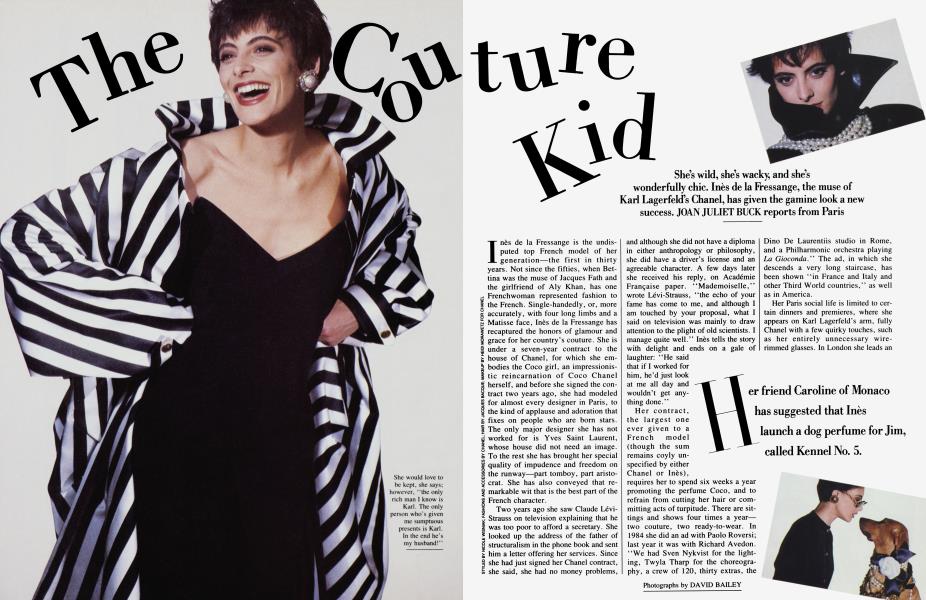
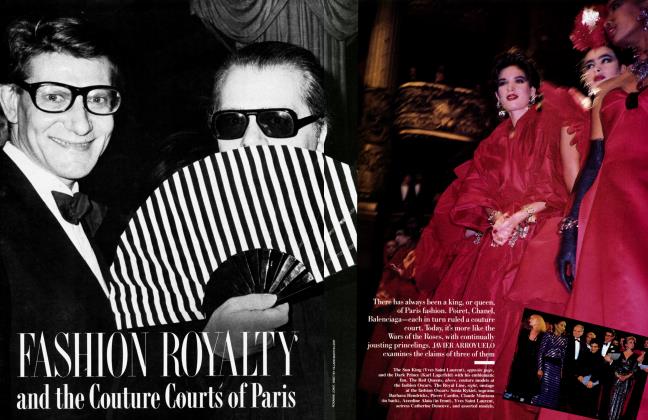
Ines de la Fressange is the undisputed top French model of her generation—the first in thirty years. Not since the fifties, when Bettina was the muse of Jacques Fath and the girlfriend of Aly Khan, has one Frenchwoman represented fashion to the French. Single-handedly, or, more accurately, with four long limbs and a Matisse face, Ines de la Fressange has recaptured the honors of glamour and grace for her country's couture. She is under a seven-year contract to the
house of Chanel, for which she embodies the Coco girl, an impressionistic reincarnation of Coco Chanel herself, and before she signed the contract two years ago, she had modeled for almost every designer in Paris, to the kind of applause and adoration that fixes on people who are born stars. The only major designer she has not worked for is Yves Saint Laurent, whose house did not need an image. To the rest she has brought her special
quality of impudence and freedom on the runway—part tomboy, part aristocrat. She has also conveyed that remarkable wit that is the best part of the French character.
Two years ago she saw Claude LeviStrauss on television explaining that he was too poor to afford a secretary. She looked up the address of the father of structuralism in the phone book and sent
him a letter offering her services. Since she had just signed her Chanel contract, she said, she had no money problems, and although she did not have a diploma in either anthropology or philosophy, she did have a driver's license and an agreeable character. A few days later she received his reply, on Academie Frangaise paper. "Mademoiselle," wrote Levi-Strauss, "the echo of your fame has come to me, and although I am touched by your proposal, what I said on television was mainly to draw attention to the plight of old scientists. I manage quite well." Ines tells the story with delight and ends on a gale of laughter: "He said that if I worked for him, he'd just look at me all day and wouldn't get anything done."
Her contract, the largest one ever given to a French model (though the sum remains coyly unspecified by either Chanel or Ines), requires her to spend six weeks a year promoting the perfume Coco, and to refrain from cutting her hair or committing acts of turpitude. There are sittings and shows four times a year— two couture, two ready-to-wear. In 1984 she did an ad with Paolo Roversi; last year it was with Richard Avedon. "We had Sven Nykvist for the lighting, Twyla Tharp for the choreography, a crew of 120, thirty extras, the Dino De Laurentiis studio in Rome, and a Philharmonic orchestra playing La Gioconda." The ad, in which she descends a very long staircase, has been shown "in France and Italy and other Third World countries," as well as in America.
Her Paris social life is limited to certain dinners and premieres, where she appears on Karl Lagerfeld's arm, fully Chanel with a few quirky touches, such as her entirely unnecessary wirerimmed glasses. In London she leads an invisible life. In Monte Carlo she goes to the occasional tennis match or charity rummage sale hosted by her friend Princess Caroline ("She's not a socialite," says Ines, "she's a working girl"). Last summer in Le Pyla, a resort south of Bordeaux, she was mainly noted for going to the fishmonger's with her dog, wearing beige espadrilles with black Chanel tips.
Her friend Caroline of Monaco has suggested that Ines launch a dog perfume for Jim, called Kennel No. 5.
Character is never an accident, though it is sometimes a miracle. Ines's familiarity with luxury and her easy attitude toward the idols of today—politicians, scientists, success itself—can be traced to her upbringing and her ancestry. Her solid sense of values and her constantly alert sense of humor belong much more to talent than to beauty, though when she is asked why she doesn't become an actress, she answers, "If a man opens a charcuterie, and makes it the best charcuterie in Paris, with wonderful salamis hanging in rows above his head, and the best pates, do people ask him why he doesn't become a brain surgeon?"
Her grandmother Simone, known as Granny, was married three times. The daughter of Andre Lazard, whose family founded the Lazard Bank, she wore a fox fur over her smock in school because she thought the smock was ugly, and longed to be allowed to wear makeup. To this end—according to Ines— when she was eighteen she married the Marquis de la Fressange. She converted to Catholicism and had four children. Ines's father, Andre, was the youngest. "He was programmed to become a banker, but he never wanted to do anything like that, so my grandmother sold her share in the bank." He devoted himself instead to mathematics, as a hobby, and psychiatry, as a patient of Lacan, France's pre-eminent Freudian. Once his analysis was over, he became a stockbroker.
Granny's next husband was Maurice Petsche, who was minister of finance. After the war she married Louis Jacquinot, a leading figure in the Resistance and later minister of the navy, minister of state, and minister of France overseas. "Granny loved politics," says Ines.
Ines and her brother Emmanuel were brought up with luxurious interference from Granny. In the summer, the children accompanied her to the Hotel Royal in Deauville. There was a suite for Granny, a suite for Ines and her brother, and rooms for Granny's paid companion, her chauffeur, and the nurse. "My parents were very young," explains Ines. "We didn't even live in the same apartment, but one floor above with a nurse. The other day I asked my old nurse what my parents did in their apartment. 'In the mornings they slept,' she said, 'and at noon they took their Triumph convertible and went for a drive.' " Ines remembers her father's study, which had maps on the wall (he piloted his own plane), and a collection of flexible rubber toys and furry animals, which he took on trips with him. "One day,'' says Ines, "they found it was difficult to park their car in Paris, so they moved to a mill the family owned in the country."
Ines's mother, Lita, was the daughter of a wealthy Argentinean and the granddaughter of a president of Colombia. Lita's father, Alberto "Negro" Sanchez Cires, was a dashing figure in Europe, where he shopped and skied and visited museums. He was a great ladies' man. Lita spent time in Europe with her father, who wanted her to speak French and Italian. When she was seventeen she became engaged to Guy d'Arcangues, a poet and socialite. Andre de la Fressange was in love with her, and he drove down to Biarritz when her fiance was giving her a birthday party. Andre waved through the window, Lita excused herself, and they drove off and were married. "I think it's rather good of her to have chosen the eccentric mathematician rather than the successful man of the world," says Ines. "Both my parents came out of this very social life, but they were very young and rather wild, and they wanted to get away from that."
At the mill, Andre de la Fressange did his mathematics on a blackboard, and Lita played the guitar. She had a tendency to tell Ines, "Don't go to school tomorrow. You'll have to get up too early." But Ines insisted on going. The local school was not very good, however, and the children were mean to Ines, so she was put in a boys' school. "I was supposed to stay only a year, but Granny pulled a few strings, so I stayed for five."
When Ines was thirteen she moved to an all-girls school, with nuns. When she was sixteen she acquired a boyfriend, who lived with her at her parents' house. "He wore cowboy boots and had an Austin with wood paneling. I thought the context was charming," she says. "My father wanted me to do everything except get married, and I'd understood very quickly that it was better to have Philippe live with me at home than go live with him in a oneroom apartment in Paris. I had no intention of leaving home; I loved the country. I finally told my father I needed a double bed."
"I am," says Ines, "definitely more conventional than my parents." Last year they took her sixteen-year-old brother, Ivan, out of school and moved to California with him because he showed signs of being a golf champion. They took along the dog and also Ines's former boyfriend, who still lives with them, twelve years later.
When Ines was seventeen she passed her baccalaureate and went on to the Ecole du Louvre to study art history. "Then I met the owner of a model agency, who said I could be a model." These are the first legitimately conventional words to pass her lips. It took her a while, she says, to learn that "being natural" didn't mean just staring at the camera. Like all the models who eventually set a style, she was considered odd at first, her eyebrows too big, her style too casual, too throwaway. Once someone had the idea of scraping her hair back and putting her into sophisticated clothes, however, she was perceived as a very chic person. She took every job she was offered, and always arrived on time.
'When you're a ,odel you never know if you're on holiday or just unemployed."
She became known for cutting up on the runway. At Sonia Rykiel she regularly showed a man's sweater while smoking a pipe. The French press took her up, she claims, because it was easier for them to interview a French model than an American one. When she went to work in New York four years ago, her agent was Mark McCormack, who also represented Bjorn Borg and the pope.
During that trip she heard that Karl Lagerfeld was doing a tour of the States for his perfume KL. Thinking it consisted of fashion shows, she asked him how he could have considered going without her. He told her to come along, and she found herself alone with him in a series of private planes and hotel suites. They became friends. A few months later she ran into him on a New York street. "I've come here to try and get a contract," she said. "Coffee or salami or soap, I don't care what." "Ah yes," Lagerfeld replied, "Inescafe." Two years after Lagerfeld joined Chanel as house designer, Ines signed her contract as house image.
"Karl considered that since Chanel made clothes for herself, and since he was himself not a transvestite, he had to design for one particular woman." To Ines, Chanel is primarily the late designer herself: "A woman with unruly hair and no hips, who liked English sweaters and old sandals and flowered hats and big jewels, who made clothes that were against the current. When the new look was all wasp waists, she made comfortable suits. They don't seem comfortable when you put them on today, but they were the clothes for women who drove their own cars and went themselves to the dry cleaner's." Her mother had modeled for a time, for Guy Laroche, after having been rejected by Chanel, who wanted her to cut her hair. Granny didn't go to Chanel: "She had a lady's maid who could iron lace, so she dressed at Marcel Rochas and Laroche." Ines, however, always had some of the Chanel spirit, mixing cotton tights with couture jackets, and wearing sneakers with a white mink coat (a present from Granny).
Men who shower furs and flowers on other models tend to take her for long walks in cold parks instead.
"One should have no respect for clothes," she says. The Chanel collection is designed on her, and her manner of mixing the expensive with the expedient has modified the way Chanel clothes are shown: Ines will come out wearing a $10,000 jacket with nothing but tights on underneath. "I prefer couture clothes because they are bettermade, the way clothes should be. It's the difference between a brick house and a prefabricated hut. Couture is things as they should be: farmyard chickens instead of battery hens, real tea instead of instant powder. I hate fashion, but I love clothes and jewels."
Clothes, jewels. . .the next words should be sugar daddy. Ines would love to be kept, she says, but she has noticed that the type of men who shower furs and flowers on other models tend to take her for long walks in cold parks instead. "The only rich man I know is Karl. The only person who's given me sumptuous presents is Karl. In the end he's my husband!"
"I think one loves only two people in one's life," she says, "and when you meet the first one, you know you can screw it up and still have another chance, with the second one. The most compelling thing is the mystery of the other person, and the best way to solve the mystery is to get married." She describes the man she is currently involved with as "intellectual, tortured, guilty, Jewish, poor, funny, and not in fashion."
Her resident boyfriend at the mill was followed by a young writer. Then she lived for a few years with a TV producer, whom she refers to as her husband and the father of her dog, Jim. Jim is a handsome, kind, and understanding animal, mainly Labrador. He lives with Ines's former "husband" in Paris because Ines spends most of her time in London. Her friend Caroline of Monaco has suggested that Ines launch a dog perfume for Jim, called Kennel No. 5. "It will smell of wet fur and raw meat," says Ines.
Ines's movements have less to do with her social life and love affairs than with doing what she pleases. When she was twenty-two she went to Poland to find her old nanny, and spent two months in the country with her, peeling beans and reading One Hundred Years of Solitude three times. Was she on holiday? "When you're a model you never know if you're on holiday or just unemployed."
The definition of glamour is enchantment, bewitchment, and Ines is an excellent creator of illusion. She understands its value, but, to her lasting credit, she is not taken in. She knows it's more fun to stun than be stunned, and somehow safer too.
Subscribers have complete access to the archive.
Sign In Not a Subscriber?Join Now


